How Much Protein You Need and

Pro Bodybuilders eat about one gram (sometimes even 1.5 grams) of protein per pound of body weight or per pound of non-fat tissue. I'm sure you've seen that the recommended dail

Comments

Wednesday, August 22, 2012

Why You Should Study Yoga Philosophy

by Nina
Arctic Sun by Michele Macartney-Filgate
Baxter’s post yesterday (see Does Home Practice Make You Healthier?) was packed full of interesting tidbits, wasn’t it? But one of the most striking comments for me was this one about yoga philosophy:

Notably, frequency of philosophy study was the yoga practice variable that most often predicted health. In addition, more frequent philosophy study also contributed to a lower BMI and higher odds of being a vegetarian. And this sometimes equated to only reading philosophy once a week.

Now I’ve been saying for some time, both to students and on this blog, that I felt yoga philosophy was one of yoga’s valuable tools for cultivating equanimity (see Acceptance, Active Engagement and the Bhagavad Gita and other posts on yoga philosophy). So it was wonderful to hear that this recent study offered some evidence to back me up! And I thought today I’d say a little bit about why I think yoga philosophy is so beneficial, and also mention a few ways for you to get started with yoga philosophy, if you have not already done so.

In general I think that yoga philosophy helps us cultivate equanimity because it provides an alternative way of thinking about our lives. Every day in our society we’re bombarded with advertising that tells us that in order to be happy, we must buy more and achieve more. That’s just due to the nature of capitalism, as, of course, various companies and individuals wanting to make money need to persuade us to be unhappy with our current situation and urge us to improve ourselves by buying their products and/or services. And striving for material success also seems to be built into our culture Unfortunately, for most of us, this pressure leaves us feeling continually unhappy and stressed out, caught in an endless cycle desire and dissatisfaction. What yoga philosophy does is remind us that there is another way thinking about our lives, and provides us with a different goal we can aim for: equanimity. The following quote from the Bhagavad Gita describes the yogi who has achieved equanimity. 

He who hates no light, nor busy activity, nor even darkness, when they are near, neither longs for them when they are far.

Who unperturbed by changing conditions sits apart and watches and says “the powers of nature go round”, and remains firm and shakes not.

Who dwells in his inner self, and is the same in pleasure and pain; to whom gold or stones or earth are one, and what is pleasing or displeasing leave him in peace; who is beyond both praise and blame, and whose mind is steady and quiet.

Who is the same in honor or disgrace, and has the same love for enemies or friends.

Although it is obviously a lifelong quest to achieve the state of equanimity described above, I’ve found that it is very beneficial when I notice dissatisfaction taking over, to step back and at least remind myself there is a different point of view. Then I can begin to let go. And obviously the people interviewed in the study Baxter discussed found similar benefits.

So, if I have convinced you to start exploring yoga philosophy, where should you start? The two most frequently read yoga scriptures these days are the Yoga Sutras and the Bhagavad Gita, and these books are a great place to begin. As they are very different from each other (and, indeed, their messages are very different as well), I thought I’d briefly describe them to you.

The Yoga Sutras is likely the most commonly cited scripture these days (though this probably was not true in the past). Composed in 150-200 C.E. by Patanjali, who may or may not have been a single person, the Yoga Sutras is a short, concise work of aphorisms. It is very intellectual and abstract as opposed to Bhagavad Gita, and while some people find it too dry and abstract. I myself find it a brilliant work on psychology and the nature of the mind. The Yoga Sutras is often considered by some to be the climax of a long development of yogic technology, and Patanjali’s school has come to be considered the authoritative system of the yoga tradition referred to as “classical yoga.”

There are many different translations, some with detailed commentaries, others with little or no explanation. I suggest you peruse several different versions to find the best one for you to start with. Being something of a nerd on the topic, I find myself using several different translations on a regular basis, including:

  • Light on the Yoga Sutras by BKS Iyengar, with Iyengar’s commentary
  • Barbara Stoler Miller’s translation
  • The Yoga Sutras of Patanjali by Edwin F. Bryant
  • Desikachar’s very loose translation in The Heart of Yoga
  • Georg Fuerstein’s very literal translation in The Yoga Tradition

The Bhagavad Gita is one section of a much longer work, the dramatic epic poem the Mahabharata, written in approximately 500 to 400 BCE. The Gita tells the story of Arjuna, the most distinguished warrior in the Pandava army, as he stops and surveys his adversaries in the Kavara army. The Kavaras are power-hungry corrupt rulers who had usurped the throne. The peace-leaving Pandavas, on the other hand, have the welfare to the people at heart. So this is considered a moral war. Arjuna sees among the opposing forces many with whom the Pandavas have no quarrel, including highly esteemed teachers and elders. He tells Krishna, his charioteer and great friend, he is determined not to fight. His scruples center on the imagined personal consequences of his fighting: his guilt for the decimation of his people. Krishna speaks with him about yoga—the Gita is their dialogue—until he is once more resolved to fight. Some people Krishna’s advice to Arjuna to go into battle disturbing, but Mohandas K. Ghandi, who called the Gita his “mother,” considered the war to be a metaphor for the battle within our souls.

As with the Yoga Sutras, there are many different translations of the Bhagavad Gita, and I recommend that you search for a translation that speaks to you. Translation can make such a difference; I’ve seen the same definition of yoga translated in these different ways:

yoga is equanimity
yoga is balance
yoga is evenness of mind

I really enjoy both the simple, very accessible translation by Stephen Mitchell as well as the more vivid and dramatic one by Juan Mascaro. And I always turn to Georg Feuerstein when I want a translation that while awkward is as close as possible to the original Sanskrit.

Although these two scriptures are just the tip of the yoga philosophy iceberg, I promise you that these two very different books are rich with insights, and you can read them over and over. And I assure you that if you find just one helpful message or concept, it will be worth your time and effort. If reading these works by yourself is too daunting, consider finding a friend or two to read and discuss the books with (I did that for many years with one of my dearest long-time yoga friends).

Subscribe to YOGA FOR HEALTHY AGING by Email ° Follow Yoga for Healthy Aging on Facebook

Monday, August 20, 2012

Balance and Safety

by Shari

A lot of my students tell me that they have balance issues and want to improve their balance with yoga practice. There is no unifying factor on why these students have balance issues. Some are due to injuries with surgical repairs (ankle fractures or other bone fractures, joint replacements of the hips or knees, spinal surgeries). Some are due to soft tissue injuries of muscle, tendons or ligaments. Some are due to brain injuries, such as strokes, multiple sclerosis, or Parkinsons Disease. Some are due to coordination issues, visual issues, inner ear issues. Some are part of medication side effects. I think you are getting the picture. So how does the yoga student and teacher address their own or their student’s balance issues?

I don’t specifically ask people if they have balance issues but instead I observe how they are in class. Then I am very free with using the wall as my favorite prop! I LOVE THE WALL! I can face it with the front of my body, I can have it behind me or I can be perpendicular to it. It depends on what I am working on at that particular time and the needs of my students. If there is a “yoga horse” in the place that you practice then it can be an even better love affair! I use the wall to allow me not to be afraid. Fear of falling can occur in all ages of students. Falling when you are younger is a lot less injurious than when you are in your 50’s and 60’s. Young bones “bounce” but older bones shatter. There are many reasons for this but the simplest can be attributed to osteoporosis and how we fall. Certain body parts are more prone to breaking than others and the surfaces that we fall on also contribute to fracture risks.

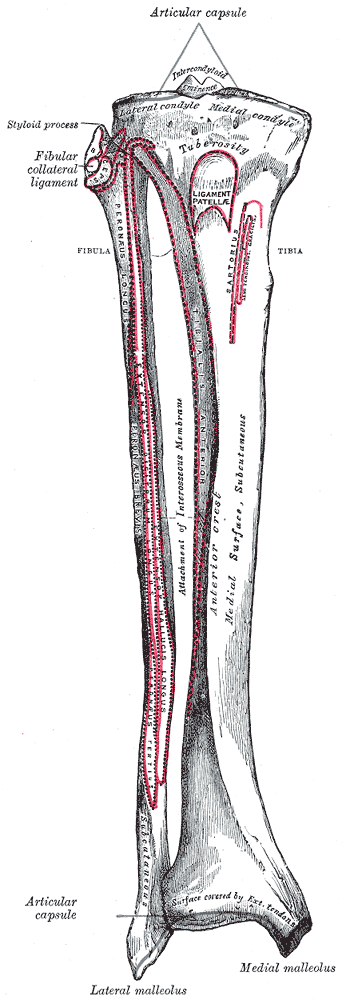
Bones of the Right Leg
The other unfortunate thing is that as we age we are less efficient in making new bone through the “remodeling process.” Bone is living tissue and it is constantly being formed and remodeled throughout our lifetime but like all parts of aging things get less efficient and slower (sigh). So falling in yoga class or during practice is not good for anyone’s health or confidence. For standing poses for some students, I may use a combination  of the wall and a chair, having them use both to assist in their balance as they are learning poses and then later on for them to increase their endurance when holding a pose. I think of blocks more as making poses accessible but not as a tool to safeguard from falling because they are too small and unstable themselves. If I have someone in class who is very unsteady I might place them in a corner so they have three points of stability (feet, side and then with a chair).

You may remember from a previous post Nina and I did way back when she interviewed me on balance (see Aging and Balance), we talked about balance receptors being found in hands and feet in large number. Being barefoot in class is really an important component of balance, and whenever possible I encourage my students to be barefoot if possible. Sometimes usage of a sticky mat isn’t as optimal as not using one (it may be easier to balance directly on the floor), so you have to decide what works best for you. Learning how to feel the intrinsic muscles in your feet (which Baxter has been so eloquent on in his recent posts on feet) and hands WILL affect balance in standing poses and some inversions.

Also, remembering to use your eyes in yoga class is also going to affect your balance (again see Aging and Balance about vestibular reflexes). Focusing on a fixed object as you move into and out of one-legged poses helps with stability. Keeping your head in neutral and not compressing your upper cervical spine into hyperextension (thrusting your chin forward) will also improve your balance (there are balance receptors at the base of your skull).

Other factors that affects our balance and safety are our individual levels of flexibility, strength and endurance. Being able to access a pose requires a certain degree of flexibility as well as alignment. When we try to do poses we aren’t ready for, we almost certainly will fall (think Headstand, arm balances, and Shoulderstands). These are truly advanced poses and take years to safely prepare to do them. Fatigue and endurance are factors in balance because we are unable to access the required muscular strength to perform an asana when we fatigue.

Lastly anticipation is also a factor in how balanced you are. The mental mindset “I always fall in Ardha Chandrasana when I do it on my left” pre-programs those pesky neural circuits into anticipating that you are going to fall so they aren’t going to be able to prevent it. Now I am not saying to disregard past experience or history it just that always doing the pose so that you fall isn’t a way to learn how NOT to fall in it. Learning to sense your balance changes within a safe context is extremely important as we try to improve our balance.

Balance like strength and flexibility is not static but improves with practice and time. I have a current student with me who began yoga because his wife told him to. He is a retired physician and told me when he started that he had cerebellar problems and couldn’t balance. Well he was correct the first year. He is now going on his second year with me and is now starting to do Ardha Chandrasana with just one foot at the wall. He can also now balance on each foot when he does tree pose (not very long but the time isn’t the issue but that he is starting to be able to do it). When I recently mentioned to him that his balance is improving he agreed and said, “I didn’t think it ever would and I am as surprised as you by it.”

I am truly humbled by the body’s ability to transform. That's one of the things that gets me onto my mat daily!

Thursday, August 16, 2012

Featured Pose: Seated Cat-Cow Pose

by Baxter and Nina
This deceptively simple, gentle pose from our office yoga series brings mobility to your entire spine, allowing you to move your spine in two of the six important movement directions in which your spine can move, extension (back bending) and flexion (forward bending).  Mobility in the spine is important for maintaining the health of your spine, and for your entire body since your spinal cord, which communicates with your entire body, moves through your spine. Although most people don’t think of having arthritis of the spine, but it is a significant problem (see Arthritis of the Spine) and moving your spine is the best medicine for arthritis in this area. The gentle spinal movements can even help relieve back pain.

The pose also benefits your hip sockets because your sitting bones move back and forward with your spine, bringing movement into your hip sockets, which can get stiff from sitting from long periods of time. And because you move with your breath in this pose, inhaling into the backbend and exhaling into the forward bend, it’s a good way to learn breath awareness and beginning pranayama.

Accessible to everyone who can sit up, the pose is also so gentle that almost everyone, in any condition to do it. You can do it in any type of chair, even in the car! (In fact, Baxter did it just yesterday, while he was stuck in a !@#$%! traffic jam coming back to the East Bay from San Francisco.)

Baxter prescribes this pose for:
  • low back pain or stiffness
  • arthritis or stiffness of the hips
  • arthritis of the spine
  • held tension anywhere from hips to neck
  • beginner’s experience of pranayama
  • general stress reliever while sitting at your desk
  • warming up for office yoga or any other physical activity
Instructions: Start by sitting near the front of the chair seat, with your feet hip-distance apart and planted firmly under your knees. Straighten your arms, and place your hands on or near your knees. Before moving into the pose, establish the lift of your spine, from your sitting bones through the crown of your head.
As you inhale, start moving from your pelvis, rocking your hips forward so your weight comes more onto the front edge of your sitting bones. As you continue to inhale, gently lift your spine and lengthen into gentle backbend. Lift your breastbone forward and up and allow your head and neck to lengthen out and back, coming into the Cow backbend.
As you exhale, start moving from your pelvis, dropping your pelvis in the opposite direction, moving the back of your waist backward and rocking onto the back part of your sitting bones. As you continue to exhale, allow your middle back to move back as well and drop your chin toward your chest, coming into the Cat forward bend.
Repeat both the Cow and Cat positions, moving with your breath, allowing your inhalations and exhalations to be slightly longer than they are when you are taking a resting breath. Do the pose for a minimum of six rounds up to any number that feels good to you.

Cautions: Because these are mild, everyday movements, those pose is relatively safe. However, if you have been instructed by your doctor to avoid certain movements of your spine, for example, some people who have lumbar disk problems are warned about forward bending movements being potentially dangerous, you should try smaller movements at first and see what your body can handle. The same cautions apply to people who have significant injuries to their necks.

Note from Nina: Oopsie! I just realized we already wrote up this pose in April (see Chair Cat Pose). Naturally, that write up is different if you care to compare it with the new one. I think it's time for us to move onto an entirely new set of poses....

Subscribe to YOGA FOR HEALTHY AGING by Email ° Follow Yoga for Healthy Aging on Facebook
Wednesday, August 15, 2012

Yoga Injuries — Fact or Fiction Telesummit

We’re pleased to announce that Yoga for Healthy Aging contributor Dr. Timothy McCall will be a featured speaker in a free “telesummit” this weekend that we think will be of interest to you:

Yoga Injuries – Facts and Fiction Telesummit
Saturday, August 25, 2012, 12 pm to 4 pm EDT; 9 am to 1 pm PDT

“Yoga is a wonderful, powerful practice, with the potential to change lives. It's our hope that this telesummit will not just help clear up misconceptions about yoga injuries, but also afford an opportunity for you to learn more about how to make the most of your own practice. And if you’re a yoga teacher, this is a great opportunity to study with leading national teachers and gain new insights into how you can ensure that your students get the best yoga experience—no matter what level or age.”

To register for the telesummit, go to http://yogauonline.com/yogaspirit/affiliate/9433/yoga-injuries-register.

In addition to Timothy’s session entitled “Yoga As Medicine – How to Get the Most Out of Your Yoga Practice No Matter What Your Age,” there will be seven other sessions from an outstanding lineup of teachers, including Roger Cole, Ph.D., Julie Gudmestad, P.T., Dr. Loren Fishman, and Judith Lasater, Ph.D., P.T., among others.

During the summit, you’ll be able to listen in via your computer to get all this information.

Here is the lineup:

Saturday, August 25, 12 pm EDT to 4 pm EDT/9 am PDT to 1 pm PDT)
Session 1. Roger Cole, Ph.D.
Reporting or Narrative? Reflections on Yoga Injuries Facts and Fiction


Media debate on yoga injuries got you confused? Learn how to distinguish facts from fiction. In this talk, Roger Cole, an internationally recognized, Iyengar yoga teacher and a Stanford-educated scientist, takes an in-depth look at some of the more disturbing claims about yoga injuries. Roger evaluates the evidence, and clears up some of the most pervasive misinformation.

Roger Cole, Ph.D., is a certified Iyengar Yoga teacher, who has written extensively for Yoga Journal and numerous other yoga publications. Roger teaches yoga workshops internationally, and he has taught yoga as a healing art to physicians, physical therapists, and medical students. As a speaker on yoga safety to the American College of Sports Medicine, Roger was also quoted in the January 2012 New York Times article on yoga injuries. 

Session 2. Dr. Timothy McCall
Yoga As Medicine – How to Get the Most Out of Your Yoga Practice No Matter What Your Age


In this informative talk, Dr. Timothy McCall, author of Yoga As Medicine, takes a closer look at just why yoga is so good for us, and explores its benefits for various types of health conditions. He discusses how to maximize the transformative potential of your yoga practice, and shares the most important factor to pay attention to in order to protect ourselves from injury.

Dr. Timothy McCall is board-certified in internal medicine, an award-winning writer, and a medical editor of Yoga Journal. Dr. McCall has studiedyoga with Patricia Walden and other leading yoga teachers since 1995. He is the author of two books including the acclaimed, Yoga as Medicine: The Yogic Prescription for Health and Healing, and has written numerous articles on the health benefits of yoga and yoga therapy.

Session 3. Ellen Saltonstall
Seven Keys to a Safe Yoga Practice


Are you working your intelligent edge in your yoga practice—or just plain pushing? In this talk, Ellen Saltonstall looks at the seven most important factors to ensure a safe yoga practice, no matter what your level of experience. She also gives an overview on the results of a survey of yoga injuries she and Dr. Loren Fishman conducted, and highlights the main conclusions from said survey.

Ellen Saltonstall has studied yoga for more than 30 years, and teaches workshops on yoga anatomy and the therapeutic applications of yoga both nationally and internationally.  She is well known for her clarity and depth, and lauded for her enthusiasm in encouraging students of all levels to find their inner joy and freedom through yoga. Ellen is the co-author with Dr. Loren Fishman of Yoga for Arthritis and Yoga for Osteoporosis. She and Dr. Fishman frequently offer online courses on YogaUOnline.com.

Session 4. Julie Gudmestad, P.T.
Yoga and the American Body: It’s Not One Size Fits All


The typical American body has tight legs, tight hips, a weak back and a weak rotator cuff. Yoga can be a great way to help overcome these conditions, but if you (or your yoga students) suffer from any of them, it could also predispose to injury. In this important talk, IYengar teacher and physical therapist Julie Gudmestad shares key insights into what to look out for, and which precautions to take to avoid injury.

Julie Gudmestad, P.T. has been certified as an Iyengar Yoga teacher since 1988, and also works as a physical therapist specializing in chronic pain, sports injuries, and stress-related problems. She is a frequent presenter at Yoga Journal conferences and is best known for her "Anatomy of a Yogi" column, which was featured in Yoga Journal for seven years. In her teaching of yoga, Julie Gudmestad aims to make the healing powers of yoga accessible to people of all levels and abilities. It is her belief that yoga encourages a mindful state that can help people heal emotionally, spiritually, and physically.

Session 5. Dr. Loren Fishman
Pre-Existing Medical Condition? Yes, You Can Still Practice Yoga


Yes, you can still practice yoga if you have a pre-existing medical condition. There are no generalized contraindications, but certain yoga postures are contraindicated for certain medical conditions. In this talk, Dr. Fishman goes into what you need to ask your yoga teacher, and what your teacher should ask you, if you suffer from a pre-existing medical condition.

Dr. Loren Fishman is Medical Director of Manhattan Physical Medicine and Rehabilitation in New York City. He lived in India for a year and studied yoga with B.K.S. Iyengar and has practiced yoga since 1973. Dr. Fishman is the author of 7 books, including Yoga for Arthritis and Yoga for Osteoporosis with Ellen Saltonstall. He is recognized as a pioneer in the treatment of piriformis syndrome and rotator cuff tear, and has developed several non-surgical interventions using simple yoga postures for these conditions.

Session 6. Peggy Cappy
Yoga for People Over 50 - Practicing Yoga Safely the Rest of Your Life


You don’t need to be thin, young or a contortionist to do yoga. In this talk, Yoga for the Rest of Us, author Peggy Cappy discusses how yoga can be practiced safely by everyone, whether you are slightly out of shape, very out of shape, or recovering from an injury. Peggy emphasizaes to never underestimate the effectiveness of any modified pose, just because it looks easy.

Peggy Cappy is the creator of the PBS series “Yoga for the Rest of Us” and the founder of Gentle Stretch Yoga for seniors and for others who need a gentle and modified approach to yoga. Peggy has helpled people ages 50 and older retain or improve their energy and their flexibility in more ways than they ever dreamed possible through yoga, helping them experience greater comfort and ease in their body, mind, and spirit.

Session 7. Tias Little
Yoga as Alchemy—The Art of Teaching Yoga


Becoming an effective yoga teacher is not a simple charge, because yoga touches not just the body, but the entire body-mind, says Tias Little, co-founder of Prajna Yoga. In this talk, Tias will explore the multi-faceted challenges yoga teachers face, and will offer his views on the limitations of the current standards for yoga teacher training. What does it take to offer students the full transformative potential of yoga? How can yoga teacher grow to master the anatomical nuances of yoga postures for students of different skill levels? How can yoga teachers gain a deep, experiential understanding of the mind and all the nuances of the emotional body, as it relates to the practice of yoga asanas? Join Tias as he explores the teaching of yoga as an internal art, and offers his perspective on how yoga teachers can continue to deepen the well they draw from in their teaching.

Session 8. Judith Hanson Lasater, Ph.D., P.T.
Practicing Yoga - The Whole Picture: Practicing Yoga Won’t Hurt You, But It Might Well Save Your Life


In this inspiring talk, Judith Hanson Lasater takes a step back to look at the bigger picture: Yoga is much more than just the physical poses, although that’s often where we start. The fundamental lesson of yoga is to create a habit of self-awareness, self-listening, self-observing. And therein lies the deepest, most intangible benefits.

Judith Hanson Lasater has been a yoga teacher for more than 40 years. She holds a doctorate in East West Psychology, is a physical therapist and the author of eight books including Relax and Renew, 30 Essential Yoga Poses, Living Your Yoga, and Yoga Body: Anatomy Kinesiology, and Asana. Judith has been a leading presence in shaping how yoga is taught and credentialed in the US, and she is much loved for the depth of knowledge she embodies.

Diving Deeper into Prana

by Baxter

When I want to dive a little deeper into any yoga-related topic, I feel blessed to work with one of the smartest and well-studied yoga teachers in America today, Richard Rosen. Richard is the owner of the Piedmont Yoga Studio in Oakland, CA, as well as author of two books on pranayama (a word I will let him define in a moment) and a Shambhala audio series on pranayama, as well as a new book on the earliest yoga poses Original Yoga (see here to read the introduction). To experience Richard’s writing firsthand, in addition to getting one of his books, you can sign up to receive Piedmont Yoga Studio’s monthly email newsletter (see piedmontyoga.com/). He always includes a fascinating article on some aspect of yoga, which I always learn a lot from!

When I asked Richard if he had written anything specifically on prana, or energy, he immediately sent me a twelve-page word document on pranayama that contained some intriguing kernels of information about prana that I thought would complement our initial look at prana last week (see May the Prana be with You). If you read that post, you'll see that I was not too far off in my definition of prana last week if we look at how Richard frames it:

“Prana is not specifically the breath, but rather the “life force,” a subtle energy that pervades the universe and manifests, in one important way, as breath and breathing”

He mentions breathing here, because he is ultimately interested in prana’s relationship to the yogic practice of pranayama. There are a lot of definitions of pranayama floating around out there. If you take a public class, you might think it refers to simply watching or observing your breath. Or you might think it refers to one particular way of breathing, namely taking a longer in breath and out breath. If you have been a student of Pattabhi Jois’s Ashtanga yoga, you might equate pranayama to the Darth Vadar-like breath technique known as ujjayi breath. And you’d be partially correct, as all of these things are part of the branch of yoga practice known as pranayama.
View from First Bridge by Brad Gibson
But let’s step back for a moment and take a look at Richard’s definition of the word. We have his take on prana, but what about the second half of the term, ayama?

“Ayama means both “extension” and “restraint.” I think of pranayama as the conscious, intelligent cultivation and refinement of the life force through the medium of the breath.”  


Because we in the west have such a love affair with yoga poses, that is, asana, we have come to equate yoga with asana. As Richard points out, “you might be surprised to learn that traditionally pranayama is considered the central practice of hatha yoga.”  So if pranayama is the central practice of yoga, what kind of boon does it promise if we actually start to practice it regularly? Richard points out many documented (meaning they are mentioned in the source books on hatha yoga we have available to us) benefits that come from regular, consistent practice, done over a long time, including such things as stoking the digestive fire, appeasing thirst and hunger, opening the sinuses, curing may diseases and conditions, and purifying both the gross and subtle energy systems of the body. In addition, prana and the practice of pranayama are said to destroy illness and increase longevity. The ancient yogis were interested in this because it gave them more time to achieve their yogic goals.
Richard  also points out some more benefits that we should eye with a bit of skepticism, such as making you look like you are sixteen, making you a second God of Love, and bestowing even more extraordinary mental and physical powers. For us regular “householders,” what can we realistically expect from a regular breath practice? This of course depends a bit on what you put into it!  Richard states:

“It’s likely that you’ll become more aware of, and gain greater control over, your everyday breath. Why is this a benefit? It’s already well known and widely accepted that your breath and your mental states are closely related, that the former reflects and can be used, to a certain extent, to influence the latter…. With the instrument of your breath then, you can monitor and modulate you psychic “temperature” throughout the day, cooling yourself down when the mercury rises, and heating yourself up when it drops off.”

Both Richard and I have heard from students who claim their work with prana via breath has resulted in a more relaxed and energized life on and off the mat. And, finally, Richard concludes: “all this to say that your breathing will become less effortful and more efficient.” Realistically, the more efficient and responsive your respiratory system is, the better you are able to handle stress. The lower your stress levels, the more beneficial the effect of yoga on the aging process. It all seems to come full circle once again. From my vantage point, I love the fact that so many different techniques are available to us under the large umbrella of yoga to assist us as we age!

Next time we look at pranayama, I’ll share with you my favorite summer breath technique, so until then, do what you can to stay cool!

Monday, August 13, 2012

Frequently Asked Questions: Yoga and Aging

by Nina And Baxter

Recently Baxter and I helped Brad prep for an interview with More Magazine (we'll let you know when it comes out) about yoga and aging. The interviewer sent Brad a few very general questions, the kind that people who know little or nothing about yoga frequently ask. I thought you might be interested to hear our answers. 
Latch on Weathered Door by Nina Zolotow
Q: How is yoga good for aging bodies?

A: The physical postures help improve the following:
  • strength
  • balance
  • flexibility
  • agility
  • circulation
In addition, by reducing stress, yoga helps improve both physical and emotional health. Chronic stress can overtax your body potentially causing:
  • heart disease
  • hypertension (high blood pressure)
  • insomnia and/or fatigue
  • digestive disorders
  • headaches
  • chronic anxiety or depression
  • weakened immune system
Several age-related diseases, such as Alzheimer’s, Parkinson’s, and diabetes are exacerbated by stress, so reducing stress can be helpful for these conditions. And some theories of aging propose stress as a factor in the aging process itself!

The National Institutes of Health has sponsored several studies on the yoga and age-related conditions, including arthritis and osteoporosis as well as on cancer-related issues that point to definite benefits for influencing the aging process.

Finally, and perhaps most importantly, yoga’s mindfulness practices and philosophy help you develop equanimity, enabling you to face life’s vicissitudes with grace and composure.

Q: Since we are all aging all the time, how can we define specifically when yoga is beneficial for aging bodies and minds?

A: It is never too early to start reducing stress and improving your physical health, so whatever age you are today is the right age to begin.

It is also never too late to start. At any age, in any condition, there is always something you can do, whether it is poses in some form or another, breath practices, meditation, and/or cultivating equanimity through yoga philosophy.

Q: Are there specific poses or aspects of yoga that are beneficial for aging?

A: Very briefly:
  1. Stress management techniques, including meditation, breath practices, and relaxation poses and methods.
  2. Standing poses for strength, balance, flexibility, and agility—all in one package! But all poses have their benefits.
  3. Meditation and yoga philosophy for cultivating equanimity in the face of life’s vicissitudes.
  4. Since everyone ages differently, yoga’s greatest strength is the wealth of possibilities it offers. Each person can do the practices that are most effective for him or her at a given time. A healthy 65 year old is going to be capable of doing a lot more challenging physical practices than someone of the same age with a chronic disease; however, in many traditions such as Iyengar and viniyoga, there are ways to adapt the practice for any condition by using props and modifications. Even people who cannot stand can get tremendous benefits from doing yoga from a chair.
  5. For age-related conditions, including arthritis and osteoporosis, as well cancer-related issues, different poses and practices are helpful for each of the conditions.
Q: Are there risks to yoga for aging bodies?

A: No more than other activities that have a physical component! But it is important to look for a well-trained teacher, preferably someone who has undergone months if not years of training and who has some knowledge of anatomy, who can help you adapt the practice to your particular body and concerns.

It is also important to listen to your body. If a pose causes pain (rather than just a stretching sensation), you should always back off, regardless of what the rest of your class might be doing.

As Baxter says, “Yoga is a system designed to optimize our lives, regardless of how old we are.”

Friday, August 10, 2012

Friday Q&A: Morton's Neuroma

Q: I have a question about flat feet and Morton's toe. I'm a 57 YO man who walks a lot and I have both. I always have difficulty balancing on one foot—tree, eagle pose, etc., and have recently had a bout with Plantar Fasciitis showing up in my left heel. No fun. I was at a yoga class yesterday and some poses felt good, others hurt. When I left the class, I literally limped home and iced it for 1/2 hr. then heat, then rest. I had acupuncture at Quan Yin this morning for it and bought new, sturdy shoes and heel pads. It feels a little better today. Can you suggest any asana or other treatment I can do at home that may help speed the healing process and prevent future trouble?

A: This question from last week was really a three-parter, and I covered flat feet with you all last week (see Friday Q&A: Flat Feet), so let’s turn to the second issue that came up for our student last week, Morton’s neuroma. It turns out this particular condition can cause pain in the ball of the foot, as we shall see below. 

According to the Mayo Clinic, “Morton's neuroma is a painful condition that affects the ball of your foot, most commonly the area between your third and fourth toes. When it develops, it may feel as if you are standing on a pebble in your shoe or on a fold in your sock. Morton's neuroma involves a thickening of the tissue around one of the nerves leading to your toes. In some cases, Morton's neuroma causes a sharp, burning pain in the ball of your foot. Your toes also may sting, burn or feel numb. Morton's neuroma may occur in response to irritation, injury or pressure. Common treatments for Morton's neuroma include changing footwear or using arch supports. Sometimes corticosteroid injections or surgery may be necessary.”

Interestingly, there's no outward sign of this condition, such as a lump or swelling on top or bottom of the foot. Instead, any of the following symptoms could appear: a feeling as if you're standing on a pebble in your shoe, a burning pain in the ball of your foot that may radiate into your toes, or tingling or numbness in your toes. We don’t know what causes this problem to develop, but it is theorized that irritation, pressure or injury to one of the nerves that lead to your toes may be the culprit. High-heel shoes, high-impact sports or sports with tight fitting shoes (can you say sport rock climbing?) or the presence of other foot deformities are all considered risk factors for developing a Morton’s neuroma. I could hypothesize that our student’s flat feet may have put him at risk for developing one of these buggers, but I don’t know about other activities that he was doing when it showed up. Obviously, the first two risk factors are addressable with lifestyle changes and choices.  Not so much the foot deformities.

If you go in for evaluation for foot pain on the ball of your foot, your doc will likely press around on the foot, especially between the third and fourth toes, to see if you are tender there or have a fullness that is not visible from the exterior. In addition, X-rays may be ordered to rule out a fracture as a cause for your pain, or an ultrasound may be used to look for the swelling of the nerve indicative of a neuroma. Typical western medical treatment usually starts with the least expensive and simplest approach. This could include over the counter arch supports and pads to take pressure off the neuroma. Your doc might go so far as to recommend you get special customized arch supports made for your shoes. Another fairly common treatment involves injection a steroid medication into the swollen area, as it is a strong anti-inflammatory medication. There are three other more extreme surgical approaches that are invasive and beyond the scope of this blog post. My hope is that you would not have to go to that extreme.

The folks at the Mayo Clinic do have some other ideas that could help, which are pretty common sense, too, like taking anti-inflammatory medications like aspirin or ibuprofen, as they can help with pain and swelling. Or try an ice massage. Regular ice massage may help reduce pain. If you have not already changed your footwear, what are you waiting for? Get rid of those heels and make sure the box of your shoes is wide enough!  Finally, they suggest you give your foot a break. For a few weeks, reduce activities such as jogging, aerobic exercise or dancing that subject your feet to high impact.

How might yoga fit into this healing process? Well, I, and many of my students, have noted that regular asana practice leads to a slight widening of the feet. This may be because the practice is done with bare feet (no shoes!). Regardless, this additional space might translate into enough space between your metatarsals to relieve the pressure on the nerve and allow healing to take place. We also often encourage students to spread their toes wide, which could travel upstream a few inches and also provide some much-needed space in the front foot. Finally, a modified practice, done with the buttocks supported on a chair for standing pose variations, as an example, could keep much of your body active while allowing your feet to have less pressure on them. And, of course, a regular practice of inverted poses could relieve all of the blood pressure effects of normal upright walking and standing, giving your feet a real rest. I’d recommend Legs Up the Wall as a “must do” on a daily basis for healing and recovery.

Next time, we’ll look at heal spurs in the mix of the other things our student has going on.  Until then, tread lightly!

Subscribe to Yoga for Healthy Aging by Email ° Follow Yoga for Healthy Aging on Facebook ° Join this site with Google Friend Connect