How Much Protein You Need and

Pro Bodybuilders eat about one gram (sometimes even 1.5 grams) of protein per pound of body weight or per pound of non-fat tissue. I'm sure you've seen that the recommended dail

Comments

Wednesday, February 5, 2014

The Musclemag International Light-Heavy Course

The Musclemag International 
Light-Heavy Course


There are two practiced forms of heavy and light training in bodybuilding. Both have equal merits and in this course we will use the two of them in our workouts. But first, WHY LIGHT AND HEAVY?

One of the most talked about topics in bodybuilding is "Should I train light or should I train heavy?" There are just as many advocates of the heavy school of training as there are of the light. Mike Mentzer trains heavy and Serge Nubret trains light, yet both have world class physiques.

Recent scientific research regarding muscle fibers reveals that there are actually two different types, red fibers (or slow twitch), and white fibers (or fast twitch). It would appear that to develop a muscle to its fullest potential both kinds of fibers must be stimulated. The research indicates that the slow twitch fibers respond to heavy training, and the fast twitch require lighter training. So, it would seem that you have to train both heavy and light to develop your muscles to their fullest potential.

Long before research into fast and slow twitch fibers, Reg Park used and recommended the use of heavy and light workloads in training. During that era, his physique was considered one of the best of all time, and even today he is considered highly.

The late Reg Park
Reg often wrote workout schedules incorporating his own system of light and heavy training, and it is from his wisdom that we recommend the following routine as our first Heavy and Light workout.
  
First Heavy and Light Routine

Train four days per week. Monday, Wednesday, Friday, Saturday.
On Mondays and Fridays do your chest, shoulders, triceps and forearms (push and grip) as follows:

Chest -
1) Bench Press (Heavy) 5 sets of 6 reps.
2) Dumbbell Flyes (Light) 4 x 12.

Shoulders -
1) Standing Press Behind Neck 5 sets of 6.
2) Seated Dumbbell Lateral Raise 4 x 12.

Triceps -
1) Lying Triceps Extension (Heavy) 5 x 6.
2) Triceps Pressdown (Light) 4 x 12.

Forearms -
1) Reverse Curl (Heavy) 5 x 6.
2) Wrist Curl (Light) 4 x 12.

On Wednesdays and Saturdays train your thighs, calves, back and biceps (squat and pull) as follows:

Thighs -
1) Parallel Squat (Heavy) 5 x 6 reps.
2) Leg Extension (Light) 4 x 12.

Calves
1) Standing Calf Raise (Heavy) 5 sets of 12.
2) Toe Press (Light) 5 x 12.

Back
1) Bentover Barbell Row (Heavy) 5 x 6.
2) Front Chins (Light) 4 x 12.

Biceps
1) Barbell Curl (Heavy) 5 x 6.
2) Dumbbell Concentration Curl (Light) 4 x 12.
  

How To Get The Best Out Of Light And Heavy

 1) The Heavy Part

With the exception of calf training, all body parts start out heavy. The exercises are done for 5 sets of 6 reps each and the following system should be used:

Do your 1st set of 6 with about 50% of your best 6 rep poundage. A warmup set.
2nd set of 6 with about 80% or your best 6 rep poundage. A second warmup.
For your 3rd set pile on enough weight so you can just get 6 reps. If you can do more, do them.
Rest about 2 or 3 minutes, and try to get another 6 reps with the same weight on your 4th set.
Rest another 2 or 3 minutes, then try for another 6 reps with the same weight.
It may not be possible to get a full 6 reps on all three heavy sets, but keep pushing. As soon as you can get 6 good reps on all 3 heavy sets, increase the weight by 5 lbs next workout.

2) The Light Part

Once again, with the exception of calf training, each part is to be done for 4 sets of 12 reps as follows:

Go all out to get 12 reps on your 1st set.
Rest only 40 seconds, then do another set of 12 reps with about 5-10 lbs less weight.
Do another 2 sets, reducing the weight each time, and resting no more than 40 seconds.

The objective of this routine is to fully stimulate the deep muscle fibers with the very heavy sets, then completely pump and burn the fibers with the lighter, faster sets.

Stay with this routine for about 8 weeks.

Second Heavy and Light Routine

The other system of heavy and light training is a more recent one, and its origins would indicate a lot of influence from the teachings of Vince Gironda. Unlike the first method, this heavy and light approach recommends that a light set immediately follow a heavy set of the SAME EXERCISE.

In other words, do a heavy set of squats for 6 reps, then immediately follow it with another squat set of 10 reps with a much lighter weight. The theory behind this system is that to stimulate all aspects of a muscle, you must first of all hit it with as much heavy stimulation as you can for low reps, and then immediately pump it very,very hard with a lighter set of the same exercise.

Train four days a week as before, on Monday, Wednesday, Friday and Saturday.

On Mondays and Fridays train Legs, Chest and Back:

Thighs -
1) Leg Extension 6 reps heavy -> 10 reps light, 3 sets.
2) Parallel Squat 6 reps heavy -> 10 reps light, 3 sets.

Calves -
1) Standing Calf Raise 10 reps heavy -> 10 reps light, 3 sets.
2) Seated Calf Raise 10 reps heavy -> 10 reps light, 3 sets.

Chest -
1) Dumbbell Fly 6 reps heavy -> 10 reps light, 3 sets.
2) Bench Press, same as above.

Back -
1) Front Chin, same as above.
2) Bentover Barbell Row, same as above.


On Wednesdays and Saturdays train Shoulders and Arms:

Shoulders -
1) Side Laterals,6 reps heavy -> 10 reps light.
2) Standing Press Behind Neck, same as above.

Biceps -
1) Dumbbell Concentration Curl - same as above.
2) Barbell Curl - same as above.

Triceps -
1) Pressdown, same as above.
2) Lying Extension, same as above.

Forearms -
1) Wrist Curl, same as above.
2) Reverse Curl, same as above.


How To Get The Best Out Of Light And Heavy (Second Method)

As with the first approach, you must constantly strive to handle more and more weight on your exercises. With the exception of calves, perform the exercises like this:
  • Do a nice slow warmup set of 10 reps on your first exercise, then rest for  60 seconds
  • Now, pile on enough weight so that you can just manage to get 6 reps in fairly good style. These reps need not be too strict, and some men even do 'half reps' on this first set in order to handle more weight.
  • As soon as you can't do any more reps, reduce the weight so that you can immediately do another 8-10 reps on the same exercise. Having the weights already set up, if possible, is a very efficient way of doing this.
  • After resting about 60 seconds, do another heavy -> light set.
  • Rest another 60 seconds and do a final set.
  • After 3 sets like this your muscles should be exhausted.

How to Reduce the Poundages Correctly

It is impossible to tell you exactly how much weight to take off for your light sets. Some lifters have tremendous recovery abilities and can continue the exercise with only a 10% reduction in weight. Others reduce by 25% and some even more.

The weight should not be too light or you will not stimulate the muscle fibers enough, and if it is too heavy you'll find yourself working on your nerve. 

We shall forever be grateful to the Late Robert Kennedy, the
publisher of Musclemag and countless bodybuilding books.
Robert has been a real blessing to the sport of bodybuilding
God bless your soul, Robert.
------------------------------------------

Tired of wasting money, with no results?
I offer consultations on diet, supplements, training for your individual needs. No one-size fits all diet and exercise programs but custom-made programs. I tell you what supplements are worth investing your money on, based on your own needs. You get to ask me any and as many questions as you want if you are my student. At the end of the day, no more guess work, no more trial-and-error, no more wasting thousands of rupees on supplements that didn't do a damn for you. I tell you the secrets based on scientific research and my experience in the gym. They want to enrich themselves selling you products that may not work for you, me I enrich you with knowledge so you can go on and achieve bigger things. I haven't only been to school: I have been under the bar too! 

Email me on vicgoyaram@gmail.com
-------------------------------------------
My Bio: I am a Mauritian originally from Roche Bois, Port Louis and now based in Cape Town, South Africa where I am busy with my postgraduate studies in molecular biology of exercise. My research, supervised by Prof. Edward Ojuka, looks at the influence of nutrition and exercise in gene expression in muscle, research which is relevant and applicable to exercising individuals, sports persons and diabetic individuals. The knowledge that I share with you stems from my 18 years of experience in bodybuilding and 8 years (and counting) of university education in the field. I have also published work in the American Journal of Physiology: Endocrinology and Metabolism (2013), International Journal of Sport Nutrition and Exercise Metabolism (2013) and co-authored two book chapters on exercise and diabetes. I also presented my research work at the 2012 International Sports and Exercise Nutrition Conference (UK). I am grateful to each and everyone at the UCT Research Unit for Exercise Science and Sports Medicine. "Knowledge without sharing is worth nothing"
------------------------------------------
Join us for discussions on our facebook group
Free advice & daily bodybuilding talk
Your #1 Bodybuilding destination in Mauritius 
_________________________________________________________________________
©,2013, Veeraj Goyaram, Bodybuilding Mauritius. Any reprinting in any type of media is prohibited.
Disclaimer: The Content on this site is intended to be used for educational and entertainment purposes only. It is not intended to be and should not be interpreted as medical advice or a diagnosis of any health or fitness problem, condition or disease; or a recommendation for a specific test, doctor, care provider, procedure, treatment plan, product, or course of action. BODYBUILDING MAURITIUS is not a medical or healthcare provider and your use of this site does not create a doctor / patient relationship. We disclaim all responsibility for the professional qualifications and licensing of, and services provided by, any physician or other health providers posting on or otherwise referred to on this Site and/or any Third Party Site. Never disregard the medical advice of your physician or health professional, or delay in seeking such advice, because of something you read on this Site. We offer this Site AS IS and without any warranties.  Correspondence: vicgoyaram@gmail.com
_______________________________________________________________________________

Old School Bodybuilding Charts. Compiled by Veeraj Goyaram

Old School Bodybuilding

Old School Bodybuilding Charts
Compiled by Veeraj V Goyaram

The famous Weider Charts (Course 1 to 5)


------------------------------------------

Tired of wasting money, with no results?
I offer consultations on diet, supplements, training for your individual needs. No one-size fits all diet and exercise programs but custom-made programs. I tell you what supplements are worth investing your money on, based on your own needs. You get to ask me any and as many questions as you want if you are my student. At the end of the day, no more guess work, no more trial-and-error, no more wasting thousands of rupees on supplements that didn't do a damn for you. I tell you the secrets based on scientific research and my experience in the gym. They want to enrich themselves selling you products that may not work for you, me I enrich you with knowledge so you can go on and achieve bigger things. I haven't only been to school: I have been under the bar too! 

Email me on vicgoyaram@gmail.com
-------------------------------------------
My Bio: I am a Mauritian originally from Roche Bois, Port Louis and now based in Cape Town, South Africa where I am busy with my postgraduate studies in molecular biology of exercise. My research, supervised by Prof. Edward Ojuka, looks at the influence of nutrition and exercise in gene expression in muscle, research which is relevant and applicable to exercising individuals, sports persons and diabetic individuals. The knowledge that I share with you stems from my 18 years of experience in bodybuilding and 8 years (and counting) of university education in the field. I have also published work in the American Journal of Physiology: Endocrinology and Metabolism (2013), International Journal of Sport Nutrition and Exercise Metabolism (2013) and co-authored two book chapters on exercise and diabetes. I also presented my research work at the 2012 International Sports and Exercise Nutrition Conference (UK). I am grateful to each and everyone at the UCT Research Unit for Exercise Science and Sports Medicine. "Knowledge without sharing is worth nothing"
------------------------------------------
Join us for discussions on our facebook group
Free advice & daily bodybuilding talk
Your #1 Bodybuilding destination in Mauritius 
_________________________________________________________________________
©,2013, Veeraj Goyaram, Bodybuilding Mauritius. Any reprinting in any type of media is prohibited.
Disclaimer: The Content on this site is intended to be used for educational and entertainment purposes only. It is not intended to be and should not be interpreted as medical advice or a diagnosis of any health or fitness problem, condition or disease; or a recommendation for a specific test, doctor, care provider, procedure, treatment plan, product, or course of action. BODYBUILDING MAURITIUS is not a medical or healthcare provider and your use of this site does not create a doctor / patient relationship. We disclaim all responsibility for the professional qualifications and licensing of, and services provided by, any physician or other health providers posting on or otherwise referred to on this Site and/or any Third Party Site. Never disregard the medical advice of your physician or health professional, or delay in seeking such advice, because of something you read on this Site. We offer this Site AS IS and without any warranties.  Correspondence: vicgoyaram@gmail.com
_______________________________________________________________________________

The Power of Mental Exercise, Part 1

by Ram
The New Novel by Winslow Homer
Recently we had a query from one of our readers who asked to know each staff member’s fitness regimen (see Friday Q&A: How do you keep fit?). Nina wrote about our responses in her post Decide Each Day What to Do that I thought was not only fun but appropriate and interesting.  However, I realized that while posting my reply to Nina, I committed a faux pas. I had missed mentioning mental exercises as part of my fitness regimen that take up 30-45 minutes of my time daily.

Now you may wonder why I am attaching so much importance to mental exercises. According to Ayurveda and Yoga, disease first begins in the mind, and when this is not checked, it spreads to the body where it shows up as specific symptoms. Today, Western medical science accepts that there is a powerful mind-body connection through which emotional, mental, social, spiritual, and behavioral factors can directly affect our health. Science has well documented the role of the mind in the disease process and has explanation of how our thoughts and feelings affect our physiology.

You need to be mentally fit to ward off any ill health or disease. Mental fitness is just as important as physical health and shouldn’t be neglected. Mental fitness is exactly what it sounds like: keeping the brain and emotional health in a healthy state by performing  mentally stimulating tasks. Mental exercises refer to a series of exercises that help you to be more alert, think rationally and logically, make sound and correct decisions and boost a declining memory. Incorporating mental exercises into your life can help you reap the benefits of a sharper mind and a healthier body for years to come. For this reason, it’s not surprising that in general people who possess a higher level of mental agility are also physically healthy. Individuals who exercise their mind regularly live significantly longer without any signs of age-associated diseases.

Research findings indicate that humans actually build/rebuild brain cells throughout life. Several regions of the brain that are involved in memory, reflection, decision making, planning and emotional control have neural stem cells that can mature into functioning neural cells. Learning/stimulating environments maintain, build and remodel neural network connectivity and also trigger production of nerve growth factors that stimulate new neural connections. The brain actively grows and rewires itself in response to stimulation and learning. Mental exercises help you see the world in a new way and strengthen your neural networks. All of us are devoted to exercise to bulk up our bodies, but remember the concept of “use it or lose it” applies not to just the muscles but also to the neural pathways and connections in our brains. Several studies report that our brain grows stronger from use and from being challenged in the same way that muscles grow stronger from exercise.

The phrase "our brain is plastic" refers to the brain's capacity to rewire itself through experience. When we learn new things, our brain puts out new neural branches and forms new connections among existing neurons. The brain is constantly changing, morphing and rewiring itself. Plasticity is the reason why stroke patients can relearn skills after a brain damage. Plasticity also explains how a healthy part of the brain might assume the job of a damaged part. Thus, the brain is continually re-sculpting itself in response to experience and learning. A mentally active individual’s brain is a dense forest of thickly branched neural connectivity trees. It is this neural density that provides the mental resistance that keeps the physical body strong that in turn promotes healthy aging. Research studies find that mental exercises, including reading and doing a puzzles, delays the onset of Alzheimer’s disease, cancer and other stress-associated disorders. In part 2 of this series, I will discuss a variety of exercises and activities that can successfully strengthen all the areas of the brain.

Until then you could choose to incorporate some form of mental exercises in your day. You may ask what kind of mental exercises? Since this is a yoga blog, I have come up with brain exercises that relate to yoga. Here’s a sample list that you could attempt:
  1. Next time you are in a yoga class and the teacher is providing instructions for a pose, try to recall the name of the pose in Sanskrit. It is a perfect way to stimulate the brain. Alternatively, try memorizing the Sanskrit names of yoga asanas and place the specific pose to the name (for example, several my students get confused about Parsvabakasana, Parsvakonasana, and Parsvottanasana).
  2. Using your memory is a great mental exercise. The next time you complete a 60- or a 90-minute yoga class, attempt to write down some or the entire sequence of the asanas (in the same order) that your teacher taught you in the class.
  3. A simple way to stimulate new nerve connections in the brain is by using the opposite or non-dominant hand/side for routine tasks. When it comes specifically to Yoga, if you have a habit of doing the poses right side first, practice the same by starting on the left side before the right and vice versa.
  4. Changing your daily habits and routines will allow mental stimulation to occur as well. For example, take a completely different route to your yoga studio. This is a new experience that builds new connections and sets you on the path to mental fitness. And if you practice at home, try practicing in a different room or space in your house and either find or create an entirely new sequence to practice.
  5. Stimulate new neural network connections and brain growth by learning something new. Read yoga philosophy and learn the Sanskrit names for important yoga concepts (for example, vrittis, swadhyaya, dharana, vibhuti, samprajnata, and so on).
Guess what? To stimulate new nerve connections by using my non-dominate hand, I just used my left-hand for the computer mouse while writing this piece. And if I can do it successfully, you too can do it!

Subscribe to YOGA FOR HEALTHY AGING by Email ° Follow Yoga for Healthy Aging on Facebook

Tuesday, February 4, 2014

To Leak or Not to Leak: Urinary Incontinence

by Shelly Prosko, PT, PYT, CPI

You sneeze or laugh and you accidentally “leak” a small amount of urine. You are embarrassed, but not concerned enough to seek treatment because, after all, this is a normal experience as we age, right? Wrong. It is true that urinary leakage is extremely common, but it is not normal. In fact, over 1/3 of men and women between the ages of 30-70 years old experience urinary incontinence (the inability to control the bladder) at some point in their lives. The prevalence is much higher in women than in men. However, it is estimated that 66% of us don’t even discuss it with our physicians! Perhaps this is because we don’t know there is help or because we are too embarrassed. For us women, maybe we believe that it is normal after childbirth and will eventually resolve. Perhaps we believe it is just another “normal process of aging.” But it is not a normal aging process. Urinary incontinence is a symptom of an underlying problem, and it can be prevented and treated in most cases!

The two main types of urinary incontinence are stress and urge.  In order to treat it properly, it is important to know the difference between the two, and to know which one you may have. However, it is common to have a combination of the two as well.

Stress incontinence is what occurs when the pelvic floor muscles (PFM’s) have become too weak to stop the flow of urine during actions that put pressure or stress on the bladder, such as coughing, sneezing, laughing, twisting, or lifting. Pelvic floor weakness can result from the muscles being overstretched or damaged during trauma such as surgery or childbirth, or even from low estrogen levels, such as during menstruation or menopause. Additionally, the ability of any muscle to perform optimally depends partly on its length-tension relationship, which can be influenced by alignment. PFM activation could therefore potentially be compromised mechanically if postural alignment is suboptimal.
Female Pelvic Floor Muscles
Urge incontinence is when you have a sudden urge to urinate with an inability to control the bladder. This happens when the pelvic floor muscles are chronically tense to the point of fatigue, and consequently give out at inappropriate times. Chronically tense and tight PFM’s can be a result of an over-active bladder (OAB) where one experiences urinary urgency (urge to urinate) and/or frequency (urinating more frequently than normal). If your PFM’s are consistently tense, and you don’t know how to relax, release, and control them, other problems in addition to urge incontinence can arise, such as low back pain, irritable bowel syndrome, interstitial cystitis, bladder pain syndrome and painful intercourse.

Many people believe that the popular Kegel exercises, which consist of “squeezing” the PFM's, will solve all leakage problems. However, this is not necessarily the case! In order to truly have a healthy pelvic floor that functions optimally, you must first cultivate a sense of awareness of the area, and then learn how to release, engage and control.

If your incontinence is partially due to chronically tensed PFM's that are fatigued when you need them most (remember, even if your PFM's are weak, they can still be tight!), then simply performing Kegel exercises may actually be worsening your problem! Starting by learning how to release your PFM’s in conjunction with a yoga breath, such as abdomino-diaphragmatic breathing:
If your incontinence is PFM weakness due to being overstretched or inadequately activated, then correctly prescribed PFM exercises can help. In a later post, I will discuss the yoga principle of mula bandha, and how it might be used in treatment of incontinence. I do want to point out that I am by no means a bandha expert! However, much of my training and studying (from well respected yogis) has taught me that mula bandha is NOT simply activation of PFM’s.  Also, keep in mind that the PFM’s are still only a small part of the overall treatment of this dysfunction.

If you don’t know which of these two PFM problems is causing your incontinence, I recommend consulting a qualified PT or other medical expert who specializes in pelvic health to help you figure out which type of incontinence you have.

Research has shown that successful physical therapy treatment of incontinence consists of protocols that also include hip adductor and deep abdominal muscle strengthening, lumbar or core stability training, and prescription of exercises that address postural misalignment or hip tightness that may be contributing to pelvic floor weakness.

As a physical therapist and yoga therapist, it has been extremely valuable to use yoga as part of therapy for incontinence issues. I have found that focused meditations such as body scanning and breath awareness have been instrumental in creating a higher awareness of the pelvic floor, which is the first step to releasing then engaging and controlling the PFM’s.

I recommend starting with what I call the “Toilet Meditation,” which is simply being completely present and aware when performing your toilet duties! Focus on observing the rhythm of both the respiratory AND the pelvic diaphragms as you breathe, releasing your PFM’s and taking your time. We often are rushing when we urinate, and may not even be fully emptying our bladders in the first place. If you suffer from mild leakage, you may be subconsciously tensing your PFM’s for fear of leakage throughout the day. That low grade tensing may carry over to when you are actually supposed to be relaxed, during urination. This can further create more tension and tightness in the PFM’s and potentially result in a sense of urgency to urinate throughout the day.

All this can lead to changes in your nervous system. Messages from your bladder to your brain become hypersensitive, and the part of the nervous system that sends the message “hurry hurry, I have to go” overrides the part of the nervous system that sends the message “no, it’s okay, chill, we got time—the bladder has much more room yet.” This can also lead to behavioral changes. For example, as you read this, are you feeling an uncomfortable urge to urinate? Or if you hear running water, does it increase your urge?

Anecdotally, I have seen a number of women whose incontinence issues started with mild stress incontinence that developed into more severe urge incontinence. Therefore, it has led me on a path to be a huge advocate for teaching pelvic floor awareness and release first, before simply teaching contract and squeeze methods. This is one major advantage that yoga, or any mind-body practice, can have in treating incontinence more than just a traditional western medicine approach alone.

I also have found that the abdomino-diaphragmatic breath or belly breath, with awareness of the natural motion of both the diaphragms, has been a great tool to begin addressing incontinence. Some of my favorite yoga poses in which to perform and observe this breath are: Crocodile pose (Makarasana), Garland pose (Malasana), Extend Child’s pose (Balasana), Hero pose (Virasana), and Reclined Cobbler’s pose (Supta Baddha Konasana).

In my next post, I will focus on how yoga can more specifically address incontinence issues. Remember, although incontinence is common, it can be treated. So whether you are a new mom or a retiree, you can still continue to enjoy a healthy lifestyle knowing you have confidence in controlling your bladder!

Subscribe to YOGA FOR HEALTHY AGING by Email ° Follow Yoga for Healthy Aging on Facebook

Spread your protein intake. Don't eat them all at once! By Veeraj Vic Goyaram

Nutritional Science Update

Spread your protein intake. Don't eat them all at once!
By Veeraj Vic Goyaram

We kick off our 2014 "article season" on Bodybuilding Mauritius with a nutrition science research update. As bodybuilders we all know that protein reigns supreme on our nutrition list and as such the total daily amount of protein that we consume is very important. However, new research underscores the importance of evenly distributing your protein throughout the day rather than cram all your protein in one or two meals, especially dinner.

American researchers (Mamerow et al., 2014) examined two different protein consumption patterns in healthy subjects, namely:

A. EVEN: diet provided an even protein distribution at each meal: ;30g (breakfast), 30g (lunch), and 30g (dinner).

B. SKEW: diet provided an exaggerated skewed protein distribution (SKEW): ;10g (breakfast), 15g (lunch), and 65g (dinner)

They then measured muscle protein synthesis in muscle (technical term: Fractional Synthesis rate or FSR) and found greater (25% more) protein synthesis over a 24 hour period in subjects consuming protein evenly throughout the day (Figure 1).  

 
Take-home lesson and recommendations
  • "More anabolic bang for your protein buck": It is good to spread your protein intake throughout the day rather than cram everything in one big meal.  A dose of 30g protein per intake is fine as long as it is a high quality protein which brings about 10g of essential amino acids (EAAs).
  • "More is not better": The body has no means to temporarily store excess protein (unlike fats and carbohydrates) to allow it to stimulate protein synthesis at a later time. Therefore, quite frequent feedings are needed. But be careful, moderation is the key! For example, Symons et al., (2009) have shown that consuming 12 ounce of lean beef (90g protein) does not give greater anabolism than a 4 ounce serving (30g protein).  
References
Mamerow MM, Mettler JA, English KL, Casperson SL, Arentson-Lantz E, Sheffield-Moore M, Layman DK and Paddon-Jones D. Dietary Protein Distribution Positively Influences 24-h Muscle Protein Synthesis in Healthy Adults. J Nutr 2014. (ahead of print)


Symons TB, Sheffield-Moore M, Wolfe RR, Paddon-Jones D. A moderate serving of high-quality protein maximally stimulates skeletal muscle protein synthesis in young and elderly subjects. J Am Diet Assoc. 2009;109:1582–6.
------------------------------------------


Tired of wasting money, with no results?
I offer consultations on diet, supplements, training for your individual needs. No one-size fits all diet and exercise programs but custom-made programs. I tell you what supplements are worth investing your money on, based on your own needs. You get to ask me any and as many questions as you want if you are my student. At the end of the day, no more guess work, no more trial-and-error, no more wasting thousands of rupees on supplements that didn't do a damn for you. I tell you the secrets based on scientific research and my experience in the gym. They want to enrich themselves selling you products that may not work for you, me I enrich you with knowledge so you can go on and achieve bigger things. I haven't only been to school: I have been under the bar too! 

Here is my card:


------------------------------------------
Join us for discussions on our facebook group
Free advice & daily bodybuilding talk
Your #1 Bodybuilding destination in Mauritius 
_________________________________________________________________________
©,2013, Veeraj Goyaram, Bodybuilding Mauritius. Any reprinting in any type of media is prohibited.
Disclaimer: The Content on this site is intended to be used for educational and entertainment purposes only. It is not intended to be and should not be interpreted as medical advice or a diagnosis of any health or fitness problem, condition or disease; or a recommendation for a specific test, doctor, care provider, procedure, treatment plan, product, or course of action. BODYBUILDING MAURITIUS is not a medical or healthcare provider and your use of this site does not create a doctor / patient relationship. We disclaim all responsibility for the professional qualifications and licensing of, and services provided by, any physician or other health providers posting on or otherwise referred to on this Site and/or any Third Party Site. Never disregard the medical advice of your physician or health professional, or delay in seeking such advice, because of something you read on this Site. We offer this Site AS IS and without any warranties.  Correspondence: vicgoyaram@gmail.com
_______________________________________________________________________________

Monday, February 3, 2014

All About the Spine: Anatomy and Movements

by Shari

Recently in my classes and private sessions I have been receiving a lot of questions about the spine and exactly how it moves in different yoga poses. I thought I would do a blog post to summarize basic spinal anatomy and what the yoga practitioner needs to consider when practicing. I believe it is important for us to learn about spinal movements so we can begin to understand why one movement feels good to do while another movement either hurts or just doesn’t “go anywhere.” Many of our teachers are very skilled in the instructions they give us, but, for me, I always think that it is important to understand the why (I have never been very good about blindly following orders).

Let’s start with the anatomy of the spine. The spine is composed of separate vertebrae, which are separated into five regions of the spine. The cervical spine is the neck area and there are seven cervical vertebrae. The thoracic region is the area that begins at the level of the collarbones (clavicle) and extends all the way down to the waist. The thoracic vertebrae connect to the ribs, and there are 12 thoracic vertebrae and 12 paired ribs. The lumbar region begins at the bottom of the rib cage and extends into the pelvis. There are five lumbar vertebrae and the last vertebra sits on top of the sacrum. The sacrum consists of five vertebrae fused into a single bone (the five are initially un-fused at birth, but begin to fuse in our late teens). It is joined on each side to the pelvis and sits deep to the pelvic basin. At the bottom of the sacrum, we find the coccyx, which is composed of three vestigial vertebrae—our “tail” of bygone days.

It is important when learning about the spine to view it from multiple angles, including sideways, front facing and back facing. When you view it from these three angles, you can begin to appreciate the beauty and complexity of the spine. Some of the things that you may notice immediately when looking at pictures or, better yet, a three-dimensional model, of the human spine is that the various regions look different. The cervical vertebrae are petite and small in size, the thoracic vertebrae are bigger, with longer and more angled spinous processes, and the lumbar vertebrae are much more massive and substantial.

Also, it is apparent that the spine is not a rod but has four basic curves. The cervical region curves inward (concave), the thoracic spine curves outward (convex), the lumbar spine curves inward (concave), and the sacral region curves outward (convex). The shape of the spinal curves are important for transferring the load/weight. Maintaining those curves with weight-bearing forces keeps the spine healthy with minimal deterioration of joint surfaces. The cue that we sometimes hear in yoga class to keep our spine “straight” is a misnomer, because naturally the spine is curved! We don’t want to take the curves away but we do want to balance where the movement occurs.

Another point to consider is that the shape of the spine will change when we move through a range of motion in our daily lives as well as in our asana practice. Whenever we sit, stand, walk, reach, lie down, and so on, we are changing spinal position. Sometimes the adjustments are small and imperceptible, and other times they are much more global. Going from sitting to standing changes the spinal curves in small degrees, while going into a deep forward bend or backbend changes the curves more dramatically. The muscles that attach to the spine are forever working to keep the spine stable in whatever position we are in.

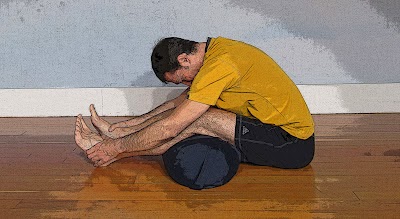
There are four specific movements that the spine moves through. When we bend forward and curve the spine (reversing the lordosis of the cervical and lumbar region and exaggerating the curve of the thoracic region) this is called flexion. We cause spinal flexion in forward bends whether in a chair or seated on the floor. The degree of forward bend is generally limited by our leg and back flexibility. Some very common forward bends that require different degrees of flexion could be Seated Forward Bend (Paschimottanasana) and Plow pose (Halasana), which you could think of as an upside down from of Seated Forward Bend.
Why do I say there are different degrees of flexion? Well, for someone who is very tight in their legs or in their back muscles, just the act of sitting in Staff pose (Dandasana) with a lift under their pelvis is very challenging. Their natural inclination might be to sit in a rounded back or flexed spine position to start and then when they bend forward even more this becomes an unhealthy forward bend because there isn’t good distribution of the change in the spinal curve.

For the tighter student, learning to sit with their spine in neutral curves is the way to begin practice for spinal safety. The student who has a lot of flexibility in their hamstrings may have tight back muscles so when they bend forward there is no change in their spinal curves—both examples are extremes.

The key to healthy forward bends, whether in Paschimotanasana or Halasana, is for there to be “ease” in the bend.  The same principles apply to standing forward bends like Pyramid pose (Parsvottanasana). Props like chairs, bolsters, and blocks allow you to find the shape of the pose without the struggle of getting into a pose you aren’t ready for.

The opposite of flexion is extension. In extension, the curves of the cervical and lumbar region are deepened and the curve in the thoracic region is lessened. We extend our spines in classic backbends like Upward Bow pose (Urdva  Danurasana) Upward-Facing Dog pose (Urdva Mukha Svanasana), and Camel pose (Ustrasana).
Of course, our spines can also twist, as when we turn to look behind us in a car. We twist our spines in seated twists, such Bhajrajasana, or Marichyasana, and in standing poses, such as Triangle pose (Trikonasana) and  Revolved Triangle pose (Parivrtta Trikonasana). And in certain poses we combine both flexion and twisting as in Parivrtta Janu Sirsasana. Poses with both extension and twisting are less common, but one example is the One-Legged Downward-Facing Dog pose with a twist.

Finally, we can side bend, as when we reach down to pick up something like a handbag or grocery bag that is next to our foot. We side bend our spines in side-bending yoga poses, such as Gate pose (Parighasana). And in many poses we combine both side bending and twisting, such as in Triangle pose (Trikonasana) and and Revolved One-Legged Forward Bend (Parivrtta Janu Sirsanana). Generally, we don't purely side bend without some twisting or purely twist without some side bending, though the primary movement will look like side bending or rotation.

The key concept to protecting your spine in all your poses is understanding where we want to encourage the movement and how to distribute the movement so as not to cause excessive motion  at one vertebral level. Another key concept is to avoid using momentum to push through “resistance.” When we are overly aggressive in attempting to gain motion this is where injury will surely occur.

So let’s break down this concept of spinal motion a bit more. If we understand that different parts of our spine move more in certain movements, does this mean that certain asanas will affect different parts of the spine differently? Yes, absolutely! The cervical and lumbar regions are concave when the spine is at rest. When we move into a backbend, these areas become more concave in relation to the curve reversal of the thoracic region. Because the thoracic region is stabilized from the front (anteriorly) by the rib cage and from the back (posteriorly) by the long spinous process, there is relatively less curve reversal from convex to concave in this region. As we move into a forward bend, the rounding of the thoracic curve increases into more of a convex shape. The opposite occurs in the cervical and lumbar spines; they start in relative concavity and as the forward bend moves throughout the spine, their shape changes from concave to relatively convex.

In twists, it is important to encourage full spinal involvement, but also to understand that the majority of the twist will occur in the cervical region, followed by the thoracic region and lastly the lumbar region. There is very limited rotation of the lumbar vertebra due to their specific structural construction. Also, please try to avoid allowing your spine to round or flex whenever doing twists. The key to healthy twists is to keep the spine long, with a good conscious control of maintaining the curves as you twist. This is often erroneously called keeping the spine “straight”, but now you know better when you hear this cue from a teacher!

When you practice, try to picture how your spine changes shape from the starting position into the position of the asana and then back to starting position. This is your experiential anatomy lesson of flexion (forward bending) and extension (backward bending), and twists. 

Subscribe to YOGA FOR HEALTHY AGING by Email ° Follow Yoga for Healthy Aging on Facebook