How Much Protein You Need and

Pro Bodybuilders eat about one gram (sometimes even 1.5 grams) of protein per pound of body weight or per pound of non-fat tissue. I'm sure you've seen that the recommended dail

Comments

Showing posts with label Calves Exercises. Show all posts

Sunday, September 4, 2016

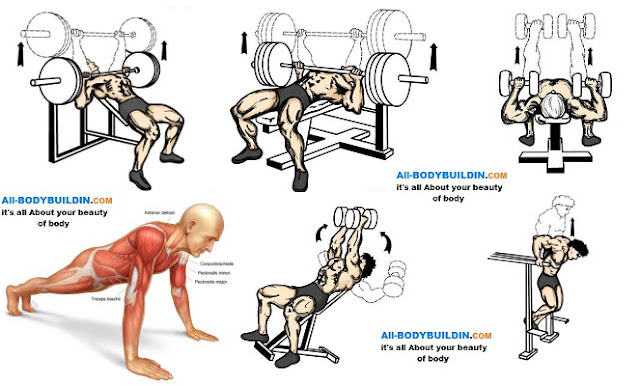
The Top 5 Chest Muscle Exercises

As people start to anticipate another season at the beach or around the pool, many are attempting to rev up their workout routines to strengthen and tone their bodies. Amongst the many muscle groups being targeted is the chest muscle. Other than the arms, the chest is the certainly something people want to show off, and a great looking chest requires focused strength training. Here we have compiled some of the more effective chest muscle exercises to help you get that body you'll be proud to show off.
Chest Muscle Exercises

The Best Chest Muscle Exercises

  • Bench Press
For its ability to work the entire chest muscle, the bench press is one of the oldest and most effective chest exercises there is. It is performed whilst lying flat on your back with your hands shoulder length apart. The barbell is lowered down to the chest in a controlled movement and then thrust upwards until the arms lock. This movement is repeated several times with reps ranging from 8-15 in 3 sets. For best results, begin with a weight you can press fairly easily for 15 reps and then increase the weight and reduce the amount of reps with each successive set.


  • Incline Press
The incline press is great for working the top half of the chest or pectoral muscle. It is performed in much the same way as a traditional bench press. The only difference is that instead of lying flat, you will lie at an incline. Because of the angle, incline presses will pose more of a physical challenge, so make sure you begin with a lighter weight until you're sure how much weight you can handle.

  • Dumbbell Presses
Like the barbell bench press, dumbbell bench presses are performed whilst lying flat on your back with your feet comfortably on the floor. Select a pair of dumbbells of equal weight, beginning first with a load you can handle with each arm for approximately 15-20 repetitions. Increase the weight for each set and reduce the number of repetitions to give the muscle a maximum workout. For a variation you can also perform dumbbell presses at an incline or decline.

  • Dips
Dips are a powerful chest muscle exercise performed using a "dip bar" on which you raise and lower your body weight. Although the exercise may look easy it can be extremely taxing. When done consistently as part of an overall workout routine, dips can help to really tone and strengthen the chest muscle.

  • Push-Ups
The great thing about push-ups as a chest muscle exercise is that they can be done at any time, without having to drive to the gym or buy expensive equipment. Push-ups help to tone and strengthen the chest muscle and can be performed with several different variations, including close grip, wide grip and weighted pushups.
With focused strength training, along with the proper diet, you can build lean chest muscle, burn fat and finally get that rock hard body that looks great on any beach.


Monday, August 29, 2016

A Killer Exercise to Build Bigger Calves

When training the calves, there are five common exercises: Standing Calf Raise, Seated Calf Raise, Donkey Calf Raise and Toe Press on a Leg Press. Of the five exercises listed, only one exercise, the Seated Calf Raise, effectively trains the Soleus muscle in your calves. Since a muscle responds better to lots of variation, the Soleus gets "short changed" with only one exercise. However, there is killer exercise that can be added to your Soleus training routine for more variety. This killer exercise is called the Squatting Calf Raise or Calf Rock Ups. Calf Rock Ups are very intense and can be included as an alternative to Seated Calf Raises.
Exercise to Build Bigger Calves
To perform the Calf Rock Ups, drop into a deep or full squat, where your lower hamstrings are touching the top of your calf muscles.
Grab onto a rack in front or beside you for balance during this exercise. In the deep squat position, raise your heels as high as you can and squeeze/contract your calf muscles hard for 1-2 seconds before descending.
Descend slowly and accentuate the "negative" part of this exercise.
Since the Soleus responds best to higher reps, you can perform the Calf Rock Ups using 2-3 straight sets of 20-30 reps using your bodyweight for resistance at first. If you're new to calf training, you may need to use lower reps and more sets to build your strength in this exercise. As you get stronger and can perform the exercise in the 20+ repetition range, then you can squat under the Smith Machine bar and performing your Calf Rock Ups with resistance on the bar. This setup will also help you keep your balance.
As you become more advanced in this exercise, you can place your toes on a raised block to get more stretch at the lower position of each repetition. Use caution with this approach and make sure that your ankle flexibility and Achilles tendon are up to the task.
This exercise is also an excellent substitute for the Seated Calf Raise if you're in a gym that does not have a Seated Calf Machine. For complete calf development, you must train the Soleus intensely. This exercise will provide the added intensity and extra variety in your Soleus training to add more calf size.

Saturday, August 6, 2016

Legs Workout Routine - Build Tree Trunk Thighs With This Killer Routine

Have you achieved some decent upper body development? Do you have a big chest, thick arms, maybe even a broad back? What about your legs? Most lifters wuss out and neglect leg training. Whether or not you're one of those guys, now is the time to step up and take your lower body training to the next level. Here is a killer legs workout that will make tree trunks out of your thighs. All you've got to do is put in the hard work. Check out this killer legs workout routine...
1. Squats
That's right, squats! What other movement would you put at the beginning of your legs workout routine? If you've been making the leg press the mainstay of your lower body training, it's now time for the change that will take your whole physique to another level. The squat is called the king of all exercises for a reason - it's the best mass builder there is.
First of all, concentrate on perfect form. Take a medium-width stance that feels strong. There's really no point in brining your feet in close together just to involve more quads. You'll get plenty of quad development if you're squatting heavy weights! Place the bar lower on your rear delts if you can, and higher up on your traps if you can't do that.
Legs Workout Routine
Once you're in the standing position with the bar on your back, fill your belly with air and push your butt to the rear. The sitting back motion at the beginning will help you recruit your hamstrings and glutes and move more weight. Squat back and down until your thighs are parallel to the ground, and stand back up. Repeat until the set is over.
For this first movement, warm up and add weight gradually until you get to your heaviest set of five reps. Slightly more or fewer is okay, but aim for a weight that allows you to get five reps with no possibility of a sixth! After a few minutes' rest, drop the weight and do another set of 8-12 reps. If you've given your all, that's all the squatting you need for the day.
2. Leg Curls
Most lifters would head to the leg press next, but you're not most lifters, are you? Developing big, strong hamstrings is hard, and you need to prioritize it every legs workout if you want it to happen. Start by warming up with a few easy sets of 10-12 reps. Then, pick a weight that allows you to just barely eek out 15 reps. That last one should be a do-or-die effort. Rest 30 seconds, and do a few more. Rest 30 seconds again, and do just a few more again. Your hamstrings will be absolutely toast if you give each of these three "mini-sets" your full effort.
3. Walking Lunges
Nope, we're not going to the leg press yet! Lunges are a hard, free weight movement that you can't do properly if your legs are totally fatigued. Take a minute to recover from the leg curls, then put a bar on your back and start lunging up and down a clear space in the gym. Add just enough weight to the bar so that 3 trips of about 20 steps per leg is difficult. You don't need to kill yourself on these to get the full benefit, nor should you. Don't go to failure and make some poor employee mop you up off the floor because you killed yourself in this legs workout routine!
4. Leg Press
Finally, we get to the machine that most lifters unfortunately call home on legs workout routine day. You already squatted hard, though, so you've earned the right to blast away on an easier movement. Don't think it's going to be easy, though!
Use a foot placement that feels the strongest. For most people, this is relatively high and wide on the platform. No, it doesn't matter that your feet aren't low and close together - your quads will still gets LOTS of work. Moving lots of weight and involving your quads AND hamstrings is more important for overall leg development than feeling the burn in your quads, anyway.
You're already pretty warmed up, so quickly work up to a weight that challenges you for 10-12 reps. Make sure to use a FULL range of motion, going as absolutely low as the machine will allow. Most guys do a kind of half knee-bend with way too much weight just so they can load up tons of plates. Their legs still don't have much to show for it.
After that initial set, catch your breath, wait a few minutes, then lower the weight just a little bit and bust out a set of 20. I don't care if it takes five minutes and you have to take 10 breaths between every rep, you are GOING to get all 20 reps. This is the kind of hard training that will truly set you apart from the pack and give you tree trunks for legs.
5. Leg Extensions and Leg Curls
You're pretty much done at this point. You've stimulated your legs as much as is necessary with the first four exercises, and you are in store for some serious growth as long as you eat enough. To finish with a good pump, head on over to the machine area and do a few supersets of leg extensions and leg curls for 2-3 sets of 15-20 reps. These should not be too hard, but they should burn. After each round, stretch your quads and hamstrings. Hobble out of the gym and prepare to do it all over again in a week!
What About Calves
Whether they put them in their legs workout or do them on a different training day, most lifters do not give a good effort to their calf training. There's no way you're going to be able to train your calves proper about this grueling legs workout routine, so head on home and train your calves another day.

Saturday, April 30, 2016

3 Calf Exercises That Show Results

The calves can be the most stubborn and hard to work muscle in your entire body. You'll have to do a lot of pumping to get the calves you want. Sometimes, it just comes down to genetics so be prepared with your expectations. Other times, it's bad training that leaves us with small calves. Here are detailed instructions on how to properly do the top 3 calf exercises that will get your calves bigger.

1. Leg Machine Calf Press - Use caution when performing this exercise. Using the leg press, position your back comfortably on the back rest, and place your feet on the plate. Put your toes on the lower edge of the platform so your feet are half hanging off (this is why you must be careful). Make sure your feet are shoulder width apart. Push the weight up and swing the safety locks. Remember not move your knees, only your ankles should be performing the movement. Let your feet come back down in a long stretch and pause. Then slowly raise your feet and extend your feet. Hold this position at the top and squeeze your calf muscles as tight as you can. Slowly, come back down. Repeat this exercise. Recommended reps are 8-10.
Leg Machine Calf Press
2. Standing Calf Raises - There are muscles in the calves. The Gastrocnemius, which straight knee raises will focus on, and the Soleus, most active when the knee is bent. You can do this exercise three different ways. With a machine, freestanding with weights or free standing without weights. If you do it freestanding with weights, be sure to put a barbell across your back or a dumbbell in each hand. For the machine, stand on the foot block and place your shoulders underneath the padding. Stand so that the balls of your feet are only touching the foot block. Point your toes forward; your feet should be shoulder width apart. Start with your heels down in a good long stretch, keeping your knees stiff but never keep them locked. Move only your ankles, not your knees when you raise. Raise up the balls of your feet as high as you can get. For use without a machine, perform the same steps on a foot block.
 Standing Calf Raises
Notes: Working the inside of your calves requires you to raise yourself to the inside balls of your feet. Naturally, the outside of your calves can be worked by raising towards the outside balls of your feet.
Do not turn in toes or feet.
Do not bend or straighten the knees. This brings your quads into the exercise and you'll see less gains.
3. Seated Calf Raises - The second exercise for calves is the machine for the Seated Calf Raises. Put your desired weight on the machine and sit down. Keep your feet shoulder width apart with the balls of your feet on the foot block. You can adjust the pads at your knees for the desired height. Lift up the weight with your feet and remove the pin that's in the machine. Slowly lower for about 2 seconds down as far as you can go. Pause at the bottom and wait another 2 seconds. Then raise, again, lasting 2 seconds and stop at the top. Flex your calves when you reach the top and hold it for 2-3 seconds. The recommended sets are about 8-10, depending on whether you are going for size or strength. And that's all there is to this one.
Seated Calf Raises

That's how you add muscle properly to those stubborn calf muscles. Keep the routine up and you'll see improvements, I promise.
                                                            Article Source: http://EzineArticles.com/6788539

Sunday, April 3, 2016

Lower Body Exercises For Beginning Bodybuilders

The lower body contains some of your biggest muscles which are capable of bearing significant weights. The temptation for beginners to go for broke by performing heavy squats should be resisted. To begin with you should concentrate on building the muscles safely by using machines that isolate muscle groups. The squat is an excellent compound exercise that trains numerous lower body muscles but it is one you should learn properly after spending three months strengthening the individual muscles that will be utilized later

The muscles of the lower body can be divided into five groups:

1. Quads – this is the big muscle group consisting of four muscles at the front of the thigh. These are the primary muscles used when performing exercises such as squats, leg press, lunge and leg extension.

2. Hamstrings – these are the main muscles at the back of the thigh. These are the primary muscles used when performing leg curls.

3. Gluteals – these are the muscles that make up the buttocks.

4. Hip flexors – these are the small muscles at the front of the pelvis that allow you to raise your legs to the front.

5. Calves – these are the two muscles found in the lower leg.

For beginners these muscles should be exercised as follows:
Lower Body Exercises


1. Leg press – 1 set of 10-15 reps. This is a useful exercise for the quads but it also works the hamstrings and glutes to a lesser degree.

2. Leg extension – 3 sets of 10-15 reps. This is a useful exercise for adding definition to the quads.

3. Hamstring curl – 3 sets of 10-15 reps. This exercise isolates the hamstrings.

4. Standing calf raise – 3 sets of 10-15 reps. This exercise works the gastrocnemius muscle.

5. Seated calf raise – 3 sets of 10-15 reps. This exercise works the soleus muscle underneath the gastrocnemius muscle.

As with all exercises you need to take care in scheduling specific body parts. To begin with you should incorporate your lower body exercises into a program similar to the one suggested below:

Day 1: Biceps, Back, Abs

Day 2: Hamstrings, Shoulders, Abs

Day 3: Quads, Forearms, Calves

Day 4: Triceps, Chest, Abs

For the first couple of weeks complete one set but then add one set each week to a maximum of three. At the end of three months you will be ready to move on to more intensive intermediate level exercises.

Monday, February 22, 2016

Calves Muscles – Exercises for your calf muscle

Most people who lift weights tend to neglect their calves but if you want a complete, fully developed and admirable body then you shouldn’t neglect your calves. They are hard to train and it does hurt to do it but the results will show if you train them as hard as you do your chest or biceps
You need to train your calves at different angles with heavy weights.

Here are the top exercises for the calf muscles
Calves Muscles

One Legged Calf Raises

Stand with one foot on the edge of a board. Hold on to a weight in one hand and hold on to a stationary object with the other hand. Lower your heel of the board until your calf if fully stretched. Then lift your foot until you are standing on your toes as high up as you can.
Repeat for the other foot.

Barbell Calf Raises
One Legged Calf Raises

Stand on a board with both your feet. With your heels over the edge of the board and a barbell across your back lower until you stretch your calves. Higher yourself up with your calf muscles until they are fully contracted.
Variations include using different foot positions to fully maximise calf development.

Seated Calf Raises
One Legged Calf Raises

Using a seated calf machine place your knees under the bar and place your feet on the board with your heels over the edge.
Stretch and contract your calf muscle like before to fully work them.
Variations include working the feet one at a time.