How Much Protein You Need and

Pro Bodybuilders eat about one gram (sometimes even 1.5 grams) of protein per pound of body weight or per pound of non-fat tissue. I'm sure you've seen that the recommended dail

Comments

Showing posts with label hip replacements. Show all posts

Friday, May 15, 2015

Friday Q&A: Preparing for a Hip Replacement

Brooding Woman by Paul Gauguin
Q: It looks like I am scheduled to have my right hip replaced in two weeks. Have tried to work my way thru it for the past two years using alternate modalities without much luck. Any words of advice? 59 year old male in Portland.

A: From the sound of the first sentence, I sense a bit of ambivalence about the upcoming surgery from our reader. Can’t say I blame him, although I wish I had more information about why now is the time for the surgery. For some of us who do yoga and prefer to utilize alternative therapies as a first line approach to our health, we often can feel conflicted when the Western approach seems the one we need to try. If you are in this quandary, I recommend you check out Nina’s insightful post No Shame, Please (Western Medicine and Yoga are Complementary).

The most common reason for a hip replacement in an otherwise healthy adult without a history of osteoporosis or an acute fracture of the head of the femur bone is significant osteoarthritis or wear-and-tear arthritis with secondary pain that is becoming unbearable. Most of my patients and students who have found themselves in a position of worsening hip pain due to OA are usually told by their orthopedic surgeon to return for a hip replacement when they can no longer tolerate the pain or function normally with the pain. This is partially encouraged since the hip replacement has a limited life expectancy before it may wear out and need replacing—around 15 years of so. So your doc wants to have you wait as long as you can—within reason—so you are old enough at the time of surgery that you might be able to live out your life and not need said replacement of the replacement! 

As I said, I might feel a bit ambivalent about such a major surgery, as I always like the idea of keeping my body as intact as I can. However, hip replacements have become fairly routine and are overall safe procedures, although not without risks (as for any major surgery). It turns out your mind can influence the outcomes of surgery, so it never hurts to cultivate a positive attitude towards your upcoming surgery, anticipating a good outcome. There have been studies done looking at pre-surgery attitudes and outcomes, and it turns out that having a negative expectation, what researchers call the “nocebo effect” (as opposed to the more famous placebo effect), results in higher complication rates than are normally found. So, if you notice that your thinking around your upcoming surgery is trending on the negative side, consider employing the yogic concept of pratipaksha bhavana, or cultivating the opposite (although this is about healthy eating, see this for a general idea: Cultivating the Opposite). You can do this during your meditations between now and surgery day by using a mantra that reflects your desired outcome, such as “My hip is healthy and pain free,” which you can repeat mentally as you exhale during your meditation. 

Leading up to surgery, even if it is very soon, you could also be doing a modified home asana practice that avoids poses that worsen your particular hip pain, but that keeps all the other parts of your body flexible, strong, agile and balanced, so you head into surgery with a quality of physical and mental fortitude. Consult with a seasoned yoga teacher if you at a loss as how to do this on your own. 

Also, our in-house physical therapist, Shari Ser, has written about post-hip replacements and yoga in her post Total Hip Replacements and Yoga). So read that post over to get ready to employ your yoga tools along with the post-op physical therapy visits your doctor will likely assign for you. Shari has done such a thorough job of it that I don’t want to rehash this excellent post. I strongly echo her recommendation to work with an experienced yoga teacher following your surgery.

I’d add one more suggestion, however, to working with you pre-op attitude. You might see if you can speak with your physical therapist prior to surgery and ask them to describe some of the initial exercises they will have you start in the hospital or as soon as you go home. There have been studies that showed improved healing times and shortened discharge times from the hospital from surgical patients who were taught to visualize their exercises mentally in the days leading up to when their docs would OK them to start doing actual physical therapy compared to similar surgery patients who were not taught the visualized practices. As a yoga practitioner, you may find this sort of visualization easy to practice and beneficial in the same way as the study participants.

Finally, it couldn’t hurt to focus on the quality of gratitude, especially gratitude for the fact we have access to modern surgical technology that has the potential to return you to normal daily function of your hips and pain-free movement. I’d hope that in the same situation I could utilize all these ideas to improve my chances of a successful surgery and return to activity. All the best! 

—Baxter

Subscribe to Yoga for Healthy Aging by Email ° Follow Yoga for Healthy Aging on Facebook ° Join this site with Google Friend Connect

Friday, October 31, 2014

Friday Q&A: Modifying Poses for a Hip Replacement


Pose to Avoid for People with Posterior Lateral Hip Replacement
A reader left this question on our post Featured Sequence: Dynamic Reclined Hip Stretches (Rerun).

Q: What adaptation would you use for someone with a hip replacement?

A: To answer this question, we need to consider the type of hip replacement the yoga practitioner has had. Which type of replacement person has had is going to affect their asana practice.

To review from our post on total hip replacements and yoga, the basic categories of total hip replacement are:
  1. posterior lateral approach
  2. anterior lateral approach
  3. anterior approach
  4. minimally invasive anterior approach or minimally invasive posterior approaches
These are all different, but as far as hip precautions go there are no hip precautions for the anterior approaches.

In general, everyone who has a hip replacement should ask their surgeon what their post-operative physical limitations are and for how long. Make sure you learn how to safely get up and down from the floor so you don’t dislocate your new hip. And make sure that you learn the specific precautions associated with your category of hip replacement. The key is that you learn to identify what position your hip is in when you do your poses. Think of both legs when you do each side (don’t just focus on the surgical side).

In the more traditional posterior or posterior lateral approach there are limitations on hip flexion, adduction and internal rotation. That means that if you combine these three positions you are more apt to dislocate your prosthetic hip because the muscle support is weakened by the surgical procedure. Poses you might want to not do for approximately six months would be: Standing Forward Bend (Uttanasana), Eagle pose (Garudasana), Cow-Face pose (Gomukhasana), and Child’s pose (Balasana). Gentle backbends generally are okay for posterior/posterior lateral hips.

For anterior lateral hips the precautions will be very different. Typically hip extension and hip abduction will be affected and you don’t want to be aggressive in these combined movements. So start thinking about your backbends and standing poses. Remember that the position of the front and the back legs are very different in the standing poses. The front hip may be placed into positions of flexion and external rotation and abduction but the back hip may be in extension with external rotation.

For anterior hip replacement surgeries the doctor will typically tell you that you have no restrictions but that doesn’t mean you are going to jump back into your asana practice. The hip is going to be sore and painful because of the surgical trauma (though it is less in this procedure than some of the other ones I talked about because there is no actual muscle cutting in this procedure but the muscles are certainly stretched as they are moved for the surgery).

Now to Baxter's sequence, Dynamic Reclined Hip Stretches: To answer this question I combined hip surgeries into two categories; anterior and posterior approaches. That’s because functionally there isn't a whole lot of difference in precautions for each subcategories within the two main categories.

1. Deep Hip Flexion.
 

Flexion Greater Than 90 Degrees
All four poses in the sequence involve deep hip flexion. The reason hip flexion works for low back discomfort is that the ilium rotates posteriorly when the knee and hip are flexed, and, conversely, the lumbar spinal curve is reversed and the back flattens. This often feels good because those tight low back extensor muscles are stretched.

However, with a hip replacement, flexion beyond 90 degrees often causes a "pinching" sensation in the groin region. If the hip replacement was an anterior approach there is no fear of dislocation but discomfort can certainly arise. However, with a posterior lateral approach, the position of deep hip flexion is not recommended due to dislocation risks. (Unfortunately there is no time when a hip replacement will not dislocate, but typically the high-risk time is 0-90 days post-operatively).

As a modification, you could try using a chair. Place your top leg on the chair so your calf is resting on the chair seat, and your hip and knee are bent at 90/90. Lengthen your bottom leg underneath the chair seat. This makes the pose more passive and this gentler approach might be the safer way to go. (I don't like teaching my students to “deeper” into a pose using overpressure with their arms because I think this is a potential way to cause injury. I believe that for muscle release to occur, you should take the joint to its pain-free position and breathe while statically holding the pose.)  

2. Hip and Knee Flexion with Abduction and External Rotation 
Position 2 in this sequence is a red light for a posterior lateral approach because two of the three dislocation movements are present: hip flexion beyond 90 degrees and, for some approaches, external rotation being limited due to how the hip might be fixed within the joint. So for this type of hip replacement, you could modify the pose with a chair, as recommended for position 1. After placing your top leg on the chair so your calf is resting on the chair seat, let your knee and thigh roll outward.

3. Knee to Chest Moving Over the Midline.

For a posterior lateral hip replacement, Position 3 should never be done! This is the full rendition of dislocation position, which is flexion with adduction and internal rotation. To get a similar stretch (the tensor fasca lata, lateral hip abductors or piriformis) I suggest a Jathara Parvartanasana variation. This pose is a reclined twist, with, in this case, two bent knees. Before coming into the pose, either place either a folded blanket between your thighs and legs down to your ankles or place a foam block between the knees. And place a bolster on the floor to support your legs after you come down so your legs don’t go all the way down to the floor.

Finally, the key concept is that regardless of the type of surgical approach, you need to learn to respect your hip and never push into pain. Posterior lateral hip replacements are more dislocation-prone than anterior hip replacement procedures but end-range overpressure will cause discomfort in anterior hip replacements. And, unfortunately, if the prosthesis is sized improperly, even trying to do the modifications I’ve recommended might still be uncomfortable. In that case, go back to your surgeon—or ask your student to go back to their surgeon—for some frank discussions on the specific dos and don'ts for their hip replacement.

—Shari 

Subscribe to Yoga for Healthy Aging by Email ° Follow Yoga for Healthy Aging on Facebook ° Join this site with Google Friend Connect

Friday, July 19, 2013

Friday Q&A: Helping a Student with a Hip Replacement

Hip Joint from Behind
Q: I am a relatively new yoga instructor that teaches Gentle Hatha to (mostly) seniors.  Recently, a gentleman came in with bilat hip replacements from 10 and 12 years previous. He rides his bike and is in pretty good shape for a gent in his 60's. His hips were replaced by a posterior approach. How cautious do I need to be with this man? Do we modify mostly in the early days after the operation? Of course, I've modified the asanas to his ability and told him to not push it to the extreme. So is it fresh post op that we worry mostly about or for decades following? Thanks!

A: This is a great question and I am glad you asked it. In most cases, the hip replacement should outlast an individual’s lifespan. The literature states that total hip replacements typically last from 15-to-20 years after the initial surgery, but in some instances they can last over 30 years. But this is neither a guarantee nor assurance, for the simple reason that life is unpredictable.  Many factors affect the future of a hip replacement, such as accidents, fractures, late infections, and deterioration in overall health. Also, how well you take care of yourself down the road is something the surgeon cannot control. The longevity of a hip replacement thus depends on many factors, including the following:
  • Surgeon skill in implanting the components
  • Known history or track record of the implants
  • How well you take care of yourself and your health
  • Understanding and respecting the limitations of a prosthetic lifestyle
  • Your activity level and body weight
  • Avoiding high impact or extreme sports
Medical literature states that the most common reasons for individuals needing subsequent hip replacement surgery include:
  • Loosening of the implant. 
  • Dislocation of the implant
  • Infection, such as staph infections either around the time of surgery or later through the introduction of the bacteria into the blood stream.
It is believed that the most common reason why hip replacements fail is because the weight-bearing surface wears out and the prosthesis begins to loosen. So, what is hip replacement loosening? When a hip replacement is placed into the body, it is either press-fit into the bone or cemented into position. Either way, it is fit tightly into the bone of the thigh (femur) and pelvis so that the implant cannot move. Hip replacement loosening occurs over time, and can cause problems with the normal function of the hip replacement prosthesis. When implants loosen, the hip replacement can begin to move small amounts. This can be caused by the shaft of the prosthesis becoming loose in the hollow of the thighbone or due to thinning of the bone around the implant.

Loosening of the joint can occur at any time, but it normally occurs 10-15 years after the original surgery was performed. Signs that the joint has become loose include pain and feeling that the joint is unstable and that there is increased loss of hip mobility. Another operation (revision surgery) may be necessary, although this cannot be performed on all patients.

Both physicians and patients are very concerned about the problem of hip replacement loosening because a hip replacement revision surgery (replacement of a joint replacement) is a much more difficult operation and hip replacement revisions are often not as successful as the first operation. After revision operations, patients tend to recover less overall motion of the joint. Also, the longevity of the implant decreases with each revision. Therefore, physicians tend to avoid joint replacement surgery until absolutely necessary, and try to get as much mileage out of each replacement as possible.

In about 1 in 20 cases, the hip joint can come out of its socket. This is most likely to occur in the first few months after surgery when the hip is still healing. But, unfortunately some people’s hips will dislocate very distant to the original hip replacement. My advice here is that a hip doesn’t typically dislocate without warning signs. Pain that increases as an activity is continued is the most prevalent symptom.

So how cautious should you be with your student? The surgical hips will have a certain degree of motion that is limited by their soft tissue, hip capsule, how the prosthesis sits in the acetabulum, and so on. Start by checking your student’s range of motion while he is lying in a supine position. Test all the movements of the hip (hip up toward chest with knee bent, same knee position but bring it out to side for abduction, and turn the hip out in abduction for external rotation by bringing the bent knee up toward the armpit. Then look at his hip mobility while standing: hip flexion, abduction, external rotation and extension. You should also see if he tolerates adduction by having him sit on a chair and cross one leg over the other. If he can't do this, then any pose that has internal rotation must be modified significantly. You should have your student do this for both hips to get a sense of how it feels to his hip and see if there is any pinching or grabbing. Then you can modify the asanas accordingly.

If you ask a surgeon if his patient has any precautions after three months post op, he will generally say no, but he will modify his statement telling the patient to “use your own judgment.” So do we continue with precautions forever? Well, that is an area of disagreement. I err on the side of moderation saying, “If it makes you anxious or causes pain, discomfort, pulling, or pinching, please stop.” A student can have the potential of dislocation forever if they are not mindful on how they move and move repeatedly into discomfort. And remember the combined positions of flexion, abduction and internal rotation are the holy triad. If your student can tolerate the movements separately then you can find his limits and slowly challenge his hips, but both you and he must be aware of how the hip feels. NO PAIN should be elicited from asana and that means soreness after class or the next day. Learning how to ask how a movement feels is tricky because not everyone will say something hurts, so this includes learning which words your student uses to describe sensation changes.

So for your student, keep making sure that he observes his body’s limits and doesn’t push beyond his current activity. And congratulate him for coming to your class and investing in his continued health!

—Shari

Tuesday, November 13, 2012

Total Hip Replacements and Yoga

by Shari

Nina asked me to add to Baxter’s post Arthritis of the Hip Joint about what the next step might be when your own self care management techniques are not as effective and your quality of life is severely impacted. I thought I would give some background about the elective procedure of total hip replacement and why people might elect to have it done. I see a lot of total hip replacements in my work as a home health physical therapist, and I also do have yoga students who come to my class either after the procedure or before hand as they are preparing themselves for the surgery.
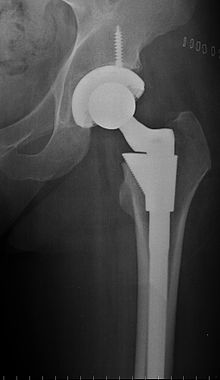
X-Ray of Hip Replacement from Wikimedia
As background, here is what the Mayo clinic says about hip replacement surgery:

"Hip replacement surgery, also called total hip arthroplasty, involves removing a diseased hip joint and replacing it with an artificial joint, called a prosthesis. Hip prostheses consist of a ball component, made of metal or ceramic, and a socket, which has an insert or liner made of plastic, ceramic or metal. The implants used in hip replacement are biocompatible — meaning they're designed to be accepted by your body — and they're made to resist corrosion, degradation and wear.

The goal of hip replacement surgery is to relieve pain and increase the mobility and function of a damaged hip joint. If a stiff, painful hip joint has forced you to cut back on everyday activities, successful surgery may allow you to resume them. Conditions that can damage the hip joint, sometimes necessitating hip replacement surgery, include:

  • Osteoarthritis
  • Rheumatoid arthritis
  • Broken hip
  • Bone tumor
  • Osteonecrosis, which occurs when there is inadequate blood supply to the ball portion of the hip joint
To perform a hip replacement, your surgeon:
  • Makes an incision over the front or side of your hip, through the layers of tissue
  • Removes diseased and damaged bone and cartilage, leaving healthy bone intact
  • Implants the prosthetic socket into your pelvic bone, to replace the damaged socket
  • Replaces the round top of your femur with the prosthetic ball, which is attached to a stem that fits into your thighbone
Your new, artificial joint is designed to mimic the natural, gliding motion of a healthy hip joint. "
Artificial Joint from Wikimedia
Techniques for hip replacement are evolving. As surgeons continue to develop less invasive surgical techniques, the hope is that these techniques might reduce recovery time and pain compared with standard hip replacements. However, studies comparing the outcomes of standard hip replacement with those of minimally invasive hip replacement have had mixed results.

Choosing an orthopedist to perform your surgery is a very personal decision and we all research our concerns in different manners. Please, though, when you have found a surgeon that you want to work with, make sure you discuss the different types of hip replacement surgeries that they may perform so you understand clearly the advantages and disadvantages that each surgical procedure presents. Be particular that the surgeon understands your own particular yoga practice and what it entails. Bring pictures of poses that you currently do (or have done) and make sure the doctor understands the stresses you place on your hip joint. Telling a physician who doesn’t do yoga “I do yoga” isn’t enough, so show him or her the positions your hip needs to be able to move through.
The surgical options that exist are very different in what the post operative limitations are and the longer standing limitations that the post replacement hip might present you with.

The basic categories of total hip replacement are either:
  • posterior lateral approach
  • anterior lateral approach
  • anterior approach
  • minimally invasive anterior approach or minimally invasive posterior approaches
These are all different, but as far as hip precautions go there are no hip precautions for the anterior approaches.

Now this important for the practice of yoga. Which approach is recommended for your particular situation is going to affect your asana practice. Please ask your surgeon what your post-operative physical limitations are and for how long. Make sure you learn how to safely get up and down from the floor so as to not dislocate your new hip and that you learn the specific precautions associated with your category of hip replacements. The key is that you learn to identify what position is your hip in when you do your poses and you need to think of both legs when you do each side (don’t just focus on the surgical side).

In the more traditional posterior or posterior lateral approach there are limitations on hip flexion, adduction and internal rotation. That means that if you combine these three positions you are more apt to dislocate your prosthetic hip because the muscle support is weakened by the surgical procedure. That is definitely going to affect your asana practice. Poses you might want to not do for approximately six months would be: Standing Forward Bend (Uttanasana), Eagle pose (Garudasana), Cow-Face pose (Gomukhasana), and Child’s pose (Balasana). Gentle backbends generally are okay for posterior/posterior lateral hips.

For anterior lateral hips the precautions will be very different. Typically hip extension and hip abduction will be affected and you don’t want to be aggressive in these combined movements. So start thinking about your backbends and standing poses. Remember that the position of the front and the back legs are very different in the standing poses. The front hip may be placed into positions of flexion and external rotation and abduction but the back hip may be in extension with external rotation.

For anterior hip replacement surgeries the doctor will typically tell you that you have no restrictions but that doesn’t mean you are going to jump back into your asana practice. The hip is going to be sore and painful because of the surgical trauma (though it is less in this procedure than some of the other ones I talked about because there is no actual muscle cutting in this procedure but the muscles are certainly stretched as they are moved for the surgery).

So now armed with your knowledge of what type of hip surgery you have had, and what your physical restrictions are and for how long, consider the critical importance of studying with a teacher who can assist you in practicing safely. Knowing what props to use and when are important, and so is knowing how deep to go into a pose. In addition, different surgeries have different time frames for returning to asana practice but the rule of thumb to return to any activity post operatively is how you feel. You can get time estimates on when to resume an activity but the bottom line is your own healing process and energy level. As always respecting your energy level and not be overly aggressive as you return to your asana practice is crucial.

In my clinical experience I have never had a client tell me that he or she is sorry to have undergone this surgery. In all medical procedures, knowledge, mental and emotional preparation and conviction in your choice of action go a long way towards healing. That certainly sounds like an engaged yoga practice off of the mat!