How Much Protein You Need and

Pro Bodybuilders eat about one gram (sometimes even 1.5 grams) of protein per pound of body weight or per pound of non-fat tissue. I'm sure you've seen that the recommended dail

Comments

Showing posts with label hysterectomy. Show all posts

Friday, January 23, 2015

Friday Q&A: Vaginal Prolapse


Q: I have a vaginal prolapse and my surgery in 3 months time will possibly include a vaginal hysterectomy. I am 75 and an Iyengar teacher. Please could the team cover this procedure some time? I would welcome your comments on how to prepare for surgery and how to modify my practice post operatively for a better recovery.  

A: A few weeks back, I addressed a question about pain following a partial hysterectomy (see Friday Q&A: After a Partial Hysterectomy), and briefly described what a partial hysterectomy is:

 “A partial hysterectomy refers to a procedure where only the uterus is removed, not the cervix or the ovaries. This type of operation involves a shorter recovery time, and is commonly used in the treatment of fibroids and severe and uncontrollable vaginal bleeding.”  

I also mentioned that mesh is used to hold the cervix and vagina in place to prevent them from prolapsing or bulging outside the vaginal opening. With our question today, a vaginal hysterectomy is being recommended because there is already a prolapse of the vaginal structures out of the body.

Before we discuss the procedure to fix this, it is worth understanding what “vaginal prolapse” means in greater detail, what causes it, and why it is important to fix. According to the Cleveland Clinic:

In vaginal prolapse the vagina stretches or expands to protrude on other organs and structures. The situation seldom involves the vagina alone. Supports for the uterus often stretch allowing it to also fall (prolapse) when a woman strains during a bowel movement.

  • When the protrusion involves the front (anterior) of the vagina and bladder, the presentation is called a “cystocele” or dropped bladder
  • When the back (posterior) of the vagina and rectum are involved, the presentation is called are “rectocele”
  • When the anterior vaginal wall and small bowel are involved the situation is called an “enterocele”

And these combinations of structures bulge down and out of the pelvic floor and vaginal opening. Although many women don’t have any symptoms, some will notice a fullness or discomfort in the vagina, a heaviness or pulling in the pelvis, or low back pain that gets better when lying down. Sometimes the prolapse affects normal bladder function, resulting in frequent urination or stress incontinence (loss of control of bladder with coughing, sneezing, laughing, or strongly engaging the belly muscles). When the rectal area is involved bowel movements can be difficult. And the prolapse can interfere with intercourse, which can also become painful. 

As for causes and risk factors, the number one risk factor for developing prolapse of the vagina is having a history of vaginal childbirth, especially more than one time, and aging. Menopause can also negatively affect the tone of the muscles of the pelvis floor. Aging can lead to a weakening of the muscles in general, so the pelvic floor can be affected, too. Chronic cough and chronic constipation can also be risk factors.

If symptoms from the prolapse are significant for a woman, non-surgical treatments are usually tried first, such as teaching the patient pelvic floor muscle strengthening exercises, and possibly the use of a small device placed in the vagina called a pessary, which helps keep everything up and out of the vaginal opening. But for whatever combinations of circumstances, our reader is scheduled for a vaginal hysterectomy. This is a surgical procedure that removes the uterus, possibly the cervix, and, also in post-menopausal women, the ovaries (all are usually removed due to the risk of cancers developing in them over time if left in place). For the procedure, the surgeon enters from the vagina, so there is no cutting through the lower abdominal wall to get the structures and no scarring. The top of the vaginal cavity will likely still be tacked up to other parts of the inner walls of the abdomen to keep the vagina from prolapsing out after surgery.

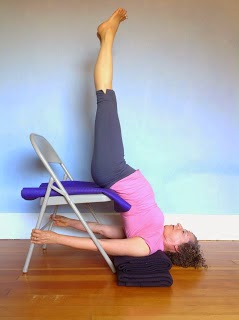
In preparation for surgery it would be helpful to discuss with your doctor and physical therapist the pelvic floor exercises they recommend for those not undergoing surgery. There could be some nice overlap with some of the yoga poses and techniques that can strengthen the pelvic floor, such as Mula Bandha, and you could integrate your physical therapy techniques with your yoga poses to have your body in the best shape possible prior to surgery. Sometimes reclining can relieve back pain associated with vaginal prolapse, so Relaxation pose (Savasana) could be an excellent pose to do regularly if back pain is one of your symptoms. In addition, supported inverted poses where the pelvis is inverted, such as Chair Shoulderstand or Legs Up the Wall pose done with a prop under the pelvis, could be employed to use gravity to pull the vagina and uterus away from the pelvic floor, especially if they relieve symptoms, even if only temporarily. For more on pre-surgery recommendations from a trained physiotherapist specializing in pelvic floor, see Yoga Prolapse Poses to Choose and What to Avoid ,

After surgery, you’ll want to follow the return-to-activity recommendations of your health care team, but restorative poses, pranayama practices that quiet the nervous system, and guided meditation with a focus on lowering stress could assist in faster recovery times. The good news is that compared to an abdominal approach hysterectomy that has a six-week recovery time on average, the vaginal hysterectomy recovery times are on average only two to four weeks. So it should not be too long before our reader is up and easing back into her normal activities, including practicing and teaching yoga again! 

For more non-yoga related advice on post-op recovery, see Recovery From a Vaginal Hysterectomy.

—Baxtert

Subscribe to Yoga for Healthy Aging by Email ° Follow Yoga for Healthy Aging on Facebook ° Join this site with Google Friend Connect

Friday, January 9, 2015

Friday Q&A: After A Partial Hysterectomy


Q: I have a student who's had a partial hysterectomy. As she described it, to prevent the organs from pressing on her perineum the surgeon used a mesh "ligament" to attach the top of the cervix to a ligament in her back. She says that it feels "weird" and sometimes uncomfortable when we work on deep inner bodywork, such as Agni Sara (or various preparations) or ways to access Uddiyana Bandha. She feels it most when we do breath retention on the out breath and create an inner vacuum as you elongate the torso. Have you come across this before? Is there any risk for her to work on this? Any modifications you'd suggest?

A: In fact, I have not come across this particular complaint from any yoga students who have had hysterectomies of any kind. However, I have personal experience with the presence of mesh used in abdominal surgery and its effect on yoga practice. Over 10 years ago, I developed a hernia in the groin area on my left side. Upon further evaluation by a surgeon, it was discovered I had an even bigger potential opening on my right groin area, and surgery was recommended to repair and seal off these openings. This was accomplished using the kind of mesh I suspect your student had placed during her surgery. I was told that I might expect some unusual sensations in the area of the groin creases after my surgery, but that it usually would disappear after an uncertain amount of time. And, indeed, following my hernia repair, I initially felt soreness, and eventually after that disappeared, I was left with a kind of tightness, especially on my right side, that I had not had prior to surgery. As I returned to my normal practice routine I noticed it in certain yoga poses, most notably in High Lunge when the right leg was back. This persisted for some time, certainly for months, but then gradually began to fade. And at this time, I no longer notice any unusual tugging or weird sensations in the area where the mesh is still certainly located. 

But back to the student in question. So, what is a “partial hysterectomy”? Hysterectomies, in general, are the second most common surgery performed in the US each year. A partial hysterectomy refers to a procedure where only the uterus is removed, not the cervix or the ovaries. This type of operation involves a shorter recovery time, and is commonly used in the treatment of fibroids and severe and uncontrollable vaginal bleeding. Mesh is often used to hold the cervix in place, since the structures that would normally do that are gone with the uterus, and the vagina could prolapse, or fall, toward the pelvic floor. Unfortunately, there can be complications with the use of mesh, such as mesh shrinkage, which can cause such serious complications as intense pain, scarring, vaginal shortening, and sexual dysfunction. Although this does not sound like the case here, it is worth being aware of these potential complications.

In the case presented here, I would be less concerned about a student who was only having “weird” sensations at certain times in the practice. However, if there is outright discomfort, it might be important for her to check back in with her surgeon and make sure there is nothing more worrisome going on. For instance, it is not uncommon for patients to develop scar tissue around the sites of abdominal surgeries. If that scar tissue, or “adhesions” as they are also sometimes referred to, is causing enough problems, pain or otherwise, it is sometimes recommended to do a follow-up look via endoscopy and possibly release the scarred areas, which in many cases will result in reduced or resolved pain and improved overall abdominal function. The first step is simply to have a follow-up with her doc.

If the student is mildly uncomfortable only when doing certain things, there might be some ways to approach her yoga practice to her benefit. Since we are not diagnosticians as yoga teachers, we would focus on trying to modify the practice so as to avoid stimulating pain. The most obvious thing to try is to do less Uddiyana Banda and Agni Sara, both reducing the depth of contraction of the abdominal muscles and the amount of time spent in either state. The student can then participate to the appropriate degree for her unique situation without going to the point of triggering the discomfort. This could hold true for other poses or practices that she discovers also create the undesired discomfort. Periodically, she could try the full poses or practices to see if her body has adjusted to the mesh, and take things from there. While it is entirely possible that with time, these sensations will subside, keep in mind that pain is the body’s way of telling us to look a little further. Please let us know how things proceed.

—Baxter

Subscribe to Yoga for Healthy Aging by Email ° Follow Yoga for Healthy Aging on Facebook ° Join this site with Google Friend Connect