How Much Protein You Need and

Pro Bodybuilders eat about one gram (sometimes even 1.5 grams) of protein per pound of body weight or per pound of non-fat tissue. I'm sure you've seen that the recommended dail

Comments

Showing posts with label props. Show all posts

Thursday, October 8, 2015

Art of Sequencing: Asana Modifications by Melina Meza

by Nina

“Another reason that modifications are dear to my heart is simply the fact that they help more people practice yoga!” — Melina Meza, from Art of Sequencing: Asana Modifications

I’m sure you’ve all realized by now that we here at Yoga for Healthy Aging are huge proponents of modifying asanas. In my post 7 Reasons Why You Should Love Yoga Props, I listed the many reasons why using props is so beneficial. And in my post Making Yoga Accessible, I explained that we had started including four different versions of every pose we feature with the intention of making the poses accessible to as many people as possible.

So I was very excited to see Melina Meza’s beautiful new book, Art of Sequencing: Asana Modifications, which she has just released. Because her book contains only photographs (no instructional text), Melina was able to include a huge number of modifications of a large range of classic poses within a single book. There are over 1,000 photographs! As an example, here are the modifications she provides for Noose pose (Pasasana).


How wonderful to have all these photographs! As a long-time yoga teacher, Melina’s reasons for focusing on modifications are the same as ours. In her introduction she writes that she realized there is a wide array of people who can benefit from having a repertoire of modifications at their disposal, including those who never learned use of props and modifications in the first place, those who have an injury and need new ways to practice now, those who are teaching and need new ways to help students, and those who just like to try new things. I’d add to her list people like us who are aging and find they need to modify their yoga practice to adapt to age-related physical changes. She herself used modifications to recover from a back injury that left her with pain and restricted movement.

In addition to the pages showing modifications, the book also includes sequences for you to practice. Baxter himself reviewed the entire book before publication to ensure the modifications and therapeutic sequences were generally safe and beneficial for those with the specified conditions. He wrote the forward:

“Whether you are a student new to yoga, or one with some experience but wanting more for your personal practice, this book will help you to understand how to adjust your poses for an optimal fit. For new teachers or those working with functional challenges or age-related bodily changes, this book will dramatically expand what you can offer your students.”

To order this new book which is the third volume in her “Art of Sequencing” series, go to melinameza.com

Subscribe to Yoga for Healthy Aging by Email ° Follow Yoga for Healthy Aging on Facebook ° Join this site with Google Friend Connect

Tuesday, May 19, 2015

Making Yoga Accessible

by Nina

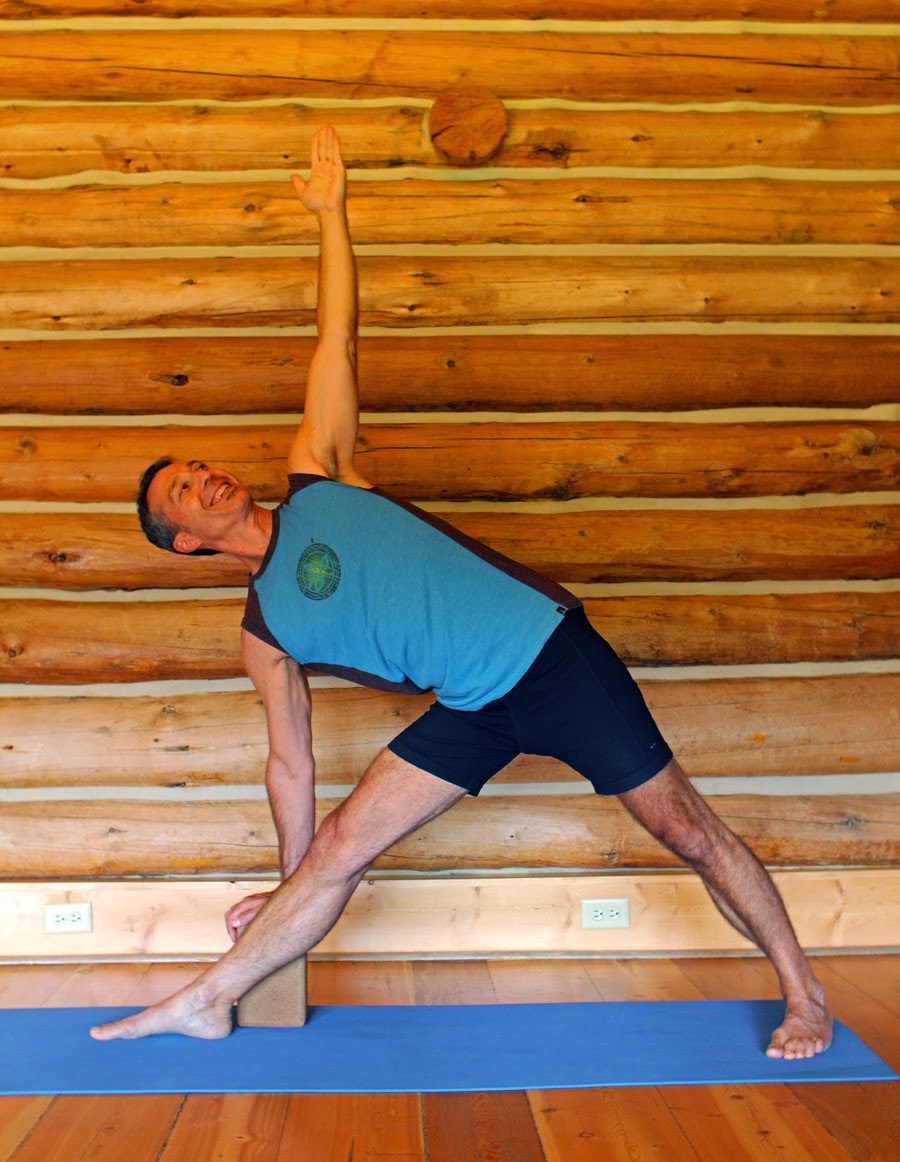
I like to think that Baxter and I have a pretty good idea of the range of physical abilities that yoga practitioners have in the real world. We’ve seen some pretty fancy stuff in person, such as crazy arm balances and impossible-looking backbends. But we also know that that the average person, especially the average middle-aged or older person, isn’t able to do the fancy stuff and sometimes even the classic stuff, such as Triangle pose (Trikonasana) with the bottom hand on the floor. In fact, even Baxter uses a block in that pose (and see how happy he looks!).
And because our blog is pragmatic, rather than inspirational or aspirational, we are committed to making sure the poses and sequences we describe are actually accessible to most people, if not all. (The exception would be some of our challenging sequences, such as the Challenging Agility Practice.) This is why recently Baxter and I have been working together on choosing a basic set of essential yoga asanas (you’ve been seeing some of those in our recent Featured Pose posts) with four different versions for each pose. 

The first version is always the classic version (done without props) of the pose. Then we provide three other more accessible versions. Sometimes the accessible versions use props, which help make the pose safer, more comfortable, or just plain doable for people (see 7 Reasons Why You Should Love Yoga Props). For example, this version of Upward Plank pose (Purvottanasana) with chair makes the pose accessible to people who can’t do the classic version without major straining or discomfort.
Other times, when a prop can’t really help, we simply change up the pose. An example of this is Side Plank pose (Vasithasana). In our post Featured Pose: Side Plank Pose, the first two variations of the classic pose, don’t use props but instead a slightly different shape to the pose (the first with a different foot position and the second with a different arm position): 
The final version reorients the pose completely, so you’re standing upright instead of balancing on the edge of your feet. 
Now you might be wondering why, if we’re so committed to being “accessible,” we don’t include chair versions of every single pose, such as Side Plank pose, so that people who can’t stand unaided, such as seniors and disabilities, can do all the poses. We do think that the chair versions of standing poses are truly wonderful and not necessarily for wimps (see In Praise of Chair Yoga). Here’s a good example of Warrior 2 done in a chair by the great teacher Eric Small:
Although in the future, we will include chair versions of some of the classic standing poses, we have decided not to include chair variations of every single pose because our blog is aimed at a different audience. Our intended audience is both middle aged and older people who want to use their yoga practice to foster healthy aging (see What is Healthy Aging, Anyway?). So we assume that you (or your students) can stand unaided, can get up and down from the floor, and are relatively healthy or are in recovery from illness. 

This is why even though many of our poses and practices can be used by people who cannot stand unaided and need to practice in chairs or wheelchairs (office yoga poses and some chair poses, breath practices, meditation practices, yoga philosophy), we don’t have specific instructions for these groups. Of course, we do think that yoga can provide great benefits to those populations, but that’s just not our target audience. But rest assured that are many great resources out there for these groups, whether that is Sam Dworkis’ book Recovery Yoga, Eric Small’s book on Yoga for Multiple Sclerosis (which has great photographs of chair and wheelchair yoga), or Timothy McCall’s Yoga As Medicine (which includes some excellent poses for people who cannot stand unaided). 

Subscribe to Yoga for Healthy Aging by Email ° Follow Yoga for Healthy Aging on Facebook ° Join this site with Google Friend Connect
Monday, April 20, 2015

Yoga Props We Can't Live Without

by Nina
A few weeks ago I wrote a post 7 Reasons Why You Should Love Yoga Props about why yoga props are so beneficial. Today I thought it would be a good idea to tell you exactly which props we recommend and why. (Just kidding about the “can’t live without” part because actually you can do a lot of yoga, especially when you’re traveling or stuck somewhere with absolutely no props at all, but I needed a catchier title than “Yoga Props We Generally Recommend.”)

Recommended Yoga Props
  • One yoga mat (a thin sticky mat, not a padded exercise mat)
  • Two blocks (wood, cork, or foam)
  • One eight-foot strap (with a buckle, if possible)
  • One sturdy chair 
  • One round yoga bolster
  • Two densely woven single blankets
Although you can find yoga props for sale at many yoga studios as well as on several web sites, you may not be able to—or wish to— make a major investment in buying “official” yoga props. So, in many cases, you may be able to make do by using things you already have around the house (see Making Your Own Yoga Props).

Yoga Mat. If you buy only one yoga prop, buy a yoga mat (also known as a sticky mat). A yoga mat provides you with the best surface practice yoga on, keeping you from slipping around, especially if you start to sweat. You can also use a yoga to keep other props, such as blocks or blankets, from slipping around by placing them on top of the mat. It’s also just generally useful. For example, you fold it up and use it to cushion for various bony parts of your body or as a firmer option for a blanket.
Yoga Blocks. You can use blocks to support different parts of your body, such as your hands or or your pelvis. For example, you may sit on a block while doing a seated twist or place both hands on blocks in Downward-Facing Dog (Adho Mukha Svanasana). And if you can’t easily reach the floor in a pose like Triangle pose (Trikonasana) or Standing Forward Bend (Uttanasana), using a block helps stabilize you and keep you from over-stretching. 
If you do not have blocks, you can use books or small boxes. However, be sure to use something that is firm rather than squishy so it can easily support the weight of your body. And make sure that for those poses requiring two blocks, that the two props you use are the same size. 

Yoga Strap. You primarily use a yoga strap to reach parts of your body that you cannot reach without overstretching or at all. For example, you can use the strap to reach your toes in Reclined Leg Stretch (Supta Padangusthasana) and to connect your hands in Cow-Face pose (Gomukasana) if you can’t make the clasp.
You can also buckle the belt into a loop and use the loop to bind your arms or legs together. For example, you can use a strap around your arms in Downward-Facing Dog pose to keep them into good alignment. If you do not have a yoga belt, you can use a tie or sash. For those times when you need to make a loop with the belt, you will have to tie your sash. 

Chair. You can use the chair for the “chair” versions of poses, such as twists and shoulder openers (see Featured Sequence: Mini Office Yoga Practice).
You can also use them to do higher versions of classic poses, such as Downward-Facing Dog pose (Adho Mukha Svanasana) and Upward Plank pose (Purvottanasana), to rest your head on while you’re in a supported forward bend, and to support your hand in standing poses if a block is too low. 
In certain classic supported inverted poses, such as Easy Inverted pose, Chair Shoulderstand, and Half Plow pose (Arda Halasana), and certain supported backbends, you will actually drape part of your body on the chair.
Chair, Blankets, and Sticky Mat All Together
You can use almost any sturdy chair for yoga, except one that has wheels, although for certain backbends you need a chair with an opening in the back that you can fit your legs through and for Half Plow pose, you need a chair without a bar across the front legs as well as a opening in the back. Most yoga studios use inexpensive office folding chairs, sometimes with the back removed, which are easy to obtain from an office supply store.

Bolster. How would we do restorative yoga without a bolster? (See Restorative Yoga: An Introduction.) For restorative yoga, you use your bolster to comfortably support your torso, pelvis, or legs, and if you’re flexible to rest your head on while you are in a seated forward bend. You can also use a bolster as a softer alternative in poses where you might normally use the support of a block.
If you do not have a bolster, you can roll one or two folded blankets to create a bolster substitute or you can use a stack of blankets folded into thin rectangles, depending on which shape is more appropriate.

Blankets. You can use folded blankets to sit on, to support your head in reclining positions, and to support and cushion your body in various ways. (A blanket is always good under your knees as shown above.) You can use rolled blankets for passive backbends and for your legs in restorative poses, and to substitute for a bolster when you don’t have one (or need more than one). 
If possible, use single-bed-size blankets of densely woven fabric, such as wool or cotton. Squishy or fluffy blankets, such as comforters or polar fleece blankets, do not provide the necessary support that you will need, as your body weight flattens them.

Happy propping!

Subscribe to Yoga for Healthy Aging by Email ° Follow Yoga for Healthy Aging on Facebook ° Join this site with Google Friend Connect

Friday, April 3, 2015

7 Reasons Why You Should Love Yoga Props

by Nina

Although we’ve heard that some yoga teachers say using props is “cheating” (see Cheating at Yoga?), we couldn’t disagree more. For us here at Yoga for Healthy Aging, props are quite simply a godsend. In fact, it took me some effort for me to whittle down the reasons why we think props are so beneficial—and loveable—to just seven. Yes, we love props so much because they:

1. Keep Us Safe. Using a prop can help prevent injuries caused by overstretching or misalignment. For some people—whether due to lack of flexibility or anatomy (short arms), reaching the floor is difficult and using a prop, for example, in Triangle pose (Trikonasana) or Half Moon pose (Arda Chandrasana) can make the difference between overstretching your hamstrings and keeping them healthy. And for people who are stiff or have back problems using a prop in a backbend like Camel pose (Ustrasana) can reduce stress in the low back. Someone whose arms are misaligned, with a carrying angle for example, can use a strap just above the elbows to prevent uneven wear and tear on the elbow joints in Downward-Facing Dog pose (Adho Mukha Svanasana). 
Camel Pose with a Bolster
2. Stabilize Us. For people with balance problems or who are weak, using props in standing poses can keep you from falling. You can use the wall (with a foot or hand on the wall) or you can support yourself with a chair. Even a block to support your hand can help stabilize you in the pose. 
Triangle Pose with the Wall
3. Allow Us to Breathe. Using a prop to achieve a healthy alignment—one in which your spine retains its natural curves and your chest is open— helps you to take deep and easy breaths. For example, if your hips are tight, sitting on a block or folded blanket allows you to maintain an upright posture, rather than collapsing your chest. Using props can also help reduce pain in a pose, like foot or knee pain in Hero pose (Virasana), and allowing you to be more comfortable, well, that makes breathing easier, too. 
Hero Pose with Block and Blanket
4. Let Us Heal. After you injure yourself or experience illness or surgery, using props allow you to gradually restore strength and flexibility to a challenged area. For example, someone recovering from a wrist injury could practice Downward-Facing Dog pose with hands on the wall, then hands on a chair, and then hands on blocks while moving through the healing process. 
Downward-Facing Dog with Chair
5. Let Us Relax. Without props, there wouldn’t be restorative yoga! In restorative poses, the props allow you to take the shape of a pose, such as backbend, twist or forward bend, without muscular effort so you can stay in the pose for long periods of time and relax deeply. And in more active poses using props in poses that otherwise push you to your absolute limits allows you to be comfortable—or at least more comfortable—while still obtaining the benefits of the pose. 
Supported Child's Pose
6. Empower Us. When you’re ready to progress beyond the basics, props can enable you take the first baby steps working toward a challenging pose. For example, practicing Warrior 3 (Virabradrasana 3) or Side Plank pose (Vasithasana) with a wall is a good way to get started working toward the classic versions of the poses. And how else could we work on One-Legged King Pigeon pose (Eka Pada Rajakapotasana) without blankets, blocks and a strap? 
Warrior 3 with the Wall
7. Enable All of Us! No matter what shape you’re in—even if you can’t get down to the floor, can't stand up or can’t move parts of your body—props allow you to take the shape of a pose and obtain the benefits of stretching, moving your joints, and breathing mindfully. (I once taught yoga to a paraplegic who had very tight shoulders and back pain from rolling his wheelchair with his arms.) As a matter of fact, my new motto is this: With yoga props, there is always a way.
Hunting Dog for Those Who Can't Kneel
For suggestions on how to make your own props using common household items, see Making Your Own Yoga Props.

Subscribe to Yoga for Healthy Aging by Email ° Follow Yoga for Healthy Aging on Facebook ° Join this site with Google Friend Connect

Tuesday, December 17, 2013

Cheating at Yoga?

by Nina

As I wrote in my post Practicing With Pain, sometimes we get a question from a reader that leaves me feeling sad. This one, from a reader who was accused by a teacher of “cheating,” came in just recently:

Am I a cheater if I use Props?
Cheat/Cheater: (Oxford dictionary): deceive, fraud, deception, a person who behaves dishonestly, a liar


Dear esteemed Writers /Teachers of this blog, I have been practicing yoga for nearly 20 years and have completed 500 hrs of teachers training. I have studied with several master teachers including Judith Lasater, Kofi Busia, Tony Briggs, Tim Miller, David Swenson among others. These days owing to some back and knee issues I use props when required since I know what’s good for me and what can hurt me. Last month I was in a class that saw a new teacher who introduced herself as a teacher with several years of experience and having studied from several well known teachers in this country and in India as well. Despite her impressive background, what surprised me was that in several hip and knee poses when I used the prop or the back wall as a support (for some balancing sequences) she would come to me and say “You are cheating; don’t cheat”. To me the word cheat meant that I was engaging in fraudulent behavior. At the end of the class I confronted her and sought out an apology from her which she refused to do. I have stopped going to her classes. Now my question to you is: Why is anyone a cheater if he/she uses a prop? Do we have to wait for a teacher to tell us to use these supports? If I know my body well and feel the need for a prop, why am I a cheater? Is the use of a belt/block/wall for poses that we feel comfortable akin to engaging in deceit or a dishonest act?


Anyone who has been reading this blog for any period of time—or who even just looks at the photos—knows that we do not consider using props to be cheating. In fact, we consider using props as needed for your body type and physical condition to be a very wise way to practice yoga. So, no, dear reader, we do not agree with the statement that the “use of a belt/block/wall for poses that we feel comfortable akin to engaging in deceit or a dishonest act.” See Yoga Props: An Introduction for a general overview of some of the props we recommend incorporating as needed into your practice.
Baxter protects his hamstrings from tearing by using a prop
I’d say that from our point of view, the only way to “cheat” at yoga is not to practice and then pretend you did. However, there are a lot of different styles of yoga out there, and not every tradition recommends the use of props. So it’s very possible that some of you, as our questioner experienced, may encounter a teacher who is unfamiliar with or does not believe in the use of props. That, of course, does not justify the rudeness of the teacher described above, and it seems wise to me that after such an unpleasant experience with this teacher, our reader decided not to return to class.

But I also think it is wise every time you take a class with a new teacher that you arrive a bit early, introduce yourself to the teacher, and briefly describe any physical problems you may have and let the teacher know you’ll be using props. I have mild arthritis in my right hip, so I always let the teacher know this and assure them, however, that I don’t need special attention as I know how to look after myself by using props and modifications. At that point, the teacher could make clear his or her particular philosophy regarding props, and it would be up to me—if props were discouraged or forbidden—to decide whether or not to take the class.

Subscribe to YOGA FOR HEALTHY AGING by Email ° Follow Yoga for Healthy Aging on Facebook

Wednesday, November 6, 2013

Yoga Props: An Introduction

by Nina

Just the other day, I got this interesting request for information on using props.

Another local yoga instructor and I live in a remote/rural area, and attending high quality trainings is difficult at best. We've been looking for a training that focuses on the use of props, but we've had no luck. We are wondering if you could address in your blog, or recommend a good book, about the use of props for seniors. We are looking to create a more supportive class for seniors without taking them straight to a chair.

Well, dear reader, you’re in luck. Because it just so happens that I was trained in the Iyengar style of yoga, and, in fact, the use of props is a modern invention generally credited to B.K.S. Iyengar himself! As the story goes, at the age of 18 (1937), Iyengar was sent by his guru, Krishnamacharya, to Pune to spread the teaching of yoga to “householders .” Observing that his new students—typically older and stiffer than the boys Iyengar had been training with at the Mysore Palace—were often  unable to find a healthy and comfortable alignment in the yoga asanas, Iyengar came up with the idea of using props, including blocks (called “bricks” in India), blankets, straps, bolsters, chairs and others, to help support the students in their poses. Ideally using a prop helps you achieve correct alignment in the pose when your body is not open enough or strong enough to do the pose without the prop. Here’s a photo of Baxter doing Triangle pose with his hand on a block instead of the floor. (To be completely honest, Baxter has tight hamstrings and these prevent him—along with a lot of other folks out there—from being able to do Triangle pose with his hand touching the floor.)
Triangle Pose with Block (on highest height)
I’m telling you all this because your best bet for learning how to use props from a teacher is to find an Iyengar yoga teacher (either official certified Iyengar or Iyengar-style), though I expect by now a lot of other types of teachers have adopted them, too. For those of you who don’t have access to a teacher who is an expert at using props, we do have some information on using props on the blog. Our restorative yoga poses, supported inverted poses, and supported forward bends all use them.

I also wrote a post Making Your Own Yoga Props that provides tips for using simple household items (such as books and sashes and bags of rice) in place of “official props.” And, inspired by this reader’s question, I’ll try to write more about props in the coming weeks.

In the meantime, you can learn from using props from yoga books. I’m going to be very bold and recommend one I co-wrote: Moving Toward Balance, the second yoga book I wrote with Rodney Yee. The reason I’m recommending this one is that we both put a lot of thought into how we presented the information on using props in this book. We included a very thorough overview of the types and purposes of props in the chapter “Preparing to Practice,” which even tells you how to fold yoga blankets! And we systematically provided an easy alternative for every single pose in the book, many of which use props. We also tried to keep the use of props very streamlined and simple because we were concerned that for people practicing at home, needing a large number of props to do a pose could be off-putting. Although these “easy” versions of the poses weren’t designed especially for seniors, I think you’ll find many of them totally appropriate versions that are in between the full version of the pose and doing yoga on a chair. And even the ones that don’t use props (such as the easy version of Warrior 2, which has hands on the hips and an only slightly bent knee) will be very suitable for older beginners.

I’ll also recommend The Woman’s Book of Yoga and Health, my most frequently used yoga book. The last section of the book, which is for older women, has some great examples of yoga poses done with props.

You can see classic Iyengar propping in Iyengar’s book Yoga, The Path to Holistic Health. Some of the propping in this book will be very useful to you, though some, well, may just be too complex and/or elaborate. The elaborate setups tend to be employed in specially equipped yoga studios by Iyengar teachers who are trained in their use.

Once you get into the swing of using props, you may find that you are coming up with your own inventions! My own teacher is constantly coming up with new ideas, which stem out of his personal practice. And I myself have come up with a few nifty ideas….

Subscribe to Yoga for Healthy Aging by Email ° Follow Yoga for Healthy Aging on Facebook ° Join this site with Google Friend Connect