How Much Protein You Need and

Pro Bodybuilders eat about one gram (sometimes even 1.5 grams) of protein per pound of body weight or per pound of non-fat tissue. I'm sure you've seen that the recommended dail

Comments

Thursday, September 26, 2013

Featured Pose: Chair Shoulderstand

by Nina

In her interview with us (see Judith Lasater on Yoga and Aging), Judith Lasater mentioned the poses that she currently practices, citing "especially Viparita Karanai (Legs Up the Wall pose), Supported Sarvangasana (Shoulderstand) on the chair and Supported Halasana (Plow pose) on the Halasana bench." In my post Judith Lasater's Favorite Poses, I talked about these poses and why, even though they may be a little tricky to learn, they're so worth the effort. On Monday, I described Supported Halasana in detail. Today, at last, I'm going to tackle Chair Shoulderstand! To be honest, when you first learn how to do this pose, it is one of the most challenging to get in and out of. So I normally teach people how to do Chair Shoulderstand in person. But I think it's worth having the instructions and photographs showing the process for those of you who may have seen a demonstration once and forgotten the steps, as well as for any brave souls who are willing just to give it a try.
Full Chair Shoulderstand (My Happy Place)
I certainly encourage you to try Chair Shoulderstand and, if you like it, to add it to your home practice because this variation of Shoulderstand will allow you experience the legendary "soothing" quality of Shoulderstand. Because you are completely inverted in this pose, the relaxation response will take effect quite quickly (see Why You Should Love Your Baroreceptors). Your neck is also flexed in the pose, which enhance the relaxation (see More Love for Baroreceptors). And you can use the supported version of Shoulderstand in place of full Shoulderstand in any sequence (or class) that includes full Shoulderstand.

Instructions: To do this pose, you just need a sturdy chair with four legs. It's okay if the chair has a bar between the front legs or a back panel.

1. Start by placing a folded yoga mat on the chair seat, letting part of the mat extend over the front edge of the chair. (If you're tall, you may need to place a folded blanket or two on the chair seat to support your pelvis.) Then place two yoga blankets, folded lengthwise into long rectangles, in front of the chair legs with the folded edges away from the chair. All the props should be on the floor, not on a yoga mat because when you come out of the pose, you'll need to slide the props. If you're nervous about doing the pose on your own, you could have a friend hold the chair steady for you just for psychological reassurance.

2. Next, sit sideways on the chair seat.
3. Steadying yourself with your hands, swing your legs over the chair back, keeping your knees bent.

4. Now comes the tricky part. Leaving your legs bent over the chair back (that part is really important as it prevents you from pulling the chair over), place your hands on the chair legs as you scoot your head and shoulders down toward the blanket. Keeping your legs over the chair back, allow your shoulders to come to rest on the edge of the folded blanket (they must actually touch the blanket, not hang in the air above it, so no cheating!) while the back of your head comes to rest on the floor (your neck should be free).
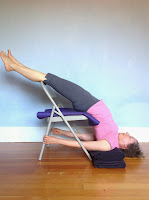
5. Once you shoulders are resting fully on the blanket stack, one at a time thread your arms underneath the chair seat and grab onto the back legs of the chair (while still keeping your legs on the chair back!). If you can't do this because your shoulders are tight or if you have broad shoulders, take your arms outside the chair legs and grab onto back legs of the chair from the outside.

6. Once you are holding onto the back chair legs with your hands—and only then!—you can bring one leg at a time off the chair seat into a vertical position.

Congratulations you've made it into a Chair Shoulderstand! If you're comfortable, stay in the pose for several minutes, as long or longer than you would in full Shoulderstand. I like to stay at least six minutes because after five minutes something magical happens, as I can actually feel my body and mind switch into relaxation mode. However, if the pose is uncomfortable or causes you any pain, come out of it. Think about what kind of changes you might make to your propping, such as adding another blanket under your shoulders (for example, if your neck feels uncomfortable) or on top of the chair seat (if your pelvis isn't well supported). Unlike Supported Halasana, Chair Shoulderstand is a pose in which most everyone can find a way to get comfortable, so it's worth taking your time to figure out the best way for you to do it. If you can't make it work on your own, consider asking your teacher to look at you in the pose and make some suggestions.

8. To come out of the pose, first bring your feet down onto the chair back.
9. Next, bring your hands onto the front chair legs.Then drop your feet onto the chair seat as you slide away from the chair (or push the chair away from you). 

10. Keeping scooting until you are back far enough so you can drop your pelvis onto the floor. Then shift the blankets under your head so you can rest for a few breaths in a comfortable position.

11. Finally,  roll over onto your side and rest there for a couple of breaths. When you're ready, use your hands to slowly push yourself up to a seated position, only raising your head when you are fully upright. Taking your time coming out of the pose helps you retain the quietness you cultivated while you were in the pose.

My greatest training aid: LIFTING CHALK. By Vic V. Goyaram

My greatest training aid: Lifting chalk
By Vic V. Goyaram
Lifting chalk is the single item which made the biggest difference in my training. I used to struggle with any exercise that required gripping heavy weights for extended periods of time, particularly deadlifts and shrugs. My palms would get sweaty very quickly and the bar would slip from my hands. I did try lifting straps but that felt very uneasy. Lifting chalk solved that problem, my back training got a massive boost and my forearm went from being a weak bodypart to one of my strongest assets. 
Magnesium Carbonate.
Tell you Chemistry teacher what it's used for!
 
For the chemistry-minded among you, lifting chalk is Magnesium Carbonate. Chalk has been used for a long time in athletic activities and sports like weightlifting, rock climbing and gymnastics as a gripping aid. Lifting chalk can come in the form of powders or blocks. The blocks are more convenient and can get less messy in case you happen to sneeze easily.  
In case you are wondering. Yes, I am in love with
Spanish weightlifter Lydia Valentin. 
Pros and cons of lifting chalk
Lifting chalk can leave traces about whose ass you have been patting in the gym and that's the only disadvantage that I can think of. You will find out most of the pros and cons by yourself. You can get chalk into the eyes of your training partner while spotting him on benches. You can also easily mess up the gym equipment and floor with lifting chalk and should that be a problem, just wipe it. Be considerate (for once) to the gym owner and other users of the gym. If you train at Planet Fatness in America you may also get kicked out and not earn your muffins or pat on the back.
In case you are wondering, again.
That's my hand print after kissing her
Don't steal your teacher's chalk (Calcium Carbonate)
Join us for discussions on our facebook group 

_________________________________________________________________________
©,2013, Veeraj Goyaram, Bodybuilding Mauritius. Any reprinting in any type of media is prohibited.
Disclaimer: The Content on this site is intended to be used for educational and entertainment purposes only. It is not intended to be and should not be interpreted as medical advice or a diagnosis of any health or fitness problem, condition or disease; or a recommendation for a specific test, doctor, care provider, procedure, treatment plan, product, or course of action. BODYBUILDING MAURITIUS is not a medical or healthcare provider and your use of this site does not create a doctor / patient relationship. We disclaim all responsibility for the professional qualifications and licensing of, and services provided by, any physician or other health providers posting on or otherwise referred to on this Site and/or any Third Party Site. Never disregard the medical advice of your physician or health professional, or delay in seeking such advice, because of something you read on this Site. We offer this Site AS IS and without any warranties.  Correspondence: vicgoyaram@gmail.com
________________________________________________________________________________

Wednesday, September 25, 2013

Yoga and Cycling

by Nina and Bridget

When I Drive a Flower Bicycle, I Will Have a Good Future
by Yu Youhan
As someone who walks and gardens a lot, I know how valuable it can be to use your yoga practice to balance your body after intense physical activity of a different kind. Our editor, Bridget Frederick, uses her yoga practice to balance her body from all the cycling she does. She has been completely bicycle dependent for the last 5 years, and has experienced her share of body aches as a result of riding 100 miles each week just to get where she needs to be. So she focuses her home practice on the areas that tend to take a beating on the bike (outer hips, shoulders, calves, hamstrings) to keep herself mobile while still commuting daily.

Because Bridget will  leading her third Yoga for Cyclists workshop on Saturday, May 24th, 2-5 pm at The Yoga Room, Berkeley, I thought it would be a good time to interview her about why and how she uses yoga to keep her body in balance.

—Nina

Nina: Why is yoga so beneficial for cyclists?

Bridget: Cyclists use their bodies in particular and repetitive ways while on their bikes. This leads to specific muscle tightness (quads, hamstrings, calves, shoulders), for which I’ve been using yoga poses as well as myofascial release to keep myself mobile while still commuting daily the last five years. Getting off the bike and really exploring these areas in depth, and especially learning a few key poses that you can do for yourself at home can lead to more comfort on and off the bike.


Nina: What are some of your favorite poses or practices for balancing your body after you've been cycling?

Bridget: Cycling tends to have the rider leaning forward (though some upright and recumbent bicycles address this issue) so slouching shoulders lead to tight chest muscles and back strain. I like to lie over a pair of blocks (one along the spine and one under the head on a higher level) for a chest opener, allowing my pectorals and biceps to widen and soften. Once my chest is open, strengthening my back and accessing more core strength is possible.

Outer hips and calves are important areas for me, so I do a lot of Supta Padangusthasana (Reclined Leg Stretch) at home, really focusing on getting some softening and opening in the hip crease of the leg I’m working with.
Pigeon pose is another one that really gets into the outer hip region, as well as the hamstrings. Many standing poses help with stretching out the calves, for example, Virabhadrasana I (Warrior 1) and Parsvottanasana (Pyramid pose). But I also have a whole series of calf stretches I do, sometimes starting off with some myofascial work to ease my calves into those poses.

My yoga practice has grown over the years because it works for me. A deeper understanding of anatomy and the connectedness of all parts of the body have made injuries much less frightening. I feel more in control of what's going on in my body and more able to address particular aches and pains, as well as support my dedication to being bicycle dependent.

Bridget's Yoga for Cyclists workshop is:
Saturday, May 24th, 2014 // 2-5 pm
The Yoga Room
2530 San Pablo Avenue, Berkeley, CA
$55.00
email bridget.frederick@gmail.com for more information

Tuesday, September 24, 2013

Aging, Telomeres, and Yoga: New Study by Elizabeth Blackburn and Dean Ornish

by Baxter

A while back, we reported on an interesting potential marker in the body for aging of the cells connected to the genes called a telomere (see Stressed Mind, Stressed Cells and Science, Aging and Yoga). A telomere is like a tail on the end of DNA strands found in our cells, and an enzyme called telomerase influences the length and activity of the telomere. Studies done a few years ago by a Dr. Elizabeth Blackburn at UCSF in San Francisco began to show a connection between telomeres and cell longevity—the longer the telomere, the longer the cell life. Her work garnered her a Nobel Prize in Medicine.
Telomere Caps
Now Dr. Blackburn has teamed up with Dr. Dean Ornish to see what effect his life-style changes approach to prostate cancer has on telomeres and telomerase activity. Dr. Ornish has already shown that a combination of dietary changes (vegan diet with less than 10% fat per day), exercise in the form of walking for 30 minutes most days, and stress management tools that include regular yoga asana and breath work, mindfulness meditation and once a week group stress reduction sessions can reverse heart disease and diabetes, and can stabilize prostate cancer and stop its progression.

In their most recent study, published in Lancet Oncology (see Effect of comprehensive lifestyle changes on telomerase activity and telomere length in men with biopsy-proven low-risk prostate cancer: 5-year follow-up of a descriptive pilot study), the two researchers looked at how the lifestyle program impacted the cellular genetic level in regards to telomere length and enzyme activity. What they found was that the 10 men studied had longer telomeres in the short (as quickly as three months!) and long run, if they stuck to the program, and the 25 men who were controls had shorter telomeres. And they also looked at gene activity in their ten study subjects, and found that 500 genes were turned on, and all were beneficial, according to Ornish. 

Even though telomeres may be an indicator of longer cell life, and by extension, longer overall lifespan, this has not been definitively concluded, so more studies will need to be done, looking at much larger numbers of people. But the early evidence is promising, and even if the telomere/aging cell theory does not pan out, it seems evident that yoga, diet, exercise and stress management do have significantly positive impacts on health, disease progress or remission, and are therefore worth the effort. And as Dr. Ornish noted, his study participants found the lifestyle plan easy to follow, with 85-90% compliance, much better than most pharmaceutical based treatment plans. Why, you might ask? Well, has he says, it’s because it’s pleasant and comprehensive and “most people feel so much better they change their lifestyle.”

To read more, you can check out articles at ucsf.edu and today.com—among others—which reported these new findings.

Subscribe to YOGA FOR HEALTHY AGING by Email ° Follow Yoga for Healthy Aging on Facebook 

2013 Mr. Olympia Preview. By Vic Veeraj Goyaram

2013 Mr. Olympia preview
Who will be the last man standing?
By Vic V. Goyaram

Sadly this will be the first Mr. Olympia without both Joe and Ben Weider, the fathers of this contest. Joe Weider passed away this year at the age of 93 after decades promoting the sport of bodybuilding worldwide. 

The 2013 Mr. Olympia year's lineup is more impressive than ever as both the quality and number of top-level competitors. Most of us also didn't realise that there will be three Mr. Olympias battling it out in the lineup, namely Jay Cutler, Dexter Jackson and defending champion Phil Heath. It is difficult to make predictions about the winner and that's the reason why I am picking my top 10. Whether you agree or disagree with my selection, feel free to join other members in discussing your favourite picks on our facebook page Bodybuilding Mauritius.

My top 6 (In no particular order)

Jay Cutler
Cutler has space on his mantel for a 5th Sandow trophy
Eyes will be on Jay Cutler for his comeback. He last competed at the 2011 Mr. Olympia with a torn left biceps. Jay is able to do the unimaginable: claim back his title after having lost it twice. He has the experience and the physique to do so and he knows how to peak at the Mr. Olympia. He looked "sick" in his recent pictures. Go Cutler!


Stakes to win: Rs. 100 pou Rs. 400

Dexter "The Blade" Jackson
Dexter, this year's Arnold victor still has a lot left in him. Top 6 all the way!
At the age of 42 Dexter Jackson still has a lot left in him. Dexter has an impressive track record at the Mr. Olympia and he equaled Flex Wheeler's record of 4 wins at the Arnold Classic this year. He also placed an impressive 4th at the 2012 Mr. Olympia when most of us thought that he was done.The Blade has also been working with trainer extraordinaire Charles Glass, by the way. Go Dexter!


Stakes to win: Rs. 100 pou Rs. 600

Kai "The Predator" Greene
The hero of "Generation" may well be the hero on the Mr. Olympia stage
Last year Kai Greene had a very lean offseason and he surprised us by his awesome conditioning and his new streamlined physique. However, he was not as full as Phil Heath and he suffered in the most muscular shots because he didn't have the overwhelming delts that Heath brought to the stage. Greene also somewhat battled with energy onstage (my observation) although he ruled the same stage. This year, under the guidance of George Farah, Greene had a lean offseason but he is a lot bigger than last year. It will be interesting to see how he does. Go Kai Greene!


Stakes to win: Rs. 100 pou Rs. 300

Mamdouh "Big Ramy" Ellsbiay
Will BIG Ramy bring the title to Kuwait?
Big Ramy makes this whole thing interesting because for a long time the sport needed a new face to challenge the top runners.  Ramy is not all talk, he has the physique to challenge everyone. He has competed in only one pro contest so far, with an easy win over Victor Martinez who was far from his best. For sure, Big Ramy remains untested in the big shows but untested or not this guy has the potential to be an Olympia winner, with a thin waist for such a big guy. Never before has a guy who has done only one pro show going into the Mr. Olympia has got so many competitors so worried. In my opinion, it is also time for Big Ramy to get rid of that gyno through surgery. I wonder why Dennis James hasn't done anything about this so far. Go Big Ramy.


Stakes to win: Rs. 100 pou Rs. 400

Phil "The Gift" Heath
The defending champ thinks that "hard work does not beat talent"
No matter how strong his challengers are, I think Phil Heath has this one. He will win it for one reason: Never in the history of bodybuilding has a pro bodybuilder earned the moniker "The Gift". I do not mean that the judges will steal the title from other and gift it to him; I mean that Phil Heath is simply too good. And please pardon my English, from recent sightings in a facebook video, Heath looked sick as fuck. Go Heath!


Stakes to win: Rs. 100 pou Rs. 150

Shawn "Flexatron" Rhoden
Did Uncle Ronnie Coleman work magic on the Flexatron?
We haven't seen much of Shawn Rhoden so it will be difficult to predict whether he has added the needed size to challenge the top runners. Nevertheless, Rhoden comes from an excellent 3rd place at the 2012 Olympia and a string of pro wins. Rhoden has very good aesthetics and some really solid bodyparts but his back needed some more improvement as well as his overall size. By himself and in any pro lineup Rhoden is a major threat but to win the Olympia won't be an easy task but then he has Uncle Ronnie Coleman in his corner. Rhoden is one of my favourite athletes. Go Rhoden!


Stakes to win: Rs. 100 pou Rs. 500

The battle for the top 10

Branch "The Texas Shredder" Warren
Branch Warren IS BACK
Branch, or more appropriately, "Tree Trunk" warren had an impressive 5th place showing at last year's Olympia after his knee injury. His legs were clearly down in size but he did manage to bring his trademark solid conditioning. It is important to note that Warren has had an impressive last 4 years in the pro ranks with a 2nd place at the 2009 Mr. Olympia, a 3rd place at the 2010 Olympia and wins at the 2011 and 2012 Arnold Classic. Branch Warren is a blue collar bodybuilder who isn't gifted in terms of aesthetics but he does his best with what he has against the Gods of aesthetics and that's what bodybuilding is all about.

Dennis "The Big Bad" Wolf
Will The Big Bad Wolf finally huff and puff and bring the whole house down?
The Big Bad Wolf amazed everyone at the 2007 Olympia and should have been as high as 3rd or second. In subsequent Olympias he placed 4th, 5th, 5th and 6th with a no-placing in 2009. He also had a decent year in 2012 with a win over Rhoden at the Prague Pro, cutting short the latter's winning streak. It is high time Wolf does something in order to not sink in the placings. I would like to see Wolf do well and get his dues. Go Wolf!

Evan "The Ox" Centopani
Evan the Ox is all set to do better than his 8th place finish last year
It is hard to believe that Evan has competed in only 5 shows since turning pro at the 2007 NPC Nationals. He won 2 of these 5 shows. Evan is as big as a house and is a wise bodybuilder. He has a great future. And yes, he placed 8th last year in his Olympia debut. That's very decent! Go the OX.

Toney "The X-Man" Freeman
As the oldest competitor in this show The X-Man can still make the top 10
Mad props to the X-Man Toney Freeman for still bringing an awesome physique in the pro ranks at the age of 47. He can crack the top 10. He placed in the top 10 in his last 10 showings anyway and was 7th last year. Go X-Man!


Who can also make the top 10?

Victor "The Dominican Dominator" Martinez
Will Victor be able to regain quickly enough to be better than his former self at the Olympia?
I can't help it, whenever I think of the Mr. Olympia and Victor Martinez I have to think of 2007 when he was the deserving winner but still lost to Cutler. After his incarceration, he placed second to Big Ramy at the 2013 NY Pro, clearly down a lot in size. People were quick in writing Victor off but had Victor been in his 2007 Olympia shape and size then Ramy would have had a very tough time. I am not sure whether Victor can regain his size in such short time to be competitive at the Olympia. But he still has a lot left in him. Go Victor!


Lionel Beyeke
Beyeke will make France and Cameroun proud on Olympia night
Allez la France et Cameroun!
Lionel Beyeke has round and generous muscle bellies reminiscent of his look-alike, Kai Greene. However his problem has been conditioning and his recent switch from Hany Rambod to Dennis James has paid off in terms of his placings in 2013. I am sure Dennis James is working hard on Beyeke as his recent facebook picture updates can attest. Beyeke has great potential to be a frontrunner in bodybuilding. If only the passionate French sports commentators could comment on the Mr. Olympia, we'd have interesting commentaries. Vas-y Lionel, Vas y la France!

Join us for discussions on our facebook group 

_________________________________________________________________________
©,2013, Veeraj Goyaram, Bodybuilding Mauritius. Any reprinting in any type of media is prohibited.
Disclaimer: The Content on this site is intended to be used for educational and entertainment purposes only. It is not intended to be and should not be interpreted as medical advice or a diagnosis of any health or fitness problem, condition or disease; or a recommendation for a specific test, doctor, care provider, procedure, treatment plan, product, or course of action. BODYBUILDING MAURITIUS is not a medical or healthcare provider and your use of this site does not create a doctor / patient relationship. We disclaim all responsibility for the professional qualifications and licensing of, and services provided by, any physician or other health providers posting on or otherwise referred to on this Site and/or any Third Party Site. Never disregard the medical advice of your physician or health professional, or delay in seeking such advice, because of something you read on this Site. We offer this Site AS IS and without any warranties.  Correspondence: vicgoyaram@gmail.com
________________________________________________________________________________

Monday, September 23, 2013

Featured Pose: Supported Plow Pose (Arda Halasana)

by Nina
In her interview with us (see Judith Lasater on Yoga and Aging), Judith Lasater mentioned the poses that she currently practices, citing "especially Viparita Karanai (Legs Up the Wall pose), Supported Sarvangasana (Shoulderstand) on the chair and Supported Halasana (Plow pose) on the Halasana bench." In my post Judith Lasater's Favorite Poses, I talked about these poses and why, even though they may be a little tricky to learn, they're so worth the effort. Today, at long last, I'll actually get into the nitty gritty details of how to get into and out of Supported Halasana, which Judith does with the Halasana bench.

If you don't have a Halasana bench (very few of us do!), you need a chair that has no bar between the two front legs because you need to be able to get your head underneath the chair seat. And you also need a chair that either has no back panel or that has a space between the panel and the seat that is large enough to fit your legs through (I'm on the small side, so I use a chair that still has a back panel).

Start by placing two folded blankets (folded as if for Shoulderstand) with the folded ends against the chair legs. Place a folded yoga mat on the chair seat for cushioning. Then lie down on your back, with your shoulders a couple of inches from the folded edges of the blankets (your shoulders will move toward the edge of the blanket when you go up), your head underneath the chair seat, and your knees bent with the soles of your feet on the floor. Lengthen your arms along the floor, with your fingers reaching toward your toes.
To come up into the pose, press your hands into the floor and swing your legs up and onto the chair seat. Scoot your legs through the chair back until your thighs rest comfortably on the chair seat. If necessary, you can steady the chair as you scoot your legs through the chair back by taking your hands onto the front chair legs. When you are settled, bring your arms up toward the chair seat, bend your elbows, and rest your arms on the floor outside of the chair legs.
(With the Halasana bench, there is no chair back to worry about so it is easier to get in the pose, however, the bench has sides so your head is closed in by the box.)

Make sure that your thighs are relaxing onto the chair seat, and that your back is near vertical (it can be slightly rounded). If you are tall, you may need to add some height to the chair seat to support your thighs (that will mean getting out of the pose, adding blankets on top of the chair seat. This photo shows a second way to do the pose, with extra height on the seat (for a tall person) and bent knees:
Congratulations you've made it into a Supported Halasana! The pose should be quite comfortable. Ideally you should be able to remain in the pose for several minutes (I stay about four) to allow the relaxation response to take full effect. Hanging upside down from your hips will also provide a lovely release of your back, as your spine lengthens with gravity. However, if the pose is uncomfortable or causes you any pain, come out of it. Think about what kind of changes you might make to your propping. If you find that you just can't get comfortable, for example, if your neck is stiff and can't bend deeply, this pose might not be for you.

To come out of the pose, bring your hands back down by your buttocks. Then press your hands into the floor as you slowly scoot your legs off the chair seat and swing them down, with bent knees, back to the floor.
When your feet are back on the floor, slide out from under the chair so your head is on the blanket stack and your shoulders are resting on the floor. Then slowly roll over onto your side and rest there for a couple of breaths. When you're ready, slowly use your hands to push yourself up to a seated position, only raising your head when you are fully upright. Taking your time coming out of the pose helps you retain the quietness you cultivated while you were in the pose.

Friday, September 20, 2013

Friday Q&A: Autism and Yoga

Hidden Flower by Brad Gibson
Q: I am a Yoga therapist in Minnesota. A family member has been given a diagnosis of Autistic Spectrum Disorder. I found very little on the IAYT publications and I also found little references on your blog for this problem. She is a 14-year-old girl who is very gifted with eye-hand coordination and physical activities, so I have few worries about doing postures and easy pranayama.

But before I design a practice regimen for her, I am wondering if any of your professionals have any advice or can blog as to contra-indications and concerns as I found not much reference to these on any of the established yoga sources I currently have access to?


A: This is a topic we have not previously addressed here at YFHA, and as for my practice, I have not worked with any individuals with this diagnosis, and I am not aware of any incidence of my fellow writers at YFHA working with this either. However, it would still be worth defining what this condition is and taking a look to see if there is any information about using yoga as a tool for improving the function and quality of life for those affected. The NIH website defines autism as follows:

“Autism is a group of developmental brain disorders, collectively called autism spectrum disorder (ASD). The term "spectrum" refers to the wide range of symptoms, skills, and levels of impairment, or disability, that children with ASD can have. Some children are mildly impaired by their symptoms, but others are severely disabled.
 

Five disorders, sometimes called pervasive developmental disorders (PDDs), [make up] ASD:
 

•    Autistic disorder (classic autism)
•    Asperger's disorder (Asperger syndrome)
•    Pervasive developmental disorder not otherwise specified (PDD-NOS)
•    Rett's disorder (Rett syndrome)
•    Childhood disintegrative disorder (CDD)."


I won’t go into details about the differences between the five disorders, but this link to the NIH site  will allow you to learn more if it is of interest to you. At this time, scientists don't know the exact causes of autism. The research to date suggests that both genes and environment play important roles in the development of autism.

As I was thinking about considering working with a student with autism, the various kinds of symptoms these students have could help or hinder a teacher’s attempts. The symptoms of autism can vary from one child to the next, but there are 3 general categories that symptoms fall into:
  • social impairment
  • communication difficulties
  • repetitive and stereotyped behaviors.
Any of these could present real challenges for the uninitiated yoga instructor.  For example, regarding “social impairment” and how this could affect trying to teach yoga to someone with autism, ASD suffers tend to look and listen less to people, leading to a failure to respond to other people. This could call for some very creative approaches to teaching! To see all that the NIH has to say about ASD, see here.

In addition to finding good resources for better understanding autism, I also came across at least two studies that have been done on yoga and autism. One study done in 2012 showed that yoga helped improve school performance and sustained attention in children with autism. Another study done in 2011 showed that yoga relaxation, dance and music therapy helped treat behavioral problems and other autism symptoms. I also came across a 2010 abstract from an ayurveda journal that indicated the positive potential for applying yoga tools to the condition of autism.

Additionally, I found at least one book on Amazon.com specifically on yoga for children with autism, as well a few websites devoted to the subject. And a year ago, in the Huffington Post, Elaine Gavalas devoted a post to this very topic and cited several of the studies above. There is even a dedicated yoga program in Madison, Wisconsin, called YogAutism, which teaches classes to those with ASD, as well as training others interested in assisting in their classes. Their website is yogautism.org.

So, although I don’t have specific recommendations or cautions for our questioner today, I am pleased to have come across so much promising information about the positive potential for yoga and autism and hope the links provided are helpful to any others out there interested in working autism. And always, I welcome any experience our readership has on this topic via our comments.  So, readers, please contact us if you have any information to add to this discussion!

—Baxter