


by Beth Gibbs
Gestures of the hands, face, and body are common in our everyday life. They can communicate moods and intentions that go beyond language. In some cultures crossed arms signal an attitude of defensiveness, palms together in front of the heart can mean devotion, and a bowed head can send a message of grief or sadness. Because I love metaphors as a way to help me understand new information, once I grasped the basic principle of mudras, I searched for a metaphor to make the information personal and memorable. It took a while but when I finally gave up my flip phone, bought a smart phone, and used the GPS function for the first time to get directions to a workshop I was attending, the light bulb went off. GPS! Global Positioning System! Simply put, at least for me, it goes like this:
Mudras can be thought of as a global positioning system for realizing a desired quality. Consciously place the hands in a particular position, pay attention, and allow the mudra to bring forth the quality.
Now I practice mudras regularly and can definitely feel their effects. Here are three of my favorites.
Adhi Mudra
 The Sanskrit word adhi means “primordial” and refers to our natural state of being. The gesture is said to bring the breath to the base of the body, help with anxiety, and instill a deep sense of grounding and stillness.
Instructions:
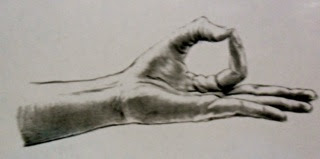 The Sanskrit word jnana means “wisdom.” Clear seeing, focus, and concentration are the qualities that this mudra brings to realization. Jnana mudra directs the awareness to the third eye, the space between the eyebrows. This is perhaps one of the most well-known mudras used for meditation.
Instructions:
 The Sanskrit word hakini means “power, dominion or rule.” The quality realized here is balance and integration. This mudra facilitates full yogic breathing and supports overall health and healing.
Instructions:

 |
| From Mudras for Healing and Transformation by Joseph & Lilian LePage |
When Joseph LePage, my primary yoga teacher, first introduced hand mudras into the Integrative Yoga Therapy Training program, I resisted. I simply did not get it. But having been raised a “good girl” with respect for teachers, I went along with the program. He introduced them. I listened. I practiced. And I felt nothing. Nada. No energy shifts, no sensations, no nothing. So much for mudras, I thought.
Then about three months later, I found myself in a stressful situation. My hands automatically moved into one of the grounding mudras I’d been practicing and WOW!!! There it was. My palms tingled, my breath slowed, and I felt a sense of calm in the middle of that most uncomfortable situation. It actually worked. I was amazed and delighted.
So, what are mudras exactly? The common English meaning of the word is “gesture,” or “seal.” The word in Sanskrit means “to bring forth pleasure or enchantment.” Mudras are thought to have arisen spontaneously from the deep meditative states experienced by the ancient Indian sages. Mudras can be used to recognize a quality, attitude, or energetic state that is already present within and waiting to be awakened. Examples of some desirable states for most of us modern humans are calming, energizing, focus, or balance.
Gestures of the hands, face, and body are common in our everyday life. They can communicate moods and intentions that go beyond language. In some cultures crossed arms signal an attitude of defensiveness, palms together in front of the heart can mean devotion, and a bowed head can send a message of grief or sadness. Because I love metaphors as a way to help me understand new information, once I grasped the basic principle of mudras, I searched for a metaphor to make the information personal and memorable. It took a while but when I finally gave up my flip phone, bought a smart phone, and used the GPS function for the first time to get directions to a workshop I was attending, the light bulb went off. GPS! Global Positioning System! Simply put, at least for me, it goes like this:
Mudras can be thought of as a global positioning system for realizing a desired quality. Consciously place the hands in a particular position, pay attention, and allow the mudra to bring forth the quality.
Now I practice mudras regularly and can definitely feel their effects. Here are three of my favorites.
Adhi Mudra

Instructions:
- Sit with your spine comfortably aligned.
- Soften your chest and shoulders.
- Close your eyes or keep them slightly open and gaze down at the floor.
- With both hands, form soft fists by placing your thumbs across your palms and folding your fingers around your thumbs.
- Rest your hands, knuckles down, on your knees or thighs.
- Hold the mudra and sit quietly for 2 - 5 minutes as long as you are comfortable.
- Focus on your natural breathing process.
- When you are ready to come out, release the mudra and stretch your body in any way that your body needs to stretch.

Instructions:
- Sit with your spine comfortably aligned.
- Soften your chest and shoulders.
- On both hands, touch the tips of your index fingers to the tips of the thumbs. Your thumbs and index fingers will form a soft round circle.
- Relax the backs of your hands on your knees, with the middle, ring and pinky fingers extended.
- Close your eyes or keep them slightly open and gaze down at the floor.
- Hold the mudra and sit quietly for 2 - 5 minutes as long as you are comfortable.
- Focus on your natural breathing process.
- When you are ready to come out, release the mudra and stretch your body in any way that your body needs to stretch.

Instructions:
- Sit with your spine comfortably aligned.
- Soften your chest and shoulders.
- Hold your hands facing each other a few inches away from your solar plexus.
- Touch the tips of the fingers and thumb of your left hand to the corresponding fingers and thumb of your right hand.
- Create space between your hands as though you are holding a ball.
- Relax your hands in your lap, with the pinky sides of your hands, your wrists, and your forearms on your thighs or in your lap.
- Close your eyes or keep them slightly open and gaze down at the floor.
- Hold the mudra and sit quietly for 2 - 5 minutes as long as you are comfortable.
- Focus on your natural breathing process.
- When you are ready to come out, release the mudra and stretch your body in any way that your body needs to stretch.
Beth Gibbs, MA, E-RYT 500, is a certified yoga therapist through Integrative Yoga Therapy. She is a senior member of the IYT teaching faculty and directs the school’s Professional Yoga Therapist Internship Program. Beth has a Masters degree in Yoga Therapy and Mind/Body Health from Lesley University in Cambridge, MA, and has served on the Educational Standards Committee for the International Association of Yoga Therapists. Her website is: proyogatherapeutics.com.
Subscribe to Yoga for Healthy Aging by Email ° Follow Yoga for Healthy Aging on Facebook ° Join this site with Google Friend Connect


