How Much Protein You Need and

Pro Bodybuilders eat about one gram (sometimes even 1.5 grams) of protein per pound of body weight or per pound of non-fat tissue. I'm sure you've seen that the recommended dail

Comments

Showing posts with label flexibility. Show all posts

Thursday, January 28, 2016

Techniques for Cultivating Flexibility with Yoga

by Nina
De Jur, Age 57
After delving into strength (see Techniques for Strength Building with Yoga), Baxter and I immediately moved onto flexibility. Now, after our usual time spent on research, discussion, and debate, we’ve come up with a basic set of guidelines for how you can use your yoga practice for improving and maintaining flexibility. 

An important thing to consider when you move into flexibility practices is how flexible you already are. Overly flexible people should emphasize strength and stability rather than promoting more flexibility. These people should do what they can do protect their joints by activating the muscles that support their joints (see below) and stretch less intensely than people who are naturally tight or even just average. Tighter people can safely move into a noticeable stretching sensation, as long as they are not feeling that sensation at tendon/bone connections near the joints. 

How Far to Stretch. Be mindful in your stretching not to go beyond the sensation of a healthy stretch into feelings of pain, burning, or compression in your joint. If you experience sensations that seem unhealthy, either back off the stretch or use a prop or different variation of the pose. Overly flexible people should be extra careful, aiming for a lighter feeling of stretch (or even do the pose for strength instead flexibility by actively contracting their muscles instead of allowing them to stretch).

How Long to Stretch. To cultivate long-lasting flexibility in your muscles and fascia, aim for at least 90 seconds. If holding for 90 seconds isn’t possible, it might be an indication that you are: stretching your muscle too far or that the opposing muscles are contracting too tightly, that the initial intensity of your stretch set off a strong stretch reflex, or that you are doing a pose or a version of the pose that is too challenging for you. So start by seeing if you can back off the stretch a bit or modify the pose. But if you just can’t get comfortable, hold the pose until you are fatigued, and gradually over time work your way up to longer holds. 

Static poses held for shorter periods of time will release the overnight tightness that we all experience and bring you temporary flexibility that will enhance the rest of your practice. For example, you could warm up for standing poses by doing leg stretches. Hold these warm-up stretches for 20 seconds or longer to trigger a relaxation in the muscles, allowing a more complete stretch. 

How Often to Stretch. To cultivate lasting flexibility, stretch a particular muscle or muscle group regularly, at least three times a week and at most every other day. In general, with consistent practice, you can see results after 3 to 8 weeks for muscles. For fascia, however, it takes longer to create lasting changes, from 3 to 6 months.

Muscles need a day of rest between stretching sessions or you could develop an overuse injury. So generally you shouldn’t stretch the same muscle group on consecutive days. However, you can do flexibility poses every day if you focus on different areas of your body on each day, for example, alternating between upper body and lower body or between backbends and forward bends. Or, you can alternate intense stretching days with other types of yoga practice, whether that is active strength, balance, or agility practices, a gentle or restorative practice, or pranayama/meditative practice on your “off days.” 

Static Poses. Entering into static poses slowly will allow elastic muscle lengthening to take place more easily. And, once in the pose, you can add in muscle activation on the opposite side of the joint to enhance the stretch (see below). 

Dynamic Poses. Slow, dynamic movements in and out of poses allow gradual muscle lengthening without triggering the muscles’ protective stretch reflex. So these are a good way to warm up your joints in an easy fashion and can lead to immediate improvements in muscle flexibility, which you can then further with your static hold of the same pose. For example, you practice Standing Forward Bend (Uttanasana) dynamically to temporarily improve hamstring/hip flexibility, which you then further with a long hold of the pose. In general, we recommend a combination of small dynamic sequences of stretches done for 6-8 repetitions, followed by holding the stretch statically for 90 seconds. 

Restorative Poses. Poses where you can relax as you gently stretch your body in a supported position are an excellent way to cultivate flexibility. For example, holding Supported Backbend for at least 90 seconds allows you to gently open your front body. Likewise, holding Supported Child’s pose for at least 90 seconds allows you to gently stretch your back body. And because fascial planes run for long distances through your body, using a supported pose that stretches your entire body (front, side, or back) will help address fascial tightness as well as muscular tightness. 

Balance Your Practice. To balance your flexibility, make sure your practice includes poses of all the basic types: standing poses, seated hip openers, backbends, forward bends, and twists, as long as they are safe for you. Of course you don’t need to do all these basic types within a single practice; just try to get to them sometime each week.

Activating Muscles. In static stretches, intentionally contracting the muscles on the opposite side of the joint—known as reciprocal inhibition—allows the muscle group you stretching to lengthen more effectively. So when you are stretching a particular muscle, bring your awareness to the antagonist muscle, which is the opposite muscle to the one you are stretching, and gently activate it. For example, when stretching your front thigh muscles in a Lunge pose, try consciously activating the back of your thigh. If you’re not used to working this way, it may take some practice. Take it in two steps: 
  1. Consciously relax the muscle, allowing it to lengthen. 
  2. Gently firm the muscle toward the bone. 
Protecting Your Joints. For people with joint problems, such as arthritis, consciously firming the muscles that support a problem joint will help protect the joint from strain or wear and tear. For example, if you have knee arthritis and are practicing Reclined Leg Stretch (Supta Padangusthasana), you could firm around your knee joint as you bring your top leg into the pose and try to maintain that firmness as you stretch the back of your thigh. 

For people who are overly flexible and can bend easily into deep forward bends and backbends, consciously activating the muscles that are supporting you in the pose will prevent you from hyperextending the joints. For example, in Standing Forward Bend (Uttanasana), you can protect your hip joints by activating the muscles around your hip joints before you enter the pose and maintain as much of that as you can while you come into the pose. While the result will be a stretch that is not as deep as usual, your hip joints will benefit. 

And just as over-stretching can cause joint problems in an active pose, it can also do so in restorative poses. So if you feel any sensations of overstretching, pain, pinching, or compression while you are in a restorative pose, come out and add more support, reducing the stretch you are experiencing. Likewise, if you notice pain in your joints after practicing restorative poses, add in more support the next time you practice.

Subscribe to Yoga for Healthy Aging by Email ° Follow Yoga for Healthy Aging on Facebook ° Join this site with Google Friend Connect

Tuesday, January 26, 2016

Flexibility Varies: Are You Tight or Flexible?

by Baxter
As you can see from these photos, anyone observing Nina and me practice Standing Forward Bend (Uttanasana) would immediately see that even though we’re both long-time practitioners, our ability to stretch the muscles in the backs of our legs varies greatly. Yes, it turns out that flexibility among people varies, and often quite a bit! Some people are naturally tight, some are naturally flexible, and others are overly flexible. 

There are three factors that influence our flexibility:
  1. Joint stabilizing structures of the joint capsule and ligaments might have more or less flexibility. (You might detect this by sensing limitation or restrictions near to your joints.) 
  2. Muscle length or fascial tightness. (You might detect this by sensing the limitation or restriction mid-muscle or along the length of a muscle group.) 
  3. Disease processes that affect flexibility, like generalized arthritis or Parkinson’s disease, which can gradually decrease flexibility over the long haul. Certain rare conditions can have more extreme effects on flexibility, such as Ehler-Danlos Syndrome, which makes people hyper-mobile and scleroderma, which makes people severely restricted. 
When you practice for flexibility, you should take all of these factors into consideration. If you’re naturally tight or have average flexibility, we recommend you begin with dynamic poses to warm up and release your overnight tightness, and then practice static stretches that you hold for least 90 seconds, if possible, to increase your chances of increasing your resting muscle length and improving your range of motion. 

If you are overly flexible, attempting to become more flexible may actually be dangerous, as you risk of worsening the lax support your joints already have. So even though being more flexible would enable to do super bendy poses with greater ease, we recommend that you focus on strength instead. Include more strengthening poses in your practice, and use isometric contractions around your joints in all your poses (see Why and How to Activate Your Muscles in Yoga Poses), including your stretching poses. 

Although there is no official standard for “average flexibility” means, you can assess yourself by doing the following basic poses and comparing your range of motion and flexibility with those of fellow practitioners, or have your teacher watch you do them and ask for their feedback assessment:
  • Standing Forward Bend (Uttanasana) 
  • Crescent Moon pose 
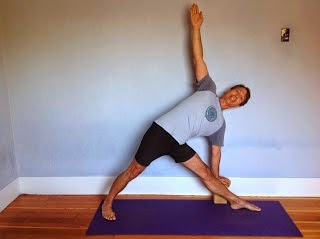
  • Triangle pose (Trikonasana) 
  • Lunge pose (Vanarasana) 
  • Bridge pose (Setubanda Sarvangasana)
  • Cobbler's pose (Baddha Konasana)
  • Easy Sitting Twist (Parsva Sukasana) 
Beware, however, that just as there is no set standard for “average flexibility” means, that within an individual, flexibility can vary quite a bit from joint to joint. For example, you might be flexible in the shoulders but tight in the hips or vice versa. So be careful not to label yourself as stiff or flexible without a good examination of your flexibility in all areas of your body. In addition, certain medical conditions can temporarily limit flexibility in specific areas of your body, such as frozen shoulder or acute shoulder bursitis, which would limit many of the movements of the shoulder joint. 

Once you have identified your tight areas, you might want to focus more attention on increasing flexibility those areas. For instance, due to being flexible in the hip muscles that allow me externally rotate my legs, poses such as Cobbler’s pose (Baddha Konasana) and even Lotus pose are fairly easy for me. However, as you can see from the photo above, my hip muscles that allow forward bending (flexion), which is required for Standing Forward Bend are much more restricted. So, it behooves me to spend more time on lengthening the muscles that inhibit forward bending from my hips, rather than focusing on hip stretches for Lotus-like poses that I don’t need more flexibility to achieve. 

So, when thinking about how you can influence your own flexibility, be sure to take a good look at your body as well as your health history. This will enable you to design a customized practice that will benefit you as an individual and help keep you safe.

Subscribe to Yoga for Healthy Aging by Email ° Follow Yoga for Healthy Aging on Facebook ° Join this site with Google Friend Connect

Tuesday, January 12, 2016

What Fascia is and Why You Should Care

by Baxter
Chiara Guerrieri by Melina Meza
Over the course of the last four years, we have written—sometimes at length—about various important components of our physical bodies, including muscles, tendons, ligaments, spinal discs, cartilage, nerves, and blood vessels. But we have only made passing reference to another ubiquitous component that in many ways holds everything together: fascia. Fascia falls into the group of specialized body tissues known as “connective tissue,” which is the material that lies between, cushions, spaces out, provides shape to and surround many other parts of our bodies. Unlike many other non-connective tissues of the body, fascia is made up of a “matrix” of material, almost like a gel, that contains fewer cells in proportion to its overall structure, making it both pliable and supportive. The cells in fascia are called fibroblasts, and they produce a tough fibrous protein called collagen, which gives the fascia shape and strength. 

Fascia is like a specialized kind of plastic wrap that:
  • Surrounds all organs, every muscle, and individual muscle fibers
  • Narrows from surrounding muscles into the tendons
  • Wraps around every bone (the periosteum)
  • Is the layer of tissue right under the skin (the dermis)
  • Surrounds blood vessels and nerves
So our fascia creates containers that contribute to and support the shapes of other structures. And when one layer of fascia is adjacent to another layer, the fascia permits some sliding, gliding movements between the structures, such as muscle and organs, that it encloses, which contributes to your ease of movement. There are also connections between fascia along the long axis of our body, creating interconnected strings of tissue that can hold tension and transmit force. This contributes to our ability to maintain our overall structure and upright posture, and when we move and change position. For example, when we bend forward, there is an increase in the tension along the myofascial plane on the back of the body, while the one on the front becomes more slack, like an extension of what you would see at an individual joint, but now affecting the whole body. Sounds like amazing stuff!

Knowing something about fascia is helpful for your asana practice because just as a muscle can shrink and tighten from environmental factors such as inactivity or habitual ways of standing and sitting, the fascia that surrounds the muscle can suffer the same fate. It turns out that when you are trying to stretch a muscle and create a longer resting muscle length, you are also stretching the fascia that surrounds the muscle. And because fascia not only surrounds individual muscles, but also forms fascial planes (connections) that run for longer distances through the body, the planes can also become tight and restricted. For example, if the myofascial connection from the outer ankle up to the side of the skull became tight, it could cause a subtle or not subtle side-bending of the body. In this case, focusing on stretching the entire side body, such as with dynamic or static New Moon pose, (Parsva Urdhva Hastasana) away from tight side could be an effective way to address that area. This goes beyond the more limited way of looking at one isolated muscle as the cause of tightness, and takes in the greater reality of our myofascial system. 

Although these planes can be lengthened via stretching and movement, it takes take them longer then individual muscles to reset to a longer length—from 3-6 months. In fact, Tom Myers, an expert who studies fascia and fascial lines, recommends that we start looking at these longer myofascial connections instead of individual muscles when we want to release tension and stiffness in our bodies. For example, if we notice that our posture is stooped forward and we think initially that it is mostly a shortness and tightening of the long, vertical abdominal muscles pulling our chest forward and down, we might instead consider that our stooped posture is actually a restriction in the long myofascial connection that runs the entire front length of our body. Our approach to improving our posture might then focus on stretching that entire front fascial connection—from the front neck to the legs and ankles—via a series of active and passive backbends, rather than just stretching the abdominal muscles. Because so many yoga poses address the entire length and circumference of the body, yoga is particularly good for stretching both muscle and fascia. 

So, understanding a bit about fascia expands your overall understanding of the complexity of your body, taking you beyond simply considering individual muscles or joints and expanding to include changing your fascia and fascial connections. Knowing that it may take longer to see significant change in areas of stiffness due to fascial tightness may help you to be more patient with your body. Because slow, gradual, longer stretches, where your muscles finally lengthen after you overcome the stretch reflex, begin to address the fascial tightness, I recommend slow, longer holds, working up to 90 seconds holds, to address both muscle and fascia, and practicing this way consistently. 

Our past recommendations here at YFHA to establish a regular home practice and to stick with it over the long haul, with a patient attitude, will serve you well as you attempt not only to release localized stiffness and restriction in certain muscles, but also to achieve more global improvement in your myofascial connections. 

Note: For those who wish to learn more about these myofascial connections, which run along the front, sides, and back of the body, both near the surface of the body and deeper, and also include spiral connections, consider reading Tom Myers’ book Anatomy Trains

Subscribe to Yoga for Healthy Aging by Email ° Follow Yoga for Healthy Aging on Facebook ° Join this site with Google Friend Connect

Tuesday, May 6, 2014

Featured Sequence: Lower Body Flexibility Practice

by Baxter

Last week I posted a strength practice for the lower body. I mentioned how preserving and sometimes improving our lower body strength is essential for our daily activities as well as for our hobbies, exercise and sporting desires. And it is equally important that we keep the lower body flexible and open, in good balance with our developing strength. It’s great to have the strength for a long hike, but if you are hampered with tight inflexible muscles, hopping over that creek might be a real stretch (sorry, couldn’t resist)! Staying flexible is not only a good way to increase the possibilities of activities we can participate in, but it is also a good way to preserve the full range of motion of all our joints, and, in doing so, keep the joint space healthy and fully functional.

Recent research shows that holding poses longer then upwards of 90 seconds can result in maintaining the muscles at the new stretched length, versus having them shorten up the next day. But you may need to work up to 90 seconds if the intensity of the held poses is too much at first, or if your muscles get super shaky and you need to come out before trying again. So, when you see suggested timings, know that you are working towards 90 second holds, but you should start out wherever it feels best for you!

Today’s sequence will include mostly static, held postures, but I often will begin with a dynamic mini-vinyasa, moving in and out of the “full” pose on my inhale and exhale as a way to warm up the muscles and joints, and prepare my body for the full pose. Take a look at last week’s sequence for ideas on how to do that.

Warm-Up Pose

Dynamic Reclined Hip Stretches: Since you will be working with all the joints of the lower body, it is nice to start by warming them up to their fuller range of motion. Repeat the sequence few times on each side (see
Dynamic Reclined Hip Stretches).
Reclining Poses

Reclined Leg Stretch (Supta Padangustasana): Three variations of this pose improve flexibility around the hip joint.

Version 1: Lying on your back, bring one knee into your chest and place the strap around the arch of the right foot. Extend the leg towards vertical (getting vertical depends on your unique muscle and joint challenges). Push out along the line of your leg bones towards your heels, and pull back towards your hip via the strap. Work your way gradually towards 90 seconds, and then move on to Version 2.

Version 2: Take both ends of the strap into your right hand, take your left arm out to your left in a T position, and slowly lower your right leg until it is about 12 inches off the floor (or more than 12 if you are tight).  Repeat the same action in your legs as version 1, working towards a 90-second hold. Then exhale your leg back to vertical.
Version 3: Now take both ends of the strap into your left hand and take your right arm out to the right in a T position. Now bring your top leg and hips into a twist to the left, until your right leg is parallel to the floor and your hips are stacked one on top of the other. Work towards 90 seconds, then inhale and come back to Version 1.

Repeat all three versions on the left side.

Bridge Pose (Setu Bandha):
This pose improves flexibility at the front of the hip joint. Come into Constructive Rest pose, on your back, with your knees bent and your feet about fourinches from your hips. Warm up by lifting your hips up as you inhale and lowering them down when you exhale, up to six times. Then inhale and stay for up to 90 seconds. Press down evenly into your feet, and lift from both your hips and your lower tip of your breastbone. Optionally, you can turn your upper arm bones under the pose, being mindful to not put any strain on your neck. As you come out of the pose, release your shoulders.

Standing Poses

Standing Forward Bend (Uttanasana):
This pose opens the back buttock muscles and the hamstrings, as well as the back calf muscles.  From Mountain pose, you might warm up for full Uttanasana by inhaling your arms overhead, exhaling into Uttanasana (maybe keeping the knees a bit bent first few times), inhaling up to Urdva Hastasana (Arms Overhead), and exhaling back to Mountain pose. Then, when you are ready, on an exhale, come into full forward bend and stay for up to 90 seconds. If you are super tight, keep a slight bend in your knees. If your hands don’t easily come to the floor, place them on blocks. Come up on an inhale.

High Lunge: This pose stretches different areas of the lower body in your two legs. A great way to get into High Lunge is from Standing Forward Bend, so with your hands on the floor or on blocks, step your left foot way back on you mat, keeping your feet hip-distance apart. Bring your right knee directly over your right ankle, arms long and strong, and work up to 90 seconds. After your hold, you can step forward into Uttanasana to transition to the second side, or step back into Downward-Facing Dog pose to do so.

Downward Facing Dog (Adho Muka Svanasana): This pose, like Uttanasana, is a good way to open up the back of the hips and legs. From High Lunge, step your front foot back to match your back foot, and place both hands flat on the floor, shoulder-distance apart. Press your hips up and away from your hands, coming into a pyramid shape. With either straight legs or slightly bent knees, imagine your hips are lifting away from your heels and your heels are releasing down away from your hips. Very gradually work your way towards a 90-second hold. 

You can transition into our next pose, Upward-Facing Dog, from Down Dog by swinging your shoulders forward over the wrist into Plank pose.  

Upward-Facing Dog (Urdhva Muka Svanasana): This pose opens up the fronts of the thighs and hips. From Plank pose, pivot at your shoulder joint, let your hips come forward towards your wrists, allowing your chest and legs to come into a back bend shape, with your thighs coming parallel to the floor. You can keep the toes turned under, or you can shift your feet so the tops of the feet are pressing into the floor. I’d suggest short holds at first, very gradually working towards your goal of 90 seconds. Keep your arms long and strong, and your legs engaged as well. A good rest in Childs Pose after Upward-Facing Dog is usually well deserved!

Triangle Pose (Utthita Trikonasana):
This is a great pose to open up the front leg inner thigh and hamstring, and back leg side hip and calf. From Mountain Pose, step your feet wide apart, perhaps between 4-5 feet, depending on your height and leg length. Turn your right foot and leg out 90 degrees, and kick your back heel back out an inch to adjust your feet. Allow your hips to rotate few degrees towards your right foot, but keep your chest aligned with the long edge of your mat. Inhale your arms parallel with the floor, and tipping from your hips and upper leg bones, bring your hips and torso out over your right leg until the stretch in your right inner thigh or hamstring indicates a good place to stop. Rest your bottom hand on your leg or a block or chair seat, depending on your tightness. Gradually work up to 90 seconds. Come up on an inhalation, exhaling your arms to your sides. Then repeat on the left side. 

Seated Poses

Cobbler’s Pose (Baddha Konasana): This pose is a great stretch for the inner thighs and outer hip muscles. Sit with a folded blanket under your hips and your legs straight out in front of you. Then bend your knees out to the sides and bring the soles of your feet together a few inches in front of your hips. You can support yourself by placing your hands on the floor by your outer hips or you can hold onto your ankles or feet. Keep a nice lift in your spine, and press the soles of the feet together, while thinking of your knees moving away from each other.

Seated Wide Angle Pose (Upavista Konasana): This pose lengthens the inner thigh muscles and the hamstrings. From Cobbler’s pose, take your legs back out in front of you and straighten your knees. Then swing your legs wide apart on the floor, perhaps 90 to 120 degrees open. Use your hands to support your chest by placing them on the floor either just behind your hips (if you are tight in the hips) or just to the outside of your hips. Adjust the position of your legs so your kneecaps point straight up. Keep your arms long and strong. If this position is really intense, consider slightly bending your knees. Work towards your 90-second goal.

Hero Pose (Virasana):
This pose is a great stretch for the top thigh muscles and the ankles and shins, and it one of my favorite meditation sitting positions. But Hero pose can be challenging, so try using various props to help get comfortable. Place a blanket folded into a large rectangle on your mat and place a block near the back of the blanket. Next, kneel near the front edge of the blanket and place the block between your feet. Keeping your knees hip-distance apart, splay your shins behind you so your feet are wider apart than your hips and slowing sit down on the block. If you’re tight, start on a high side of block and gradually work your way down to the lower heights as your legs permit. Feeling a good stretch on the top of the thigh or front of the shin and ankle is to be expected, but you should not feel pain in your knees or other joints. Once you get to your 90-second goal, you can sit longer as your body permits. I usually come out by coming forward into my hands and knees, and stretching one leg at a time back behind me to open the knees up before moving on to any other pose.  


If you want to keep your sequence short, you can end here. Otherwise, if you have time, you can move on to physical relaxation.

Relaxation

Choose any form of Savasana (Corpse pose) you prefer and focus on relaxing your lower body. If your legs feel uncomfortable, try the version with your knees resting on a blanket roll.  
Subscribe to YOGA FOR HEALTHY AGING by Email ° Follow Yoga for Healthy Aging on Facebook

Tuesday, March 18, 2014

Yoga and Flexibility: An Overview

by Baxter

As with the other essential skills of Yoga for Healthy Aging (strength, balance and agility), we have looked at flexibility in different ways over the course of time here at YFHA. I thought it was high time to have another look at this essential skill and give it its proper due! Now, a lot a folks on the street already consider modern yoga mostly a practice of “stretching,” so flexibility is on their mind as soon as the word “yoga” is uttered. And most of the men I meet on the street and ask if they have tried to do yoga, respond, “No, I’m too stiff and inflexible!” To which I usually reply, “then yoga is just what you need!”

In the grand scheme of things, maintaining flexibility is essential for living a full, active life. From the simplest daily activities, like bending down to put your shoes and socks on or buttoning up a shirt, to the more skillful actions of playing a musical instrument or doing detailed bead work, big and small muscles need to be able to contract and lengthen effectively, and our joints, the pivot points of all movement, need to be able to move through their full range of motion. For the joints, moving through the full range of motion goes beyond their job as movement pivot points, but extends to being able to move the synovial fluid, which lubricates and cushions the joints, all around the joint surfaces. Synovial fluid also delivers nutrition throughout the joint space and removes waste from inside the joint. In other words, movement helps maintain the health and function of the joints!


Most of us know from experience and observation that flexibility can decrease as we age. The American Academy of Orthopedic Surgeons notes the following realities about our aging muscles:
  • As muscles age, they begin to shrink and lose mass. This is a natural process, but a sedentary lifestyle can accelerate it. 
  • The number and size of muscle fibers also decrease. Thus, it takes muscles longer to respond in our 50s than they did in our 20s. 
  • The water content of tendons, the cord-like tissues that attach muscles to bones, decreases as we age. This makes the tissues stiffer and less able to tolerate stress.
And they note that joints are also affected:
  • Joint motion becomes more restricted and flexibility decreases with age because of changes in tendons and ligaments.
  • As the cushioning cartilage begins to break down from a lifetime of use, joints become inflamed and arthritic.
However, on a positive point, they note that individuals who maintain regular physical activity can slow down this process dramatically, and potentially maintain near normal function of both muscles and joints! In addition to activity and diet, a positive mental attitude can also contribute to maintaining good flexibility as we age, something we have also addressed on these pages as well.

In past posts, we’ve looked at several neurological reflexes that connect the muscles to the spinal cord and brain that are involved in how the muscles lengthen, due to their elastic ability to stretch beyond their resting length, and how they contract or shorten beyond their resting length. Shari did a thorough job of discussing the three main reflexes that affect how our muscles respond to our “stretching” poses in yoga: the stretch reflex, autogenic inhibition, and reciprocal inhibition (to get the details, see Flexibility and Aging).


Some of these reflexes have evolved to help the brain effectively monitor the amount of stretch a muscle is experiencing, so as to determine if it is safe for the muscle to be stretching, and, if not, to try to protect the muscle from potential injury. Still others have evolved to allow one muscle group to contract while its antagonist on the other side of the joint is told to remain uncontracted, so as to permit a desired action to take place. A good yoga example of this is if you are lying on your back and lift your right leg up in the air, the quadraceps muscle contracts and shortens at the front of the hip joint to create the movement, but simultaneously, the brain tells the hamstring muscle to relax, so there is little or no resistance from the back of the hip joint. We take advantage of this in yoga to actually lengthen the hamstrings more.

More in how these reflexes apply to yoga practice in a minute. First, I wanted to also share with you some newer information that gets at the molecular level of how we improve elasticity of the muscles. This is mostly for you science geeks out there, but even if science is not your thing, it is still very cool that scientist are still working on unraveling how we stretch and maintain or lose flexibility in our muscles. An article in Science Daily reports that a team of researchers at Columbia University report the discovery of a new form of mechanical memory that adjusts the elasticity of muscles to their history of stretching. It involves a complex protein molecule called titin that was thought to be inactive for a long time, and a chemical process called oxidation that occurs as the titin molecule lengthens during stretching. As one of the researchers (who is a yoga practitioner) noted:

"As a yoga aficionado, I believe that we are starting to understand the increase in flexibility induced by yoga. A pose like downward-facing dog is a highly effective way to unfold the knots in titin, enabling modifications that make the protein remember that it has to remain unfolded and soft."


So if we practice regularly, we are likely taking advantage of this mechanical memory of our titin molecules. The practical application of the muscle reflexes and new research to improve our flexibility is distilled in the following recommendations:
  • Slow, dynamic movements in and out of poses can allow gradual muscle lengthening without triggering the muscles protective reflex. This could be a good way to warm up for static stretches.
  • With static, held stretches, entering into the stretch slowly will again allow for elastic lengthening to take place more easily. According to Shari, if we hold a pose for more than 6 -20 seconds, we can stimulate the autogenic inhibitory reflex to trigger a relaxation in the muscle, so the timing of the hold is important.
In static poses, intentionally contracting the muscles on the opposite side of the joint will actually allow our desired muscle group to lengthen more effectively. As an example, if I am trying to lengthen my quads in Bridge pose, if I actively contact my hamstrings and gluts, I’ll take advantage of the reciprocal inhibition reflex and get more stretch and length in my quads.


If you stretch a particular muscle or muscle group regularly, probably at least every other day (we don’t want to overdo it and cause overuse injuries!), we can take advantage of the molecular changes that can lead to more sustained flexibility over time. With big gaps in practice, however, our muscles are likely to return to our pre-practice length more quickly.

So if you needed yet another reason, the importance of regular home practice has a direct impact on gaining and maintaining flexibility in your entire body. Have you had your flexibility practice today?

Subscribe to YOGA FOR HEALTHY AGING by Email ° Follow Yoga for Healthy Aging on Facebook


Friday, November 8, 2013

Friday Q&A: Is Women's Flexibility a Liability in Yoga? Baxter's Response to William Broad

The Flexible Melina Meza!
Q: So, Baxter, what do you think of William Broad’s latest claim that women’s flexibility is a liability in yoga?

A: Firstly, I want to thank Shari for her level-headed look at New York Times science writer and author of The Science of Yoga William Broad’s most recent assertion that women who do yoga are at great risk of injury due to their flexibility (see Women's Flexibility is a Liability in Yoga).  Thanks, as always, Shari, for your practical experience as a physical therapist and a long-time yoga practitioner and yoga teacher. I think your insights will go a long way in helping clarify articles like these that may have an unstated agenda that colors and lessens their credibility. I’d also direct some of you to this balanced response by yoga teacher Paul Grilley to the article as well. As always, William Broad’s articles do get us thinking and talking about yoga. 

But if I read Broad’s most recent article and his latest assault on yoga accurately, am I to understand correctly that both men’s tightness and women’s flexibility are liabilities in yoga? So is yoga now safe only for animals and children? I have always encouraged men to try yoga because they seem to hold so much tightness in their bodies. And women often master the more challenging poses in yoga from a seemingly more inherent flexibility. But I also have plenty of incredibly flexible male students and an equally large number of stiff and inflexible women in my classes. 

As a yoga teacher and also a student of yoga for several decades, I find most teachers today are cautionary to their students to be mindful of the feedback their bodies give them as they approach more physically challenging yoga poses. And yet, as if to throw one more barb of accusation at yoga and its teachers, the author offers this final warning: Unfortunately, yoga teachers too often encourage students to “push through the pain.” 

With all the supposed statistics the writer offers in the article, none are offered with this statement, and I am not certain where this impression comes from. I know that this can happen in some classes and styles of yoga, but this generalization, I believe, does not represent the overall state of yoga teaching in the US today.

And the tone used by the author implies that he has uncovered some hidden or unknown risk to yoga practitioners, and, more pointedly, women, that some of them could be at risk of hip injuries or impingements. As far back as 2009, the International Journal of Yoga Therapy published an article by Elaine Goodall "Preventing and Healing Injuries in Yoga: Acetabular Labral Tears.” In her detailed article, Ms. Goodall notes that gymnasts and dancers may have a predisposition for these kinds of injuries as well as some in yoga. So much for breaking news! 

One of my difficulties with the statistics—if they can be called statistics—that are offered in the New York Times article to back up the assertion that women are at a significant risk of hip injuries of a very specific kind is statements like this:

“Each year, he 
(Dr. Kelly) said, roughly 50 to 75 of his patients who danced or did yoga underwent operations. Most, he noted, were women.” 

The author goes to the effort of interviewing a surgeon, getting a guesstimate from said doctor, and never follows up with: how many were yoga related and how many dance related, and how many were a combination (as many yoga students, men and women, danced when younger)? And how many were men? What meaningful conclusions can a yoga teacher make from such superficial exploration?

In addition, the author points to a 2008 study done in Switzerland that looks at the kind of unique arthritis/traumatic changes to the hip called Femoral Acetabular Impingement, or FAI. However, he fails to mention that the women in that study had unusual hip anatomy, considered abnormal, though subtly so. The authors of the study go on to say, “The focus of the new concept (the theory on what underlies FAI) addressed those remaining cases of hip OA (osteoarthritis) in which the deformity (FAI) was considered mild, slight or even, in the eyes of casual observers, nonexistent.” 

So women and men who develop this impingement injury to the hip (prior to starting yoga) already had an anatomical reason that movements in the hip joint could lead to injury. Interesting. Developmental abnormalities that usually arose prior to adulthood were present in most cases. And this kind of FAI occurs in men and women, not women alone. Only once does this study mention that the pincer-type of injury is to women with underlying anatomically abnormal hips. And that these women often participate in “yoga and aerobics.” The authors don’t say the yoga caused the problem. As Paul Grilley so astutely points out, correlation does not mean causation! In fact, yoga is never mentioned again in the fairly lengthy article, and not at all in the final wrap up discussion that usually highlights the facts they find most compelling. They also don’t give statistics that clearly outline what percentage of women, with hip pain that requires surgery, have this kind of injury (FAI). So, again, the practical applicability for us in-the-trenches teachers is very unclear.

And statements like this are just mystifying: “I found that hundreds of orthopedic surgeons in the Mediterranean region heard a conference presentation in 2010 that linked F.A.I. to middle-aged women who do yoga.” If this was true, why does he not cite the study or the “presentation”? What was the presentation based on? Who made the presentation? Was there any study to back up these assertions?

And quotes like this: “Michael J. Taunton, an orthopedic surgeon at the Mayo Clinic, told me that he first learned of the danger a half decade ago and now annually performs 10 to 15 hip replacements on people who do yoga. About 90 percent, he added, are women.” This again does not help me much, as I don’t know how many hip surgeries this doctor does each year (about 20-30 a month, I would guess), so this may represent a small percentage of his annual surgeries, but the way it is presented seems really worrisome, if not epidemic, if you don’t have all the facts.

I have been teaching about the risks and benefits of yoga to future yoga teachers now for over 10 years. Some sort of classroom instruction on the topic is included in many 200-hour beginning level teacher trainings. So, from my personal experience and perspective, the yoga community is aware of potential dangers of certain aspects of the physical practices of asana and is better defining and sharing that information with each passing day.

Despite the author’s initial statements on the wonderful potentials of yoga in the first paragraph, little that follows in his article supports this assertion. I reminded myself that the final chapter of The Science of Yoga does give some insight into the author’s feelings and motivations regarding yoga:

“Yoga can grow up or remain an infant—a dangerous infant with a thing for handguns.” 

And a bit later in the epilogue, when discussing his concerns for the commercialization of yoga, he seems to pushing for huge government oversight of yoga with the following:

“Imagine if Big Pharma had no Food and Drug Administration and other regulatory agencies looking over its shoulder. The marketing of fake diseases and bogus cures…would be much worse.” 

And in the time since the release of his book, the three articles Mr. Broad has published have only dealt with potential negative aspects of yoga: the two on the dangers of yoga to men and women and one on the sexual scandals of yoga teachers.

How about a story from this self described yoga practitioner on the benefits of yoga next next time instead of sensationalist fearmongering?

—Baxter

Thursday, November 7, 2013

Is Women's Flexibility a Liability in Yoga? Shari's Response to William Broad

by Shari
The latest New York Times article from William Broad Women’s Flexibility is a Liability (in Yoga) sparked a conversation between Nina and me, both whom are long-term yoga practitioners who have grappled with orthopedic injuries. Broad states that he has recently learned that women are at higher risk of hip injuries in a yoga class because of their inherent flexibility compared to men. He quotes a single yoga teacher, Michaelle Edwards, saying that “women’s elasticity became a liability when extreme bends resulted in serious wear and tear on their hips. Over time the chronic stress could develop into agonizing pain and, in some cases, the need for urgent hip repairs.” He also says of arthritis researchers:

The investigators found that extreme leg motions could cause the hip bones to repeatedly strike each other, leading over time to damaged cartilage, inflammation, pain and crippling arthritis. They called it Femoroacetabular Impingement — or F.A.I., in medical shorthand. The name spoke to a recurrence in which the neck of the thigh bone (the femur) swung so close to the hip socket (the acetabulum) that it repeatedly struck the socket’s protruding rim.

I personally can’t stand sensationalism of any type and particularly sensationalism of the fear and scare tactics kind. When I first saw this article, I groaned inwardly. But I then proceeded to read it carefully, including the related links, and then went on to do some additional research of my own. After all that, my response is: maybe.

First of all, I, as a long-term yoga practitioner, am not sure what exactly he means. We all can be overly flexible in some areas of our bodies and conversely overly tight in other areas of our bodies. The biomechanical model of structure and function is a beautiful yin and yang interplay between forces that influence our bodies, and yes, can ultimately change our structure and function. Some changes may not be as beneficial as others so we need to be consciously selective and astute to observe what changes occur with function.

I also think, as in the past, Broad is careless in his citations of his evidence and is vague about these ER records of hip injuries. However, he does cite some orthopedists and one international study that do substantiate his observation that women who put their hips into extreme ranges of motion can injure their hips. Well, this is blatantly obvious to anyone who may be neurologically intact. When a joint is taken into an extreme position there is a pain response recognized by the central nervous system that warns the person to back off. Of course, if we choose to ignore the pain response, then is it the yoga that is causing the injury or is it the person who is foolishly not listening to the feedback their body is providing?

I also think that to address William Broad’s assertion that women are more flexible than men, we need a better working definition of (biomechanical) flexibility:

Flexibility is the range of motion in a joint or group of joints, or, the ability to move joints effectively. Flexibility is related to muscle strength. Flexibility is also the ability to move through a full range of motion.

Flexibility is a conscious movement that has an intricate feedback mechanism between the muscles and the nerves innervating the muscles and the joints and the central nervous system. There are significant protective mechanisms that prevent the individual from overstretching if they PAY ATTENTION to the sensation of pain rather than ignoring it.

So are women “inherently” more flexible than men? Well, it depends who you ask. But all sports attract a body type, and if yoga is considered a “sport” then there is a body type that is drawn to yoga. We all like to do things that are “easy” and for some flexible bodies yoga is “easy.” The rub here is that this isn’t “yoga” but athleticism masquerading as yoga!

So now let us look at his assertion that yoga is the root cause of “femoracetabular impingement”. The literature that I read, including one of his references, states that the subjective symptoms are deep anterior groin pain with associated intermittent catching and locking of the hip joint. In addition, there is a significant decrease in hip internal rotation. The morphology is that there is a breakdown of the hip labrum (how the head of the femur is connected into the cup of the pelvic acetabulum) and the articular surfaces of the femur and acetabulum. There is a structural change in how the head of the femur is sitting and facing, and movement of the hip will continue to tear the tissue structures with a loosening of the integrity of the hip joint. The problem is that a lot of individuals who have this condition are pain free, asymptomatic and don’t know they have it. The concern is that this condition may be a precursor to developing hip arthritis down the road. There are four types of femoracetabular impingement and one type is more common in women and one type more common in men!

Another article that I read stated that the condition is caused by internal rotation of the hip while in 90 degrees of hip flexion. Yes, this can be Uttanasana (Standing Forward Bend)! So is the problem the combination of these two movements? I don’t know, but does that mean you need to stop doing Uttanasana? I don’t think so unless it is causing pain. And, yes, there are some pretty extreme hip positions in yoga which only some of could do when we were younger (maybe can still do them now) but the bottom line is that we need to practice with intention and attention to form, function and our own bodies' abilities and not soldier on through the pain. Yoga, as we have mentioned time and time again, can be physically and mentally challenging, but is not supposed to hurt. So don’t be scared off again by a sensational journalist who claims he is a yogi.

In a future post I would like to present some of the inherent differences between male and female pelvis and hips that might also help to put into perspective the allegation of the differences between men and women.

Thursday, February 14, 2013

How Much Stretch is Enough?

by Baxter
Reclined Leg Stretch
Last week I looked at the concept of “compression” both as a perceivable event in your body and as a potential problem for your body when doing asana (see Tension Versus Compression). After that post, one of our readers requested information about the other sensation producer, muscle tension, and the usually desirable event that occurs when we do asana, stretching in the muscle.

In the vast majority of our yoga classes in the US, we are continually asked to notice the sensations arising from the various yoga asana as we perform them. We are encouraged to find our “edge,” a place or perception of muscle stretch before which we don’t feel much, and beyond which we feel too much or begin to encounter pain. We are led to believe that stretching our tight muscles is highly desirable, but often are not clearly told where the “finish line” of this process might be. So how much stretch is the right amount? How much is too much? And how can we tell the difference? I have an opinion on all of these questions, but I took a look around to see if there was any objective evidence that might give more credence to my opinions.

The first interesting article I came across was How Necessary is Stretching? a New York Times article from 2009. Here Gretchen Reynolds reported on at some new information about stretching that had just been discovered. One study looked at a group of runners at a university in Nebraska. Researchers measured the runners' hamstring flexibility, then compared hamstring flexibility to a measure of their success as runners (known as “running economy”). They found that runners with tighter hamstrings were actually faster and stronger runners. Reynolds noted that, “In fact, the latest science suggests that extremely loose muscles and tendons are generally unnecessary (unless you aspire to join a gymnastics squad), may be undesirable and are, for the most part, unachievable, anyway.” She went on to quote a sports medicine expert:

“To a large degree, flexibility is genetic,” says Dr. Malachy McHugh, the director of research for the Nicholas Institute of Sports Medicine and Athletic Trauma at Lenox Hill Hospital in New York and an expert on flexibility. You’re born stretchy or not. “Some small portion” of each person’s flexibility “is adaptable,” McHugh adds, “but it takes a long time and a lot of work to get even that small adaptation…””

This made me consider what purpose my yoga “stretching” was for. I tend to think that stretching is going to give me more success and less discomfort in performing my asana. The above article did mention one benefit of a regular stretching of the muscles. If done regularly, even if the length of your muscle does not change much, your perception of the intensity of the stretch sensation diminishes. In other words, you don’t feel so tight anymore. So stretching regularly will make your asana more comfortable, and if you are practicing asana to prepare for seated meditation or pranayama, you will also find it easier to sit comfortably on the floor.

For healthy aging, stretching is important for maintaining flexibility as you age. Without regular stretching, your muscles will become stiffer, potentially interfering with your ability to go about the normal activities of daily life, including dressing yourself, driving, walking unassisted and even getting in and out of a chair (see Transferring and Yoga), and can impact your ability to balance. For all these reasons, stretching is very beneficial for you whether or not your muscles actually become more flexible.

Before I go much further with that train of thought, let’s look at what else I found. When a muscle is stretched, it not just the muscle cells themselves that do the elongating, but also the connective tissue or fascia that surrounds and penetrates each muscle of the body. Where the muscle has pretty amazing ability to elongate and contract and change size dramatically, the ability of the fascia is more limited, even when it contains some elastic cells. And when the connective tissue is over-stretched, it can lose its supportive properties for the muscles and lead to increased chance of the muscle itself getting micro-tears that heal more slowly. In addition to the fascia, the other connective tissues, such as the tendons that attach the muscle to bone, are more vulnerable to injury as well.

So, I think common sense regarding stretching muscles is to work up to a point discomfort, but not into frank pain. Try to get the sense of stretch in the center of a long muscle and try to avoid sensation closer to its bony attachment at (or near) the joint.  On occasion, you will know you have overdone it by the sudden quality of pain that accompanies your stretch, but often you won’t know until the next day, when inflammation sets in and the pain is there more persistently. Shoot for taking your stretches slowly and mindfully, keeping your personal goals in mind as you work in your poses.

And as Paul Ingraham points out in The Unstretchables: Eleven Major Muscles You Can’t Stretch, No Matter How Hard You Try, some muscles aren’t actually stretchable the way muscles like the hamstrings—which are quite literally made for stretching—are. I know there are a lot of thoughts on this topic out there, so feel free to add your insights here. I believe in our collective wisdom!

Subscribe to Yoga for Healthy Aging by Email ° Follow Yoga for Healthy Aging on Facebook ° Join this site with Google Friend Connect