How Much Protein You Need and

Pro Bodybuilders eat about one gram (sometimes even 1.5 grams) of protein per pound of body weight or per pound of non-fat tissue. I'm sure you've seen that the recommended dail

Comments

Showing posts with label relaxation. Show all posts

Thursday, March 31, 2016

Coming into Balance: How Stress and Relaxation Work Together

by Baxter and Nina
Mirror Image by Melina Meza
So, you’re lying on a beautiful beach somewhere, feeling the warmth of the sun on your skin and listening to the sound of waves lapping at the shore, and you’re feeling totally comfortable and very relaxed. So what is happening to you? Is this the relaxation response? The rest and digest state? Conscious relaxation? Or what?

Another time you’re sitting alone in your house, meditating on your breath. Your knee hurts a bit. Your thoughts seem wild, and you feel fidgety and restless. But you keep coming back to your breath, and after several minutes your mind begins to settle and quiet. What’s happening to you now? And how is this different than being on the beach?

Or, let’s say one night you’re driving your car down a dark, winding road through a forest when suddenly a deer bolts into the road. Your heart begins to pound and your breath speeds up as you quickly try to take evasive action. Is this the stress response? The Fight or Flight response? On another night, you’re meeting someone you’ve just started dating. When you spot them on the street coming toward you, your heart begins to pound and your breath speeds up. It feels kind of like stress, but in a good way—you know, exciting. What’s going on there?

As we have been delving into the topics of stress and relaxation, we’ve found there’s some confusing terminology out there in the literature and even here on our own blog! So it seems like a good idea to try and define once and for all some of terms that have been most commonly bantered about. To start, let’s take a look at the following terms to get clearer on what they mean:
  1. Stress Response
  2. Fight or Flight State
  3. Relaxation Response
  4. Rest and Digest State
  5. Conscious Relaxation
Stress Response. This term describes the response of your mind and body response of your mind and body when you are faced with a challenge. Sometimes the response is to a real or perceived threat, ranging from serious life or death situations to stressful situations like doing your taxes or getting lost. Other times the response is to a positive challenge, such as running a race, falling in love, brainstorming ideas, or creating a work of art. The stress response increases the activity of your sympathetic nervous system, speeding up your heart and breath rates, and dilating your pupils to get you ready for action. When the stress response is at its extreme, you shift into the Flight or Fight State.

Fight or Flight State. This term describes the state of your nervous system when your sympathetic system is fully operational, and generally you actually are in danger, threatened, or think you are in danger. For example, if you are about to get into a car accident, your nervous system sends quick signals to your adrenal glands to release adrenalin, unleashing a rapid physical response evolved to get you to safety. (See below for details.) 

Relaxation Response. This term describes the response of your mind and body to safe circumstances or a secure environment, causing your heart and breath rate to slow, your blood pressure to drop, your energy usage to slow and your digestion and immune systems to turn on. In our above example, if you successfully avoided the car crash, once you got home and had some time to decompress, your system would slowly shift to the relaxation response. The relaxation response increases the activity of your parasympathetic nervous system, and enters you into the Rest and Digest state. 

You can trigger the relaxation response through conscious relaxation techniques or just by ordinary resting and relaxing while you are awake, such as by listening to calming music on your couch or by lying on a beach feeling the sun on your skin and listening to the waves. (This is in contrast to activities that are distracting rather than relaxing. For example, while TV distracts us from our real-life concerns, it is not actually relaxing your nervous system because the action you’re watching is typically very stimulating—as anyone who tries to go to bed after a scary movie or violent show soon realizes.)

Rest and Digest State. This term describes the state of your nervous system when your parasympathetic system is fully operational, you are mentally and physically relaxed, your body’s vital signs are in their calm state, and the immune, repair, and digestive systems are up and operating. You enter this state naturally when relaxing at home or out in nature, or when you use conscious relaxation to trigger the relaxation response.

Conscious Relaxation. This term describes any technique that triggers the relaxation response, including meditation, breath practices that are calming, guided relaxation practices, and even gentle and restorative yoga asana practiced mindfully. Keep in mind that this describes an active practice technique with a desired goal. But the awesome thing about conscious relaxation is that you can use it anytime and anywhere. You don’t need to fly to Hawaii. And although a quiet peaceful environment is helpful, you can even meditate or do breath practices in challenging environments. (See 6 Ways to Bust Stress with Yoga).

The Healthy Balance of Stress and Relaxation

So let’s say you’re sitting outside in the garden talking with a friend, and you’re feeling very comfortable and relaxed. Then your friend tells you about an interesting idea he has, and you suddenly perk up a bit. You then pitch in with an idea of your own, and that leads to very animated discussion. What’s happening here? Are you relaxed or stressed? Or, is it possible that you are both at the same?

Ding, ding, ding! Yes, it’s both at the same time. As we described in Chapter x, your autonomic nervous system, which controls background processes that keep your body alive and healthy, such breathing, maintaining normal temperature, and adjusting blood pressure to match activity, is divided into two subsystems: your sympathetic nervous system and your parasympathetic nervous system. And these two subsystems work together in tandem, providing you with a healthy balance of activity and relaxation. 

Sympathetic Nervous System. This system stimulates you when you need to be active. The activity can be as basic as getting out of bed in the morning, writing an email, or practicing gentle yoga poses, something more challenging such as running a race or giving a public talk, or something really drastic such as trying to avoid a car accident. 

Your sympathetic nervous system prepares your body and mind for action by stimulating your heart to beat faster and stronger and slightly raising your blood pressure to improve blood flow, by opening your airways so you can breathe more easily, and by stimulating your thought processes so you can assess your situation and think more quickly.

In extreme situations—where serious action on your part is needed—your sympathetic nervous system triggers the Fight or Flight response, as described above. In this state, your sympathetic nervous system actually turns off the background functions of nourishment, restoration, and healing that are provided by the parasympathetic nervous system because these functions will slow you down. Being in the Fight or Flight state is normal and healthy as long as it doesn’t happen too frequently or continue for a long period of time, when it becomes chronic stress (see see About Stress: Acute Versus Chronic).

Parasympathetic Nervous System. This system is responsible for nourishing, restoring, and healing your body and mind. As you move through your day, whether you are totally relaxed, slightly active, or even very active, your parasympathetic nervous system stimulates digestion, activates various metabolic processes, and keeps your immune system turned on. (These functions will only be turned off temporarily when you’re in a Fight or Flight state.)

When you are physically still and your mind is quiet, your parasympathetic system functions optimally, allowing you to enter the Rest and Digest state. Being in the Rest and Digest state is normal and very desirable, as it gives your body and mind time to relax completely and recover from stressful periods. There’s probably no downside to spending a lot of time in this state, except you probably wouldn’t get very much done!

On an average good day, when you’re feeling rested and cheerful, and are involved in normal work and social activities, your sympathetic and parasympathetic systems work together to keep you in balance, allowing you to be both fully functional and stay healthy. A well-balanced yoga practice, including both physical exercise and stress management practices, will help you maintain this balance when there are minor challenges in your life. It is only when you spend too much time with an overactive sympathetic nervous system due to ongoing stressful life circumstances that you can become out of balance. At this point, it’s very important to take steps to reduce your chronic stress and bring yourself back into balance again, as chronic stress is harmful to your physical, emotional, and mental health (see About Stress: Acute Versus Chronic). And conscious relaxation with yoga is the way!

Subscribe to Yoga for Healthy Aging by Email ° Follow Yoga for Healthy Aging on Facebook ° Join this site with Google Friend Connect

Tuesday, March 29, 2016

Stress Management for When You're Stressed!

by Nina
When you’re not feeling particularly stressed out, a well-rounded practice that includes active asanas and short-sessions of the stress management techniques of your choice will help keep your stress levels in check. And if you chose meditate every day, or do breath practices, restorative yoga or supported inversions on your rest days, all the better. 

But the nature of human existence is such that we all go through times when stress levels are high, whether that is due to family problems, illness, employment conflicts, uncertainty about the future, or even more serious problems. Today’s post provides recommendations for periods when you’re going through chronic stress. (For information about improving your sleep, see 5 Tips for Better Sleep. And for information about changing the way you react to stressors, see Re-Patterning Your Nervous System: Practice for the Real World.)

Confession: It was very easy for me to write this post because it was born out of my own experience. Practicing yoga on a regular basis to keep my stress levels in check in general and to give myself special attention when stress levels go up due to life circumstances has been a godsend to me. But I did have Baxter read through what I wrote and add a few recommendations of his own. So it’s all medical doctor approved!

How Often to Practice. Although we don’t recommend practicing a full-length active asana sequence seven days a week (your body needs time to rest and recover), if you are going through a stressful period, we do recommend practicing at least a short stress management session for about 20 minutes every day. What you practice for your short stress management sessions could be any of the relaxation practices you prefer or that work in your particular circumstances: seated or reclined meditation, calming breath practices, one or two restorative and/or supported inverted poses, or a guided relaxation program. And because exercise is important for reducing stress, you should aim for doing an active asana practice (or another type of exercise, such as walking) around three to four days a week.

How Long to Practice. For a balanced asana session, practice, such as one of our strength or flexibility sequences, we recommend practicing for 30-45 minutes. For a short stress management session, we recommend practicing 20 minutes per day. For both these sessions, you can actually divide them up, and practice part of your session in the morning and part later in the day. For example, you could practice active asanas in the morning and restorative poses at the end of the day, or you could meditate for 10 minutes in the morning and 10 minutes in the evening.

What to Practice. For days when you want to do a full-length active practice, practice any sequence that includes a combination of poses for cultivating the four essential skills (strength, flexibility, balance, and agility) or a sequence that focuses on one of the skills. Generally, it makes sense to include the active poses at the beginning of your sequence, although if you’re fatigued you can start with a resting pose and ease into the more active poses. But always quiet down after the active poses with a stress management practice. For days when you just need a short stress management session, choose any single or combination of stress management practices that work for you in your particular circumstances.

Static Poses. These poses are good for grounding you when you’re feeling anxious or flighty and for tiring yourself out a bit when you’re feeling hyper. Standing poses, such as Warrior 2 and Triangle pose, are particularly effect for this. But a balanced practice that includes poses from every category will engage your body and mind, and release physical tension from your body. Practice mindfully for best results (see Practicing Yoga Mindfully).

Dynamic Poses. These poses are good for releasing held tension in your body, engaging your body and mind, and mildly energizing yourself when stress makes you feel fatigued. Be careful, however, not to practice (or breathe) too quickly, as this can over-stimulate you. Practice mindfully for best results (see Practicing Yoga Mindfully).

Supported Inverted Poses. For many people, supported inverted poses are so effective for calming the nervous system and quieting the mind that even just one 15-minute session of Legs Up the Wall pose can turn the day around. And if these poses work well for you, during your active practice days, always include one or more near the end of your practice (before Savasana or meditation). Choose poses that you can hold for extended periods of time and use appropriate propping to ensure you’ll be comfortable. Warming up for these poses with active or reclining poses that stretch your legs and open your shoulders may help you be less fidgety. 

Restorative Poses. If stress is making you feel exhausted and depleted, you can put together an entire asana practice from restorative poses or even practice a single pose on its own. And if you are doing a more active practice and you enjoy restorative poses, include one or two at the end of your practice. Choose poses that you can hold for extended periods of time so you can relax, completely and use appropriate propping to ensure you’ll be entirely comfortable.

Focused Relaxation. Guided relaxation, meditation, calming breath practices, and Savasana with a mental focus are practices that you can do on their own or include in an active practice. Although these are good practices to end your practice with, you can also use them to start a practice as a way to center yourself. Choose the techniques that work best for you and your particular circumstances (maybe you’re on an airplane, for example). And make sure to use seated or reclined positions that you can hold for extended periods of time so you can relax completely, and use appropriate propping to ensure you’ll be entirely comfortable.

If you've tried any of these techniques when you're feeling stressed out, please let us know which are your favorites!

Subscribe to Yoga for Healthy Aging by Email ° Follow Yoga for Healthy Aging on Facebook ° Join this site with Google Friend Connect

Tuesday, August 25, 2015

Drawing Inside and Quieting: Roger Cole on Savasana, Part 2

Drawing Inside by Melina Meza
Here is the second excerpt from the interview that Leslie Howard did in 2008 with yoga teacher Roger Cole. In this excerpt he talks about his own practice of Savasana, compares seated meditation with Savasana, and gives his recommendations for setting up and practicing the pose.

And speaking of Savasana, this will be our only post this week, as we're  on vacation. Even bloggers need to take a rest. —Nina 

 Leslie: Have you had any special experiences with the pose, either in your own practice or with students?  

Roger: Not really. There isn’t one that stands out for me. Restorative asana experiences—Ssavasana being one of them—many times I have had resting poses or Savasana in which I just really feel like this is exactly what I need and what everyone needs—everyone needs to do this sometime. Take the time when you would not ordinarily be sleeping, and lie down and just stop. It is different from seated meditation. Seated mediastion is wonderful in its own way. In Savasana and the other more reclining poses, the brain just shuts off. In the seated pose you are very, very alert. Seated meditation is really good for this deep realization in which you you see the connection between things. In Savasana it is more like you are drawing inside and quieting, and you are observing the quietness. There is a lot less activity in Savasana.  

Leslie: Do you always practice Savasana in your own practice?

Roger: Ideally, yes but in reality no.  

Leslie: When you take the time to do it, what is your preferred method?

Roger: First of all, I am very big on restorative poses and sometimes I will substitute a restorative pose for Savasana. Now ideally Savasana is the last pose because it is the most neutral; no part of the body is elevated over the other, nothing is particularly stretching, especially if you support the arms and stuff. So if I had the ideal Savasana, I would be almost completely neutral, with maybe a little elbow flexion so I could stay longer, maybe padding under the head not to lift the head but to make it not hurt. I personally don’t need padding under the knees but padding under the heels so that the heels don’t hurt. So I make it comfortable. 

The other thing that a lot of people don’t realize about Savasana and other restorative poses is that temperature is extremely important. You get cold. And if you get cold it is just not a relaxing experience. So I am very conscious of the room temperature, and if you need to be covered with a blanket in Savasana and other restorative poses, you need to cover the hands and feet. Don’t just cover the trunk and have the hands and feet sticking out. So in my practice of Savasana ideally it would be the last pose even if I do a lot of other restorative poses. But in reality there is a time limit so if I end up staying in another pose longer well than Savasana gets shortened. Same thing when I am teaching; ideally I would like to put it at the end of every class but sometimes I just run out of time.  

Leslie: Are there any special circumstances or conditions for which you think Savasana is particularly valuable? 

Roger: One of things is that Savasana is the quickest, most generic pose. When it comes time to relax, just lie down. You can do it on a bed, which is actually very important. Bedrooms are set up with a bed so you can lie on them. Of course they have blankets and such, but the availability of having a space to do it is extremely important. If you just lie down on a dirty floor you might not relax, or if its cold or too light or in a traffic area, the bed takes care of all that. Of course, it is a little soft but its there and its available. 

In a yoga class situation, with students that have never done yoga you don’t what to do some strange thing with them in Savasana, maybe with support under the knees because that is very non threatening and it’s very intuitive. So, it’s got a lot of benefit. It doesn’t have a lot of the problems of being uncomfortable or they can’t hold it or their knees hurt or whatever. But if you are going to put people in it a long time, you are going to have to prop them up. So I think it would be particularly valuable for quick relaxation. Also, some kind of relaxation is valuable, but it doesn’t always have to be specifically Savasana. 

You asked me if there were times Savasana should be avoided. So with some kinds of back pain, such as when people have a facet joint injury, it’s too much back bend, but you can modify the pose. Generally it is a pretty easy pose to do. Also if the nose is congested, prop them up and it can be used to drain the nose. 

What about emotionally? Emotionally if someone has had a trauma, like after an earthquake or something like that or a terrorist attack, people are often afraid to close their eyes, to lie there with their eyes closed is very frightening. Also I have had a couple of deaf students and they don’t like to close their eyes because once they close their eyes in Savasana, they don’t know what is going on in the world, although they will do it. They can hear enough through their hearing aid to know when there is shuffling around, but it’s a little tricky. 

So in those instances Savasana with eyes open is a good pose and if their eyes close, apparently they have gotten over it. 

Leslie Howard is an Oakland-based yoga teacher, specializing in all things pelvic. She leads workshops and trainings nationally and internationally, and is the director of the 200 hour Deep Yoga program at Piedmont Yoga. With a state certification in massage, she also practices cranial sacral therapy. To learn more about Leslie, visit: www.lesliehowardyoga.com.  

Roger Cole, Ph.D. is an internationally recognized, certified Iyengar yoga teacher trained at the Iyengar Yoga Institutes in San Francisco and Pune, India. He is also an accomplished scientist educated at Stanford University and the University of California, with specialties in the science of relaxation, sleep, and circadian rhythms. Roger has taught yoga since 1975. He has authored dozens of articles on yoga teaching, practice, biology and therapeutics, including Yoga Journal's Anatomy Column, Master Class Column and Ask Our Expert Column, Yoga International's Asana Solutions Column, and special feature articles on the prevention of yoga injuries, the physiology of stress, relief from back pain, and the science of keeping your balance. He has trained thousands of yoga teachers and taught yoga as a healing art to physicians, physical therapists, medical students and patients. He offers weekly classes in Del Mar, California, and conducts workshops throughout the U.S. and abroad. His specialties include yoga teacher training, yoga anatomy, yoga physiology, restorative yoga, and promotion of better sleep. See rogercoleyoga.com for more information.

Subscribe to Yoga for Healthy Aging by Email ° Follow Yoga for Healthy Aging on Facebook ° Join this site with Google Friend Connect

Friday, August 7, 2015

Yoga Relaxation Techniques: They're Not Interchangeable (Rerun)

by Nina
Patterns in the Sand 2, by Brad Gibson
Okay, I admit it. It’s probably my fault. I’ve been going around saying that you can trigger the Relaxation Response (see The Relaxation Response and Yoga) using any of the following: restorative yoga, inverted poses, Savasana, pranayama, meditation, and yoga nidra, etc. as if all those practices were somehow interchangeable. This has led to questions like the following comment left on a Friday Q&A: Yoga Nidra, Restorative Yoga, Meditation and Savasana:

It is very helpful to read the distinctions between these four practices as I try to practice all of them, but it's hard to find the time. I'd be really interested to get your thoughts on whether it's important to do all four? For example, if you do restorative while listening to a nidra CD, do you also need to meditate? I'm interested to know what the various benefits are of these four practices, or are the benefits all the same? 

Let me start by saying that what I said previously—that you can use any of these practices for stress management—still holds true. And it is also true that you can choose whichever techniques you prefer to trigger the Relaxation Response. However, these practices each have different roles to play in a balanced yoga practice. 

The role of meditation in a balanced yoga practice is particularly important. That’s why I asked Timothy to write an article on the purpose of meditation (see his absolutely wonderful post Is Meditation an Essential Par of Practicing Yoga?). Basically, although you can use meditation for stress reduction, its role in classical yoga is to quiet the mind to allow union with the divine or “liberation”: 

1.2 Yoga is the cessation of movements of consciousness.
1.3 Then the seer dwells in his own true splendor.

— from Yoga Sutras, trans. B.K.S. Iyengar


Meditation is also, as Timothy mentions, a “fabulous tool to study your mind and slowly gain more control over it.”

Pranayama is also an important component of classical yoga, which precedes meditation as one of eight steps on the path to samadhi (union with the divine). It is considered an instrument to “steady the mind” and a gateway to dharana (the first phase of meditation).  

“Pranayama removes the veil covering the light of knowledge and heralds the dawn of wisdom.

Its practice destroys illusion, consisting of ignorance, desire and delusion which obscure the intelligence; and allows the inner light of wisdom to shine. As the breeze disperses the clouds that cover the sun, pranayama wafts away the clouds that hide the light of intelligence.” — Sutra 2.52 trans. by B.K.S. Iyengar


On the other hand, the two types of asana I recommended for triggering the Relaxation Response, restorative yoga and supported inversions, are brilliant 20th century inventions, mostly developed by B.K.S. Iyengar, which are designed specifically to maximize physical relaxation and reduce stress. Judith Lasater, one of the most renowned teachers of restorative yoga, writes in the introduction to her book Relax and Renew: 

“The antidote to stress is relaxation. To relax is to rest deeply. This rest is different from sleep. Deep states of sleep include periods of dreaming which increase muscular tension, as well as other physiological signs of tension. Relaxation is a state in which there is no movement, no effort, and the brain is quiet.

"Common to all stress reduction techniques is putting the body in a comfortable position with gentle attention directed toward the breath.”


Likewise, yoga nidra is also a 20th century invention (though you may see some claims to the contrary) developed by Swami Satyananda Saraswati. The first sentence of his book Yoga Nidra defines the practice like this:

“Yoga nidra, which is derived from the tantras, is a powerful technique in which you learn to relax consciously.”

In yoga nidra, you lie in Savasana while the voice of a teacher (or a recording) guides you through a physical and mental relaxation process. So, like restorative yoga, yoga nidra is specifically intended as a relaxation technique, and as such does not replace meditation or pranayama in a balanced yoga practice. This would be true of any form of Savasana in which an external voice is providing instructions and/or imagery for you. Unlike other relaxation techniques, yoga nidra includes a sankalpa (an intention) that allows you to influence your subconscious (or so it is claimed). For example, “I will awaken my spiritual potential,” “I will be a positive force for the evolution of others,” or “I will be successful in all that I undertake.” So this may be something you wish to take into consideration when choosing your relaxation practice.

Unlike the modern restorative postures, Savasana is a much older pose. Based on what I’ve read about the original practice, I’m going to go out on a limb here and say that Savasana is a reclining form of meditation. For some traditional yogis, it was a meditation on death, hence the literal translation of the name Savasana is “Corpse pose,” and it was sometimes even practiced alongside actual corpses. To practice Savasana properly, however, you must actually do the work of meditating while you are in the pose (and make sure you don’t fall asleep). If you don’t actually meditate while in Savasana, then, well, you are simply relaxing. But that's okay, too, if that is what you are after.

So there you have it. Which of these practices you decide to adopt really depends on what your goals are as well as your preferences. If you’re just after stress management and better health, it doesn’t really matter which you chose. However, if your goal is the “liberation” that is yoga’s ultimate aim, both pranayama and meditation are essential steps along the path.

Sorry if I caused any confusion! 

Ultimate liberation is when the gunas, devoid of any purpose for the purusa, return to their original [latent] state; in other words, when the power of consciousness is situation in its own essential nature. —Yoga Sutra 4.34 —trans. Edwin Bryant

Subscribe to Yoga for Healthy Aging by Email ° Follow Yoga for Healthy Aging on Facebook ° Join this site with Google Friend Connect

Wednesday, April 29, 2015

The Cellular Benefits of Meditation and Relaxation

by Ram
The Heart of a Tulip by Melina Meza
Articles on our blog by Baxter (Thoughts on Dyana), Timothy (Starting a Meditation Practice) Brad (Stress Mind, Stressed Cells), Nina (Meditation and Compassion) and yours truly (Achieving Stillness in Turbulent Situations; Memory Loss: Meditation to the Rescue), among others, have all provided lucid explanations of how to meditate and of the benefits of meditation on body and mind, along with empirical evidence of these benefits. Undoubtedly, meditation has been shown to: reduce fear, worry, anxiety, anger, and rage, reduce chronic pain, increase cognitive function, lower blood pressure, alleviate post-traumatic stress syndrome and slow down cellular aging. 

Meditation is one of several ways to trigger the Relaxation Response. Other ways that yoga provides include: breath awareness, supported inverted poses, restorative yoga poses, Savasana (with a focus for the mind), and guided relaxation, such as yoga nidra. See The Relaxation Response and Yoga and Conscious Relaxation vs. Sleep for more information on the Relaxation Response and how to trigger it.

Now, in a new collaborative study Relaxation response induces temporal transcriptome changes in energy metabolism, insulin secretion and inflammatory pathways., a group of researchers reports that meditation and other forms of relaxation trigger very important genetic, molecular, and physiological changes in the human body. Specifically, the study shows that meditation enhanced the expression of genes associated with energy metabolism, mitochondrial function, insulin secretion, and telomere maintenance (all of which are beneficial to the individual), and reduced the expression of genes associated with inflammation and stress-related pathways. (For information on inflammation see Chronic Inflammation and Yoga.)

Unlike previous studies, the latest study measured physiological changes in greater detail using techniques like neuro-imaging and genomics technology. Furthermore, the study featured both a prospective and cross-sectional component. The prospective aspect of the study featured 26 healthy subjects who were novices in the meditation and relaxation aspects (the researchers used the term N1 to denote this group). The novice group underwent weekly sessions of Relaxation Response-eliciting training for eight weeks (RR-N2) that included diaphragmatic breathing, body scan, mantra repetition, and mindfulness meditation. Additionally, a 20-minute audio CD with similar guided instructions was given to all the participants to listen to at home once a day. Thus, the trained novices (N2) served as their own untrained controls (N1). The cross-sectional arm of the study featured 26 healthy subjects who had several years of meditation and relaxation practice (M). This group was compared with the novices either before or after their training. Blood samples were collected from all the individuals at various study intervals for measurement of various parameters and for measuring gene expression changes. 

The conclusions from the study were: 
  1. Both trained novices (N2) and long-term practitioners (M) showed significant temporal gene expression changes (changes that are time dependent) compared to novices (N1). Comparison between groups showed that long-term practitioners exhibit more pronounced transcriptional changes compared to short-term practitioners. Most of these genes are significantly linked to immune response and cell degeneration.
  2. While some genes were modified only in long-term practitioners, there was another class of genes that were modified in both the trained short-term individuals and long-term practitioners, with a greater intensity in the latter group. 
  3. Rapid changes in certain beneficial genes that provide health benefits and alleviate the stress response were induced in long-term and short-term-trained practitioners. 
  4. Gene sets that were down regulated (suppressed) in both long-term and short-term-trained practitioners, though most notably in the long-term individuals, were those that were involved in inflammatory response, cellular stress, and cell death pathways. This may explain the clinical and health benefits of meditation-relaxation through dampening inflammation and stress reduction.
  5. Long-term Relaxation Response practice was also associated with genomic stability and telomere length, that is, these participants had longer telomeres, an indicator of longer cell life and, by extension, longer overall lifespan (see Aging, Telomeres and Yoga).
  6. The data from long-term practitioners and short-term trained practitioners suggest that meditation-relaxation practice promotes health benefits by affecting several cellular pathways simultaneously that ultimately modulate the immune and stress responses that counter stress-induced gene changes.
Chronic stress together with inflammation exacerbates everything from hypertension and infertility to depression and even accelerates the aging process. These conditions account for 60 to 90 percent of doctor’s visits in the U.S., and the World Health Organization estimates stress costs U.S. companies at least $300 billion a year. The health benefits from meditation-relaxation techniques are so strong that researchers are swearing by it and more doctors are recommending the practice to their patients to combat a myriad of modern ailments. Additionally, these lifestyle practices are easy to follow with hardly any noticeable side effects and are much better than most pharmaceutical-based treatment plans. 

I know if I have to choose between anti-stress/anti-inflammatory drugs or meditation-relaxation practices to curb stress and inflammation, I would choose the latter. How about you? 

Subscribe to Yoga for Healthy Aging by Email ° Follow Yoga for Healthy Aging on Facebook ° Join this site with Google Friend Connect

Tuesday, March 31, 2015

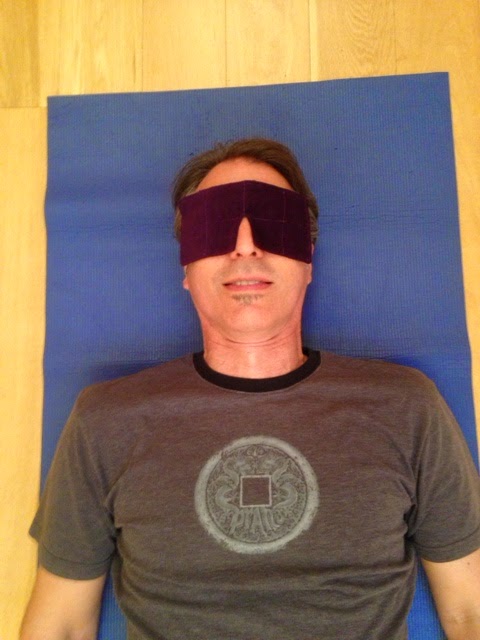
The iMask is Born! A DIY Project

by Baxter
Is it an Eye Blanket or an iMask?
I think the first time I heard about the oculocardiac reflex, also referred to as the Aschner phenomenon, was about ten years ago from yoga teacher Roger Cole. In a workshop on relaxation, Roger mentioned that the pressure on the eyeballs created by an eye pillow used for Savasana triggers this reflex from the eye to the heart, slowing the heart rate down. This can help signal the nervous system to shift from its active, sympathetic tone, to its quieter, parasympathetic tone. So this can be a great way to deepen relaxation! 

However, for some people, the weight of a typical buckwheat husk-filled eye pillow will not only relax them, but might also just do such a good job that they fall asleep. And for a reclined meditation or a guided relaxation, you want to stay on the conscious side of things! So when my friend Sharon Olson teaches her yoga nidra classes, she offers a collection of colorful bandanas to her students, which they can place lightly over the eyes to block out some of the intrusive light without over-triggering the oculocardiac reflex.

Then, at a workshop last August at River Rock Yoga in Ocean Springs, Mississippi (the only place to take yoga if you head that way!), one of my regular students from the past few years, Bill Thames, heard me mention this eye reflex and the idea of not over-stimulating it, and had an idea for a new, stylish version of the old eye pillow. It is made from two thin layers of fabric, which block out light while lying lightly on your closed eyes. He made me a prototype and sent it my way:

I tried it out and I liked it! It was light, comfortable and blocked out most of the light. And a name for it came to me quickly: the iMask! But I wondered how it would feel with a partial open seam that could allow it to conform to the nose and maybe block out more light. So I sent Bill a drawing. He got the idea, and made one according to my specs.
Then he went one further by also making one with a narrow triangle of material removed to expose the nose and lay snug against the cheeks.
I liked the new prototypes even more than the original. Here they are stacked up next to one another:
I was so excited to share these with you at this point in the process, but Bill asked me to wait for one more piece of the process: he wanted to create a pattern out of lighter material so you could have the dimensions and see the stitching. So, now here they are! This is a free DIY project for our YFHA family around the globe.
Please let us know how your iMask turns out, what material you try and how it works, and enjoy!

Subscribe to Yoga for Healthy Aging by Email ° Follow Yoga for Healthy Aging on Facebook ° Join this site with Google Friend Connect

Wednesday, April 23, 2014

One Thing: Yoga, Zen, Whatever

by Nina
Zen Jewel by Torei Enji
Last night I was thinking about someone close to me who is going through hard times—struggling with rather serious depression. Although he exercises regularly, he doesn't take yoga classes. He's considering starting, though, and naturally I'm the go-to expert on that topic so I spent some time reading up on the studios in his area in an attempt to help. But when it came down to it, I surprised myself by recommending a Zen center in his area instead of a yoga studio. That's because I felt that if he was going to do one thing for himself—in addition to western style therapy—it should be a practice that would reduce his stress levels. Stress, of course, can exacerbate or even cause depression and I know his lifestyle is stressful. And Zen style meditation is a great way to switch your nervous system from Stress mode to Relaxation mode, and to teach you to cultivate equanimity in the face of challenges.

Still, why, when I have been writing about yoga for stress management practically since Day 1 (see The Relaxation Response and Yoga) wouldn't I recommend yoga? Well, the truth is that most yoga classes (like the ones in his neighborhood) are merely exercise classes. They don't teach meditation, pranayama or any forms of conscious relaxation, except maybe a brief Savasana at the end of a sweaty flow class. Gosh, one studio was even offering something called ariel yoga, which looked kind of like Cirque du Soleil. That might be fun but those acrobatic techniques didn't really seem like the most helpful skills for him to be cultivating at this point.  I felt in the end that at least some basic instruction in meditation from an experienced teacher—and I knew he needed in-person instruction not just YFHA written instructions—and a group to practice with in beautiful, peaceful room would be more helpful to him than trying to learn to jump into Chaturanga Dandasana.  It's kind of sad but I just didn't trust those unknown yoga teachers whose bios I read online to teach him the kind of yoga I felt he needed at this time. I know that fancy poses and the promise of a "yoga body" are what sells yoga these days but some really valuable techniques sure seem to be getting short shrift in the meantime. 

Well, that's my mini rant for the day. But I do want to add that if you're going through some difficult times yourself and you want to try just one thing, do something to bring your stress levels down—yoga (see here), Zen, whatever. Besides, the Buddha himself was a yogi, right?

Subscribe to YOGA FOR HEALTHY AGING by Email ° Follow Yoga for Healthy Aging on Facebook

Thursday, May 30, 2013

Yoga Relaxation Techniques: They're Not Interchangeable

by Nina
Patterns in the Sand 2, by Brad Gibson
Okay, I admit it. It’s probably my fault. I’ve been going around saying that you can trigger the Relaxation Response (see The Relaxation Response and Yoga) using any of the following: restorative yoga, inverted poses, Savasana, pranayama, meditation, and yoga nidra, etc. as if all those practices were somehow interchangeable. This has led to questions like the following comment left on a Friday Q&A: Yoga Nidra, Restorative Yoga, Meditation and Savasana:

It is very helpful to read the distinctions between these four practices as I try to practice all of them, but it's hard to find the time. I'd be really interested to get your thoughts on whether it's important to do all four? For example, if you do restorative while listening to a nidra CD, do you also need to meditate? I'm interested to know what the various benefits are of these four practices, or are the benefits all the same?

Let me start by saying that what I said previously—that you can use any of these practices for stress management—still holds true. And it is also true that you can choose whichever techniques you prefer to trigger the Relaxation Response. However, these practices each have different roles to play in a balanced yoga practice.

The role of meditation in a balanced yoga practice is particularly important. That’s why I asked Timothy to write an article on the purpose of meditation (see his absolutely wonderful post Is Meditation an Essential Par of Practicing Yoga?). Basically, although you can use meditation for stress reduction, its role in classical yoga is to quiet the mind to allow union with the divine or “liberation”:

1.2 Yoga is the cessation of movements of consciousness.
1.3 Then the seer dwells in his own true splendor.

— from
Yoga Sutras, trans. B.K.S. Iyengar

Meditation is also, as Timothy mentions, a “fabulous tool to study your mind and slowly gain more control over it.”

Pranayama is also an important component of classical yoga, which precedes meditation as one of eight steps on the path to samadhi (union with the divine). It is considered an instrument to “steady the mind” and a gateway to dharana (the first phase of meditation).

“Pranayama removes the veil covering the light of knowledge and heralds the dawn of wisdom.

Its practice destroys illusion, consisting of ignorance, desire and delusion which obscure the intelligence; and allows the inner light of wisdom to shine. As the breeze disperses the clouds that cover the sun, pranayama wafts away the clouds that hide the light of intelligence.” — Sutra 2.52 trans. by B.K.S. Iyengar


On the other hand, the two types of asana I recommended for triggering the Relaxation Response, restorative yoga and supported inversions, are brilliant 20th century inventions, mostly developed by B.K.S. Iyengar, which are designed specifically to maximize physical relaxation and reduce stress. Judith Lasater, one of the most renowned teachers of restorative yoga, writes in the introduction to her book Relax and Renew:

“The antidote to stress is relaxation. To relax is to rest deeply. This rest is different from sleep. Deep states of sleep include periods of dreaming which increase muscular tension, as well as other physiological signs of tension. Relaxation is a state in which there is no movement, no effort, and the brain is quiet.

"Common to all stress reduction techniques is putting the body in a comfortable position with gentle attention directed toward the breath.”


Likewise, yoga nidra is also a 20th century invention (though you may see some claims to the contrary) developed by Swami Satyananda Saraswati. The first sentence of his book Yoga Nidra defines the practice like this:

“Yoga nidra, which is derived from the tantras, is a powerful technique in which you learn to relax consciously.”

In yoga nidra, you lie in Savasana while the voice of a teacher (or a recording) guides you through a physical and mental relaxation process. So, like restorative yoga, yoga nidra is specifically intended as a relaxation technique, and as such does not replace meditation or pranayama in a balanced yoga practice. This would be true of any form of Savasana in which an external voice is providing instructions and/or imagery for you. Unlike other relaxation techniques, yoga nidra includes a sankalpa (an intention) that allows you to influence your subconscious (or so it is claimed). For example, “I will awaken my spiritual potential,” “I will be a positive force for the evolution of others,” or “I will be successful in all that I undertake.” So this may be something you wish to take into consideration when choosing your relaxation practice.

Unlike the modern restorative postures, Savasana is a much older pose. Based on what I’ve read about the original practice, I’m going to go out on a limb here and say that Savasana is a reclining form of meditation. For some traditional yogis, it was a meditation on death, hence the literal translation of the name Savasana is “Corpse pose,” and it was sometimes even practiced alongside actual corpses. To practice Savasana properly, however, you must actually do the work of meditating while you are in the pose (and make sure you don’t fall asleep). If you don’t actually meditate while in Savasana, then, well, you are simply relaxing. But that's okay, too, if that is what you are after.

So there you have it. Which of these practices you decide to adopt really depends on what your goals are as well as your preferences. If you’re just after stress management and better health, it doesn’t really matter which you chose. However, if your goal is the “liberation” that is yoga’s ultimate aim, both pranayama and meditation are essential steps along the path.

Sorry if I caused any confusion!

Ultimate liberation is when the gunas, devoid of any purpose for the purusa, return to their original [latent] state; in other words, when the power of consciousness is situation in its own essential nature. —Yoga Sutra 4.34 trans. Edwin Bryant

Wednesday, February 13, 2013

Relax Frequently. Very Frequently.

by Nina

“When we’re renewing, we’re truly renewing, so when we’re working, we can really work.”—Tony Schwartz

On this blog, we’ve talked till we’re blue in the face about how important it is to reduce stress to support healthy aging. After all, chronic stress can cause everything from heart disease and stroke to depression. But when people are busy with their everyday lives, it’s often difficult for them to make lifestyle changes to support a long-term goal. But according to a recent editorial in the New York Times Relax! You’ll be More Productive, there is also a short-term payoff to relaxing on a regular basis:

“A new and growing body of multidisciplinary research shows that strategic renewal—including daytime workouts, short afternoon naps, longer sleep hours, more time away from the office and longer, more frequent vacations — boosts productivity, job performance and, of course, health.”

Yes, author Tony Schwartz says that relaxing on a regular basis “it’s possible to get more done, in less time, more sustainably.” He goes on to say that human beings didn’t evolve to expend energy continuously but rather to pulse between spending and recovering energy. This is a reference to the fight or flight response vs. the relaxation response, which we’ve discussed in previous posts (see Chronic Stress: An Introduction and The Relaxation Response and Yoga). This is not big news to us, of course. What got me intrigued, however, was Schwartz’s statement that “strategic renewal” ideally should come every 90 minutes.

“during the day we move from a state of alertness progressively into physiological fatigue approximately every 90 minutes. Our bodies regularly tell us to take a break, but we often override these signals and instead stoke ourselves up with caffeine, sugar and our own emergency reserves — the stress hormones adrenaline, noradrenaline and cortisol.”


Among other studies, Schwartz cites the work of Professor K. Anders Ericsson and his colleagues at Florida State University. Dr. Ericsson studied elite performers, including musicians, athletes, actors and chess players, and found that in each of these fields, the best performers typically practice in uninterrupted sessions that last no more than 90 minutes. They begin in the morning, take a break between sessions, and rarely work for more than four and a half hours in any given day.
Legs Up the Wall Pose (Better Than Sleep)
 Of course most of us can’t take a nap every 90 minutes—something Schwartz recommends—at work. Besides, unless you’re sleep deprived, sleeping probably isn’t the best way to relax and restore yourself (see Conscious Relaxation vs. Sleep). So—wait for it—how about doing a little bit of yoga every 90 minutes? Maybe shut your office door and do a restorative pose or two (see Mini Restorative Sequence). Legs Up the Wall (Viparita Karani) would be my pose of choice. And if you don’t have a door (yeah, I worked in one of those cubicle thingies back in the day) or feel like being active instead of resting, try some of our office yoga poses. We’ve got a sequence you can do in your office clothes (see Mini Office Yoga Sequence) and a series of seated poses you can do right at your desk (see Chair Yoga Mini Sequence). And, of course, you could always meditate, even in a noisy environment (see Achieving Stillness in Turbulent Situations)!

Thursday, January 26, 2012

Yoga You Can Do In Bed

by Nina
Patterns in a French Garden by Brad Gibson
Did I say “in bed? Yep. It’s normally not a good idea to fall asleep when you are doing yoga (you can overstretch your muscles if you fall asleep in a restorative pose and if you’re practicing conscious relaxation, well, being unconscious pretty much negates the positive effects you’re aiming for). However, there is one exception to this rule of thumb: when you’re lying in bed sleepless due to insomnia.

Whether you have trouble falling asleep initially or can’t fall back to sleep after waking in the middle of the night, instead of working on your To Do list (it’s tempting, I know), try a little yoga. There are a number of yoga practices that just might help you relax enough to finally drift off to sleep and/or improve the quality of your sleep. While practicing any of these techniques, be sure to stay warm and keep the lights off to keep stimulation down to a minimum.

Breath Awareness. This is the simplest yogic breath practice and one of the most basic forms of meditation. Simply bring your awareness to the sensations of your natural inhalations and exhalations. When you notice your mind wandering to your To Do list or elsewhere, gently return your mind to your breath.

Extending Your Exhalation. After observing your natural breath for a few minutes, you can try extending your exhalation (while inhalations are slightly stimulating, exhalations are naturally relaxing). When you reach the end of your exhalation, instead of immediately inhaling, lengthen your inhalation by one or two beats. Keep it relaxed, and if at any point you find the practice irritating, return to your natural breath.

Silently Reciting a Mantra. Just as you would when you are meditating, you can use a silent mantra or any word or phrase in bed to keep your mind from drifting into anxious thoughts. This is helpful for those of you who don’t find focusing on the breath effective (or when you have a cold!). When you notice your mind wandering from your mantra to your To Do list or elsewhere, gently return your mind to your mantra.

Guided Relaxation. Following the instructions for a guided physical relaxation (see here), with or without ear phones, allows you to focus your mind on a soothing voice and your physical sensations, enabling some people to drift off to sleep.

Self-Guided Relaxation. When you are familiar with the basic instructions for deep physical relaxation, it’s simple enough to skip the relaxation track and just gradually relax your body by following your own instructions. Many years ago, my first yoga teacher recommended this as insomnia practice.

Slight Inversion. Take the pillow out from under your head and lie on your back with your knees bent. Lift your pelvis up and place the pillow underneath it. You’re now in a very low version of Supported Bridge pose, a gentle inversion that naturally triggers the relaxation response. Try to stay in the position for five to ten minutes.

Supported Forward Bend. If you sleep alone or aren’t worried about disturbing your partner and you find forward bends soothing, you could try a supported bend in your bed. Sit with your legs straight or in crossed-legs position (whichever is more comfortable and allows a deeper forward bend) and place a stack of pillows on top of your straight legs or in front of your crossed legs. Then lengthen your spine forward and rest your forehead and arms on the pillow and relax. Try to stay at least three minutes. If you can’t get comfortable in the pose, then this one isn’t for you.

If you suffer from insomnia, I sincerely hope you’ll something on this list that will help. Most of these are techniques are ones I’ve found useful myself (I'm a bit too lazy to sit up and try an actual pose, however). Readers, if you have any additional suggestions, please chime in!

Subscribe to YOGA FOR HEALTHY AGING by Email ° Follow Yoga for Healthy Aging on Facebook

Friday, December 30, 2011

New Releases: Yoga Nidra and Deep Physical Relaxation

by Baxter and Nina

Happy New Year, everyone! We've been talking for some time about providing you with a few relaxation tracks that you can stream from our site or download onto your own audio devices. Now, at last, thanks to help from Margy Cohea and Quinn Gibson, we're pleased to release our first two tracks, both featuring Baxter Bell.

We're starting out by providing two shorter relaxation sessions, around 15 minutes each, because we know so many of you have busy schedules or aren't quite ready to commit to a whole hour of yoga nidra. You can play these tracks directly from our blog, or, if you wish to download a track, you can go to our new—gotta love it—Band Camp site (see http://yogaforhealthyaging.bandcamp.com/). Band Camp earns money through the donations you make when you download a track, so if you can afford it, help us support this wonderful site.

The first track is a physical relaxation practice, intended to be practiced in Corpse pose (Savasana). Baxter will gradually guide you, step by step, into a deep relaxation of your entire body and nervous system.
The second track is Baxter's 15 minute version of a yoga nidra practice, which is also intended to be practiced in Corpse pose (Savasana). Baxter will guide you into the state of conscious relaxation that is also referred to as "yogic sleep."
Let us know what you think! And if you have ideas for other audio tracks you'd like us to provide, be sure to let us know.

Tuesday, September 27, 2011

Stress Test

by Nina
Under the Beach Umbrella by Joan Webster 
“You did great,” my oral surgeon said. “In fact, you were the most relaxed patient I’ve ever worked on. You even fell asleep there for a while.”

“Wasn’t asleep,” I mumbled through my numb and swollen lips. “Was doing yogic breathing.”

He looked at me with fascination, then quickly handed me a piece of paper and a pen. “Could you write down what you did for me?”

“Uh, email you later?”

Of course I didn’t become so good at yogic breathing just so I could stay, uh, relatively relaxed during gum surgery (though it was certainly an interesting test of my skills). As someone who once suffered from agitated depression, I’ve been using yogic breathing, along with many yoga techniques, for many years to manage my stress levels for my emotional wellbeing.

Now it turns out that I’ve been practicing yoga for healthy aging while I was at it. Because I can tell you right now that along with exercise and diet, stress management is one of the most important keys to healthy aging. Chronic stress contributes to many common age-related diseases, such as high blood pressure and heart disease, and can cause a weakened immune system overall. It also affects the quality of your life. Possible effects of chronic stress include: chronic anxiety or depression, insomnia and/or fatigue, headaches, and digestive disorders.

And how does yoga help you manage your stress? Let me count the ways:
  • breath practices and meditation trigger the relaxation response 
  • inverted poses (and semi-inverted poses) physically reduce your stress levels 
  • restorative yoga poses relax your body and quiet your nervous system
  • active yoga poses (such as standing poses, twists, and backbends) release stress from your body and create a focus for your mind
  • yoga philosophy teaches you to cultivate equanimity in the face of difficulty
Over time, I’ll be providing detailed information and instructions for techniques in each of these different categories. And I hope very much that you’ll find one or more that’s useful.

And in case you’re wondering, yes, I did eventually email my oral surgeon. Next time you’re in a dentist chair (or are lying sleepless in bed, need a break after a stressful day, or just want to experiment), maybe you can try:

Breath awareness. Focus your attention on your natural breath, observing how your abdomen or chest rises with your inhalation and falls with your exhalation. When your mind wanders from your breath (to the dental procedure or any other topic), simply, and without judgment, return your attention to your breath. It is natural to be distracted from this practice, but it seems to work even if your attention wanders repeatedly.

Focusing on your breath will enable you to keep your mind of neutral topics rather than stressful ones, and after 10 or 20 minutes, the relaxation response (identified by Dr. Herbert Bensen of Harvard Medical School in the 1970s) will be triggered. 

Extending the Exhalation. The heart slows during the exhalation (and speeds up during the inhalation) so extending your exhalation is a relaxing breath practice (and also provides the benefits of breath awareness above). Take a deep soft inhalation followed by a deep soft exhalation. At the end of the exhalation, instead of inhaling again, retain your exhalation for one or two beats. Repeat through the procedure. Keep it easy. At no time should there be strain. If needed, return to your natural breath at any time. 

During my procedure I did the second breath practice (extending the exhalation). But I’m very experienced with yogic breathing, and we generally recommend that beginners to start with simple breath awareness. 

Subscribe to Yoga for Healthy Aging by Email ° Follow Yoga for Healthy Aging on Facebook ° Join this site with Google Friend Connect