


by Nina
"Holding on to one's thoughts is also a form of possessiveness…." —BKS Iyengar
Ram's recent post on aparigraha (non-hoarding) left a strong impression on me. In it, he mentioned several meanings for aparigraha, including "non-possessiveness, non-holding, non-indulgence, non-acquistiveness." Recently I've been thinking a lot about the "non-holding" aspect of aparigraha.
Non-holding has been on my mind because I've started to feel weighed down with possessions. That's partly because in the last few years, both my parents and Brad's parents died, and we ended up with a lot of their stuff. Some of the things were useful, like the beautiful dining room table we inherited from my parents. We are using that table now and gave our old table to our daughter who started her own household, so a kind of balance has been established. A lot of the other stuff isn't at all "useful" but still has a tremendous emotional power over me. For example, we inherited a couple of boxes of samples of my father's graphic design work, scrapbooks that Brad's mother created during the high school, college and the early years of her marriage, and some of my chic mother's favorite clothes that I'll never wear because they don't fit. It has been surprisingly hard to even consider getting rid of these things, and yet….
This is on my mind today because I just got back from a trip where I visited two longtime friends, each of whom happened to be in the same position, having things, either in her house or in a storage facility, that there was no real use for but to which she had strong emotional attachments. We all agreed that it was material we would need to part with at some point, and yet we all shared that it was surprisingly painful to even consider doing.
About a year ago, I started a practice of getting rid of at least one thing every day. I kept it up for a few months—in the beginning it was easy because every time I opened a cabinet I saw something of my own that I really didn't need—but then it became harder and harder. I would open a box of my parent's stuff, feel overwhelmed with emotion, and then close it up again. And I eventually gave up the daily practice. There's something about fall for me, though, that feels like the time to get back to business. My conversations with those two friends this weekend motivated me even more. So I returned from my summer vacation and decided to resume my getting-rid-of-one-thing-a-day practice. Today I went back and read Ram's post and a bit of the Yoga Sutras. This time I was struck by concept of "non-holding" as being about not holding on to thoughts (as Iyengar wrote) and emotions (as Ram wrote). Of course, with our parents' things that we three women are holding on to, it is not the objects themselves that we are having such a hard time letting go of, but rather the thoughts and emotions that the objects evoke.
I feel that this new understanding of "non-holding" will help make it easier for me to keep up with my letting-go practice this year and start to move from the easy tasks to the harder ones.
Subscribe to YOGA FOR HEALTHY AGING by Email ° Follow Yoga for Healthy Aging on Facebook
"Holding on to one's thoughts is also a form of possessiveness…." —BKS Iyengar
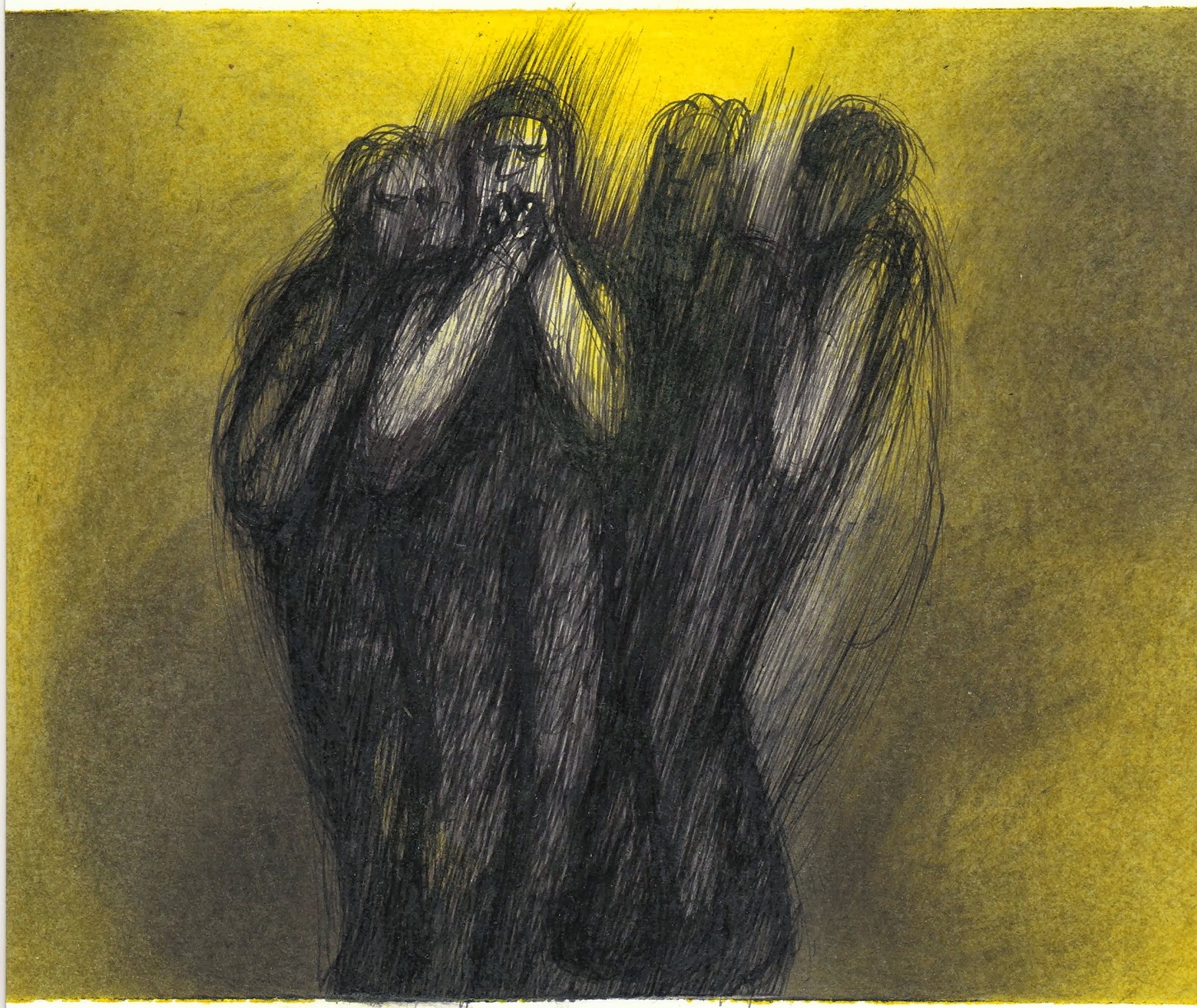 |
| Untitled Drawing by Milton Zolotow, one of hundreds |
Non-holding has been on my mind because I've started to feel weighed down with possessions. That's partly because in the last few years, both my parents and Brad's parents died, and we ended up with a lot of their stuff. Some of the things were useful, like the beautiful dining room table we inherited from my parents. We are using that table now and gave our old table to our daughter who started her own household, so a kind of balance has been established. A lot of the other stuff isn't at all "useful" but still has a tremendous emotional power over me. For example, we inherited a couple of boxes of samples of my father's graphic design work, scrapbooks that Brad's mother created during the high school, college and the early years of her marriage, and some of my chic mother's favorite clothes that I'll never wear because they don't fit. It has been surprisingly hard to even consider getting rid of these things, and yet….
This is on my mind today because I just got back from a trip where I visited two longtime friends, each of whom happened to be in the same position, having things, either in her house or in a storage facility, that there was no real use for but to which she had strong emotional attachments. We all agreed that it was material we would need to part with at some point, and yet we all shared that it was surprisingly painful to even consider doing.
About a year ago, I started a practice of getting rid of at least one thing every day. I kept it up for a few months—in the beginning it was easy because every time I opened a cabinet I saw something of my own that I really didn't need—but then it became harder and harder. I would open a box of my parent's stuff, feel overwhelmed with emotion, and then close it up again. And I eventually gave up the daily practice. There's something about fall for me, though, that feels like the time to get back to business. My conversations with those two friends this weekend motivated me even more. So I returned from my summer vacation and decided to resume my getting-rid-of-one-thing-a-day practice. Today I went back and read Ram's post and a bit of the Yoga Sutras. This time I was struck by concept of "non-holding" as being about not holding on to thoughts (as Iyengar wrote) and emotions (as Ram wrote). Of course, with our parents' things that we three women are holding on to, it is not the objects themselves that we are having such a hard time letting go of, but rather the thoughts and emotions that the objects evoke.
I feel that this new understanding of "non-holding" will help make it easier for me to keep up with my letting-go practice this year and start to move from the easy tasks to the harder ones.
Subscribe to YOGA FOR HEALTHY AGING by Email ° Follow Yoga for Healthy Aging on Facebook


