How Much Protein You Need and

Pro Bodybuilders eat about one gram (sometimes even 1.5 grams) of protein per pound of body weight or per pound of non-fat tissue. I'm sure you've seen that the recommended dail

Comments

Tuesday, September 10, 2013

The Psoas Muscle and Yoga

by Baxter

If you have been around the yoga classroom for any reasonable amount of time, you have likely heard of the psoas muscle. But you may not have a good idea of where it is or what it does! You should though, as your daily activities—or inactivity if you are sitting a lot during the day—can actually create a short, tight psoas muscle that could use a bit of lengthening. So today I’ll introduce you to your psoas muscle in a deeper way than can sometimes take place in the yoga classroom, inform you of some of its roles in posture and movement and suggest a few ways to lengthen it, if it is on the tighter side of life.

The only other time I could find on the blog that we had talked about the psoas muscle was way back in January of 2012 (I Think I Have Sciatica), where we first introduced this drawing of the lower torso and pelvis which shows nicely the psoas muscle seen here with everything except the skeleton and select muscle removed.
The psoas is said to originate from the sides of the lumber vertebrae, possibly even starting as high up as thoracic 12 (T12), so it has multiple spots on the side of the spine where it attaches. It then travels downward, close to the midline of the pelvis, just in front of the sacrum and ileum, until it heads slightly lateral and anterior, so it can leave the pelvis by sliding right over the lateral pubic bone and just behind the inguinal ligament in order to dive down and laterally attach to the upper inside of the femur bone (at a bony bump known as the lesser trochanter of the femur). Now we can actually feel the greater trochanter with our hands, just about six inches below the side of our pelvic rim, but the lesser bump is not accessible - due to lots of muscles which make touching it almost impossible. And due to the fact that the psoas lies deep within the pelvis, it can be challenging to feel it - both literally and perceptually. 

Hopefully, with the help of the picture and my written description, you are starting to get oriented to where the psoas is. But what does this muscle do when it contracts and shortens? It depends a bit on which part of the set-up is stabilized and which part is free to move. And it also depends on whether it is working in concert with other muscles to help you walk (for instance), or to help you maintain upright posture when you are standing still.

Let’s look at it working alone first. If the spinal origins of the psoas are stable and not moving, the psoas is said to have the following effect on the femur bone (to which it attaches): it flexes the femur toward the belly, pulling it slightly medially toward the pubic symphysis, and rolls the thigh bone externally on its axis. If we wanted to take the femur bone in the opposite direction as a way of stretching it, we’d need to take it backward towards the buttocks, swing it slightly out to the side and internally rotate it. Doing a modified Locust pose (Salabasana), with the legs apart a bit and an emphasis on rolling the thighbones in would be an example of a pose that could lengthen the psoas.

When we stabilize the femur, as when you are sitting in a chair, and contract the psoas, the origin gets pulled forward and down, encouraging the forward folding action known as flexion of the lumbar spine. We use this action whenever we bend over to pick something up off the floor.  The psoas also works in concert with several other spinal muscles to encourage the upward lift of the spine that we cultivate in poses like Mountains pose. In that setting, it does not create excessive lumber flexion, but does allow the natural curve in the lumber area to be present. So that is a bit about what the muscle does (realizing that the psoas works with other muscles that flex the femur bone, such as part of the quadriceps).

When the psoas is overly tight and short, it can affect the lower back in a negative way (contributing to back pain), influence the ease of a neutral pelvic tilt and affect gait. There are passive ways to release tension in the psoas and more active ways to lengthen and stretch the psoas.

In The Psoas Book, author Liz Koch recommends “releasing” tension in the psoas by lying in Constructive Rest position (on your back, with your knees bent and the soles of your feet on the floor), with your feet about 1-2 feet from your hips, and staying there for a while (maybe 5-10 minutes) with close attention to sensations in the area of the back belly and hip joints, as you attempt to sense the releasing of tension in those areas. Another version of Constructive Rest involves having your calves on a support, like our Easy Inverted pose (see Easy Inverted Pose). Once you get better at sensing release in tension in this area, slowly move one foot further away from the hips without letting the pelvis tip or tuck and stop when tension is encountered in the areas you are observing. Gradually moving that foot until the leg is straight, if you can do so without changing the pelvic alignment. A more advanced variation involves folding one leg into the chest (in an upside-down Pigeon pose), without tipping or tucking your pelvis, and then again slowly extending the other leg long on the floor (it’s the lengthening leg that will stretch that side's psoas).

In my regular classes, I often take advantage of the back leg position in Warrior 1 to bring attention to the psoas of the back leg, as it needs to lengthen in order to keep the pelvis neutral (not going into dramatic anteversion or forward tip).  From there, doing drop knee lunges, both with the hands on the floor next to the feet for an easier version, but gradually coming up higher, with hands on blocks, and finally with hands on the front thigh, while letting the hips and torso move a bit forward while keeping the pelvis stable, are great ways to lengthen the psoas. The back leg in upright Pigeon pose also gives a good stretch to the psoas.

This list of ways to work with your psoas is by no means complete. You might look at Mary Pullig Shaztz, MD’s book Back Care Basics for her approach to psoas stretching in the face of back pain. And Jean Couch’s classic The Runners Yoga Book is sure to have a few suggestions as well.  And if our readers have any favorites, please write a comment back to us! Happy stretching!

Monday, September 9, 2013

Pranayama for Everyone: Bhramari Breath Practice

by Timothy
Bee and Flower by Melina Meza
One of the dirty secrets of the yoga world is how few yoga practitioners—and how few teachers—do pranayama, yogic breathing exercises. It's better in some yoga traditions than others, but overall I've been shocked to see how few of my colleagues practice pranayama regularly. This is a shame!

The breath is probably the single best way to affect the autonomic nervous system, which in turn controls the function of every internal organ, as well as systems like digestion and immunity. Pranayama can also be the gateway into meditation and higher yogic practices. Furthermore, there is a potential synergy: the regular practice of pranayama can make your asana practice subtler and more refined, and your meditation deeper and more concentrated. For therapeutic purposes, I believe there is synergistic benefit from doing some asana, along with pranayama, meditation, and other yogic practices.

Some schools teach that only experienced practitioners should attempt yogic breathing practices. There is wisdom in being careful, as pranayama done incorrectly—and especially if it's done too aggressively—can lead to problems with the nervous system and, in extreme cases, to psychological decompensation. But there are a few basic pranayama practices that I have found are safe for virtually everyone, and I'll be writing about them in this and my next few blog posts.

I'll begin today with one of my favorites: Bhramari [pronounced brah mah REE], which means the "buzzing of the bees." Although, in my experience, this is one of the pranayama techniques that's rarely taught (at least in many traditions), it's simple, safe, and has tremendous therapeutic potential.

To do a simple version of Bhramari, sit in a comfortable upright position as you would for meditation. Keeping your mouth closed, with your exhalation make a low- to medium-pitched humming sound in your throat. As you make the sound, which should last the entire length of the exhalation, tune into the literal vibration of the sound waves in your throat and even in your skull and brain. Then inhale through your nose, and if you're comfortable, repeat. Try to make your transitions into and out of each humming exhalation as smooth as possible.

At first, you might try Bhramari for a minute, but if it's goes well you can progress to a few minutes at a time. Depending on your breath capacity, the exhalation might vary from short to quite long. I'd suggest doing as long an exhalation as feels completely comfortable. At all times, each subsequent inhalation should be smooth, without any breath hunger. If you are feeling at all short of breath, you've likely pushed harder than you should, and if so, simply take a catch up breath and then resume Bhramari. If you feel at all agitated, I'd suggest you suspend the practice for the day and try it again another time with shorter exhalations.

Most people who do Bhramari as I've described it above will find the practice soothing. Since you will be lengthening your exhalation relative to your inhalation, the Bharmari breath activates the parasympathetic nervous system, and within a few breaths can bring you to a greater sense of relaxation and calmness. According to the classic text Hatha Yoga Pradipika, "with regular practice of bhramari, bliss arises in the heart."

A recent study Immediate effect of a slow pace breathing exercise Bhramari pranayama on blood pressure and heart rate suggested that the practice can lower blood pressure. In my yoga therapy work, I've found it useful for stress and various stress-related conditions, including insomnia (try a low-pitched sound). It's also useful for nasal congestion due to colds, allergies or sinus infections (use a slightly higher-pitched sound so that you can feel your nose and sinuses vibrating).

I even sometimes recommend Bhramari as a meditation alternative for people who find their minds so distressingly busy when they sit that they can't do the practice. It's harder for the monkey mind to go wild over the racket the buzzing of the bees makes internally, allowing you to settle in something moving in the direction of meditation.

Next up: Alternative Nostril Breathing.

Subscribe to YOGA FOR HEALTHY AGING by Email ° Follow Yoga for Healthy Aging on Facebook

Friday, September 6, 2013

Friday Q&A: Pain After a Total Knee Replacement

Q: I have had a TKR (total knee replacement) in March this year (5 months ago). I still have pain and swelling in the repaired knee, mainly on the outer side and behind the knee. Is there any yoga exercise recommended to stabilize the knee and make it healthy?

A: I am sorry to read that your Total Knee Replacement (TKR) has not resolved all the issues you hoped it would have accomplished. Literature review states that 90% of all patients are pain free after six months, but sometimes the recovery period can take a full 12 months. Ten percent of TKR patients are not pain free within this time period.

Pain is a symptom of an underlying problem. The cause of the pain needs to be thoroughly addressed by the surgeon who performed your surgery. My advice would be to return to him and have him perform a complete exam, including diagnostic studies (X-ray, CT scan, blood work) to rule out any underlying infection and to ascertain the alignment of the knee prosthesis.

The other thing you might consider is a complete orthopedic examination by a physical therapist who is skilled with post-operative TKR rehabilitation, especially someone who can evaluate the biomechanical basis of your knee pain and look completely at your legs, hips, pelvis, back and how you move in space. A wonderful resource for you to check out is called Bridgebuilders to Awareness in Healthcare, a group of yogi rehabilitation professionals who blend traditional physical therapy and other rehabilitation disciplines with the practice and application of yoga in a therapeutic context to assist you in your journey back to wellness.

It is very common for the TKR to correct the arthritic cause of pain but if the patella is not tracking well and is not aligned within the patellar groove, then the imbalance when the quadriceps tendon contracts to straighten your knee will be extremely irritating. So if you are doing straight leg raises with or without weights, long arc quadriceps sets, or any other quadriceps strengthening exercises, the first thing you can do is stop anything that causes knee pain when the knee muscles are contracting. After you and your surgeon rule out any underlying pathology or prosthesis problems, you also may want to try to figure out how your current pain is different from your old pain. If you had knee issues similar to the ones you are having now then it is definitely important for you to see a rehabilitation professional.

If you are currently in a yoga class or have a home yoga practice, you really need to pay strict attention to the alignment of your hips, knees and feet as well as attention to how you move into and out of poses. You might want to stop all standing poses for now and instead work on passive inversions like Legs Up the Wall pose (Viparita Karani) or Chair Shoulderstand to see if you can mechanically drain some  of the edema. If the edema and swelling is under the knee cap, you could ask your surgeon if he will aspirate the fluid, and if he agrees, it might not be a bad idea to ask him to culture it to make sure there is no infection lurking in the joint.

I am sorry that I can’t give you a specific "yoga exercise" for stability because I can’t see your body and how it moves. But if you are feeling that your knee is unstable, this is a sure sign that the leg is weak and it is unable to balance on itself. Please be patient and be a good detective. If your surgeon's assessments all come back negative, that is a good conclusion because you will know you can work on the specific issues at hand. With diligence and compassion for your knee, it will hopefully progress and allow you to resume the activities that are important for you.

—Shari

Thursday, September 5, 2013

Yoga After Cataract Surgery

by Baxter

A teacher wrote in to ask us about a student who will be having cataract surgery. The teacher said that the student's doctor told her she should avoid lifting for two weeks, and asked us: Are there any yoga poses that should be avoided? Inversions come to mind but does that mean downward dog as well? Because cataract surgery is one of the most common surgeries performed in the US each year, many of us will have students in this very situation, and some us will find ourselves there as well. So I decided to do a full post on the topic.

It is estimated that 50% of adults over the age of 80 have a cataract. Cataract is a clouding of the lens of the eye that lies just behind your pupil and iris, the front and center most parts of your eyeball. The lens allows light and images to pass through to the back of eye onto the retina, which is the part of the eye that sends that image info to the brain. The clearer the lens, the better the image. The lens also focuses the images onto the retina, not unlike the focus feature on a slide projector or movie projector.
What causes the clouding of the lens that we call a “cataract”? The lens is made up of mostly water and proteins. As we get older, some of the proteins begin to clump together. If the clumps get big enough, they begin to partially block the light trying to pass through the lens. As long as the clumps stay small, you may not even notice the changes, but if a clump gets big enough, your vision will start to get blurry or even color tinted, usually brownish.  Even though cataracts are sometimes referred to as “age-related” and I mentioned the percentage of elderly with them, you can sometimes develop cataracts in your 40s or 50s, and there are even rare forms of congenital cataracts that infants can be born with. You are at increased risk for developing one if you have prolonged exposure to sunlight, smoke cigarettes, drink alcohol, or have diabetes.

The good news is that treating cataracts with surgery is quite safe in general.  However, during the post-surgery period, there are risks of developing problems such as bleeding, infection, or changes in the pressure inside the eye, either up or down. And there is a very slight increase in the chance of the retina at the back of the eye coming away from inside surface of the eye, a condition known as retinal detachment. This last complication is considered a medical emergency as it can lead to sudden loss of vision. To learn more about cataracts in general, check out this National Institutes of Health-sponsored web page Facts About Cataracts.
 
On the NIH web page, I found the following recommendations for modified activity after cataract surgery, but without specific connection to the above risks:

“When you are home, try not to bend from the waist to pick up objects on the floor. Do not lift any heavy objects. You can walk, climb stairs, and do light household chores.”

I can only assume that these recommendations are made to reduce the risk of bleeding, pressure changes in the eye (which can be position- and exertion-influenced) and retinal detachment. So, how should you modify this student’s yoga practice during the two-week post-operative period, and maybe for a full eight weeks, the typical time for the surgery to completely heal up?

Inversions should certainly be avoided. This includes standing forward bends like Uttanasana and Prasarita Padottanasana, and even Downward-Facing Dog. You can still include modified poses like Half Dog pose at the wall.  If you apply the rule of not bending past 90 degrees from vertical, you will minimize the pressure increase to the head and subsequently to the eye.  As far as I know, there has not been a specific study to confirm eye pressure changes doing inverted yoga postures, but it seems likely that they would potentially cause it and are therefore best avoided. Also, as I think I have mentioned before regarding yoga and high blood pressure, you also need to limit the length of time you stay in a static or held pose, especially the standing poses, as the exertion required often leads to an overall increase in blood pressure, which could also influence pressures in the eyes.  Other rather obvious poses that could have a similar effect are those that require strong, sustained contraction of the abdominal muscles, which would also increase blood pressure in the eyes.  Poses like Boat pose (Navasana), deep held twists (even sitting versions), and arm balances like Crow pose (Bakasana) also fall into this category. 

In a time of healing—for cataract surgery or any other health recovery time—you want to keep the nervous system quieter, spending more time in the “rest and digest” part of the autonomic nervous system. So spend this two week healing period doing gentler practices, including lots of supported restoratives and guided meditations on health and healing. It would be great to hear back from the person who sent in the question on how things turn out for your student, and from any of our readers who have worked with this situation before.

Wednesday, September 4, 2013

Judith Lasater on Yoga and Aging

After the Fire by Brad Gibson
As Shari and I were discussing our series on menopause and perimenopause, Shari had the idea of contacting her former teacher, well-known yoga writer Judith Lasater, to see if she had some advice for us. To our delight, Judith agreed to do a brief interview with us for the blog. After some back and forth, we decided to ask her a single question. We love her answer, and hope that you will find it inspiring. —Nina and Shari

Q: You've been practicing yoga since you were a young woman. As you went through peri-menopause and menopause, how did you change your personal practice to address your symptoms and adapt to your changing body?


Judith: When I began my yoga practice in 1970, I had the idea that I would pretty much be following the same practice routine forever that I had established from the beginning.

Nothing has been further from the truth. At the beginning I adapted my life to fit my practice. I started going to bed earlier so that I could awaken to practice in a quiet morning environment. I changed my diet, what I read, who I hung out with, and soon, my job, as I decided to begin teaching yoga.

But over the years, the opposite has happened. Gradually my practice has evolved to fit my life. There were adaptations with pregnancy, motherhood, and, of course, with peri-menopause and menopause.

Hopefully with aging one becomes more naturally introspective and less influenced by the external world. As I entered peri-menopause, I noticed a definite shift of my interest. It was as if a “natural” pratyahara was taking place.

I wanted to meditate longer, practice pranayama longer, and my asana practice changed as well. Soon fifty percent of my practice consisted of supported backbends and supported inversions, especially Viparita Karani (Legs Up the Wall pose), Supported Sarvangasana (Shoulderstand) on the chair and Supported Halasana (Plow pose) on the Halasana bench.

I found I needed this intense internal focus time in my life to integrate not only the physical changes that I was experiencing, but also the life changes of parenting teenagers and young adults. Additionally I was becoming the major emotional and familial support for an aging mother.

When I chatted with other women yoga teachers my age, we found we were all moving in the same direction with our practice. We began to eschew so much action in the practice and instead were increasingly nourished by cultivating the receptive consciousness of quiet poses for at least half of our practice of asana.

The most important thing I learned about this process is a lesson I still learn repeatedly. I would distill this lesson into a “mantra” of these three words: Trust yourself first. This will guide you well as you transition through life’s stages.

Note from Nina: For photographs of Judith's favorite poses and more information on them, see Judith Lasater's Favorite Poses.

Judith Hanson Lasater, Ph.D., PT, has taught yoga since 1971. She is a founder of Yoga Journal magazine, President Emeritus of the California Yoga Teachers Association, and was selected by Natural Health Magazine in 2010 as the only yoga teacher out of five people honored for their contribution to promoting natural health in the US during the previous 40 years. She has written eight books on yoga including the most recent: What We Say Matters and YogaBody. See judithlasater.com for more information about Judith, her teaching schedule and her books.

Tuesday, September 3, 2013

Aparigraha (Non-Hoarding) and Healthy Aging

by Ram
Naushon Tree by Brad Gibson
In the Sadhana Pada of the Yoga Sutras by Patanjali we are introduced to the eight rungs/limbs/steps of yoga whose practice helps us to develop attention as a tool to discriminate between ignorance and awareness and truth from illusion, the means for liberation or enlightenment. One of the eight limbs is aparigraha, which has several meanings, including non-possessiveness, non-holding, non-indulgence, non-acquisitiveness. Verse 2.39 in the Yoga Sutras describes aparigraha as:

aparigraha sthairye janma kathanta sambodhah

When one is steadfast in non-possessiveness or non-grasping with the senses there arises knowledge of the why and wherefore of past and future lives. —trans. by Swami Jnaneshvara


 Aparigraha comes from the word parigraha, which means reaching out for something and claiming it for oneself; the "a" prefix' before parigraha turns it into an antonym. Thus, aparigraha is the concept of non-possessiveness or non-hoarding. Aparigraha means to limit possessions to what is necessary or important and taking what is truly necessary and no more. Nina briefly touched on this topic in one of her earlier postings (see Yama Drama).

Our senses are like portals or gateways into our body, mind and consciousness. We are what we eat, smell, see, hear and touch. Through our senses, we absorb the world around us. If we take in harmonious impressions, we will in turn be healthier. If we absorb disharmonious impressions through our senses, we are inviting with it all kinds of body-mind problems. Through these five senses we get attracted to material possessions and surround ourselves with them. Hoarding is the accumulation of things that may have little or no value. So great is the need to accumulate these things that they then becomes difficult to part with it. Hoarders accumulate and store old newspapers, food cartons, cans, mail, notes, clothes, garbage and other debris. Hoarding begins slowly and builds over time. Hoarders will not give up their possessions as they develop an emotional attachment to their belongings and have a distorted view about the importance/lack of importance of material possessions. People who develop a habit of hoarding identify their possessions as a part of their identities. Losing or disposing of a possession may produce extreme anxiety or a sense of loss and grief. Researchers believe that individuals who are experiencing emotional upheavals in their lives when faced with aging and the possibility of outliving their resources may begin to collect and save as these material possessions provides them a sense of security—sort of a comfort zone.

But hoarding is not just about accumulating material possessions. It is also about hoarding/holding thoughts and emotions that affect our normal mindset and thinking process. Hoarding, be it mental or physical, is associated with an inability to process information and make decisions when confronted with a large amount of information, attention and focus deficits and a failure of categorization. We tend to fill our minds with fear, worry, anxiety, grief, anger, rage, jealousy, and judgments, among others, and we do not let go of these emotions. Over time, these emotions—whether it be bitterness, fear, emotional damage, rejection or abandonment—build up. If you hoard/accumulate unexpressed or suppressed emotions and if they are not getting released, they keep building up in your body. Ultimately these pent-up emotions can trigger mental and/or physical pathological conditions. Thus, hoarding emotions can be devastating to both mind and body.

What is the easiest and effective way to ward off emotional hoarding? A simple method is meditation (dhyana), the cheapest and simplest recourse to a healthy body and mind (see Balancing Your Emotions with Your Breath). While meditation may not cure a person from the act of hoarding, the person having a meditation practice will react to life’s turbulence differently. This reaction and suitable action measures comes from a true awareness; awareness to the emotional turbulence arising from within that has remedial effects. As explained in an earlier post (see Never Go to Bed Angry), the individual will not only have the capacity to transcend the physical and emotional upheaval but will also not evoke the same physical and emotional reactions that are commonly seen in a person who does not meditate.

Just as you take a car for a regular tune up, you also need to detoxify and tune up our body and mind on a periodical basis. Disposing of any unwanted material possessions and detoxifying our mind-riddled emotions on a regular basis is a panacea for healthy aging and living. If you can do it for your car, you might as well think about doing the same for your mind and body.

Subscribe to YOGA FOR HEALTHY AGING by Email ° Follow Yoga for Healthy Aging on Facebook

Monday, September 2, 2013

Trusted Bodybuilding Resources on the Internet. Part One: Renowned Bodybuilding writers. By Veeraj V. Goyaram

Trusted Bodybuilding Resources on the Internet. 
Part One: Renowned Bodybuilding writers

Researched and composed by Vic Goyaram

Bodybuilding, the Internet Revolution and the internet info dilemma

The internet has massively revolutionized the sharing of information in bodybuilding such that a lot of information is available at the click of the mouse. Additionally, famous people in the industry are now more accessible via their website, blog, Facebook, and Twitter pages.  Having been an avid reader for nearly two decades of writers like Will Brink, Jerry Brainum and Ron Harris, imagine my thrill when I am able to comment on their facebook updates and have then often reply back. I am star-struck each time one of them does so!

The internet revolution, however, poses the following dilemma.  
  • The information on the internet very often conflict with one another. Not everyone can make sense out of it.  
  • A lot of information is, in fact, disguised marketing that attempts to have you purchase products that may be useless to you. 
  • There is often too much science in certain articles. Many authors sometimes give complicated scientific explanations without even making things simple to the lay-public. They do not regard the fact that not everyone has a Bachelor of Science in physiology. 
  • We have people giving advice online who spend a lot of time fighting and arguing like schoolkids: lots of rants and stupid stuff.  
  • Then, finally we have the Internet experts: the ones who know it all from behind the computer screen but are in fact wimps in the real world. 
Whom to trust??

This article aims to provide you with a shortlist of the people and websites that I trust for information. I have learned a lot from these sources and much of my knowledge comes from their work that I have been reading over the decades in bodybuilding magazines and eventually on the internet. There are others that I have recently discovered and grew fond on. Now that I have my website it is my turn to return the love.

1. Doug Brignole 
I think it is not a secret that I am an avid follower of Doug Brignole's teachings. Doug is an expert in the bio-mechanics of exercise with extensive competitive bodybuilding experience What I really like about Doug is his open-mindedness and ability to constantly put hitherto established bodybuilding practices to the test and analysing the effectiveness of exercises. "Deviance drives innovation!". Doug writes for Ironman and Labrada Nutrition and has authored a book named Million Dollar Muscle, a copy of which I am soon going to purchase. I also swear by the 4XMass and TORQ method that Doug and his pals at Ironman Magazine developed. Doug is a great asset to the sport of bodybuilding and an example of longevity. Therefore, he gets the Bodybuilding Mauritius seal of approval. 

Where to find Doug's articles:
http://www.dougbrignole.com
Doug Brignole @ Ironman Magazine

2. Hugo Rivera 
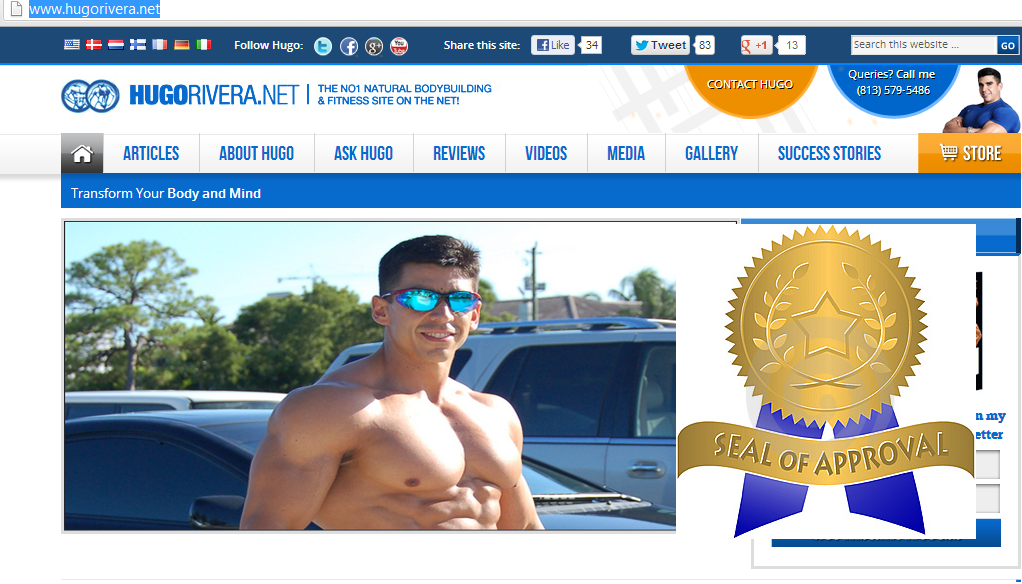
Hugo Rivera is a very experienced trainer and competitive bodybuilder with an impressive track record in NPC shows in America. I have been a reader of Hugo's articles since 2002 and his work has always impressed me considerably. He is a best-selling fitness author of more than 10 books like the "Body Sculpting Bible for Men". I am a follower of Hugo on Facebook, his website and on the Labrada Nutrition website. His treatment of topics in bodybuilding training, nutrition is highly educational. Hugo Rivera gets the Bodybuilding Mauritius Seal of Approval. 

Where to find Hugo's articles:
hugorivera.net
Hugo Rivera @ Labrada Nutrition

3. Ron Harris
I began reading Ron's articles in Musclemag in the mid 2000s and have been hooked ever since. Ron is very experienced and clued up on all topics of bodybuilding. I am also an avid follower of his Facebook status updates where Ron not only shows great knowledge of bodybuilding but also a sense of family and the attitude of never giving up. At 43, Ron shows no sign of slowing down and still has the desire to keep competing. At the age of 31, there are a lot of things that I can learn from Ron concerning longevity. Ron recently discovered the highly effective and joint-sparing TORQ method of training and has adapted it to his own needs. He gives his readers a  detailed rundown of his training routines on his Gaspari Nutrition blog regularly. I have learned two important things from Ron: a) It is never too late to learn new things. b) you can take any training system and adapt it to your own needs. Not always is there a need to go by the book. Ron Harris gets the Bodybuilding Mauritius Seal of Approval. 

Where to find Ron's articles:
http://www.ronharrismuscle.com/

4. Will Brink 
I never miss any of Will Brink's regular updates with a cup of steaming coffee in my hand. This is a good habit that I got from Will himself because he is an ardent supporter of the health benefits of coffee. There is no sunshine without coffee, he always say. I began reading Will Brink's articles in Musclemag in the early 2000s and have been a fan ever since. Will is a person of great integrity when it comes to delivering the truth about products. If something doesn't work, then Will will say it honestly. Will's knowledge of supplements is outstanding to say the least. Will Brink gets the Bodybuilding Mauritius Seal of Approval.

Where to find Will's articles:
www.brinkzone.com

5. Dr. Layne Norton
I started reading Layne's articles sometime in 2004 on bodybuilding.com. I could relate a lot to him as he was busy with his BS in Biochemistry while I was wrapping my BS in Biology in Mauritius. I was a bit jealous of Layne as he was in America and going to pursue his postgrad in at U of Ilinois at Urbana Champaign while my possibilities in the small island of Mauritius was non-existant. Nevertheless, I thought I'd enrich myself with his free knowledge. I took notes and I got entire notebooks full of Layne Norton tips that date from more than a decade! Today Layne has his PhD in Nutritional Sciences and I am on my way to achieving my PhD in Exercise Science. Layne was instrumental in my decision to pursue my further education and my MS thesis was corrected and awarded a distinction by one of his PhD advisors at U of Illinois at Urbana Champaign. Layne's advice is solid, by the way, no matter what his haters say. He gets the Bodybuilding Mauritius Seal of Approval.

Where to find Layne's articles:
http://www.biolayne.com/

5. Jerry Brainum

Jerry Brainum is one of my most trusted sources for information on sports nutrition and supplements. Long before I could master the scientific and technical jargon to understand nutrition/ supplement science I was greatly benefiting from Jerry's writing in IRONMAN. He does a great job translating scientific information into layman's terms. As you can see on his homepage, Jerry provides "Nutrition Science Uncensored" information that you can put your trust in. He gets the Bodybuilding Mauritius Seal of Approval.

Where to find Jerry's articles:

6. Christian Thibaudeau
I began studying Thib's materials some 6 years ago, particularly through his "Black book of training secrets" publication.  Christian says that “Training is my passion. I love everything about training. That's why I don't have ONE training methodology to my name but include every single type of methods that has been shown to work. I have too much respect for every single successful coach or athlete to dismiss any technique, program or system just because it doesn't sit well with my own personal likings and beliefs.” That tells you a lot about the man.

Christian Thibaudeau @ T-Nation

Thank you Doug, Ron, Hugo, Will, Layne, Jerry and Christian
Your work inspired me to pursue my further studies  

Forever grateful. America, I will come one day!

_________________________________________________________________________
©,2013, Veeraj Goyaram, Bodybuilding Mauritius. Any reprinting in any type of media is prohibited.
Disclaimer: The Content on this site is intended to be used for educational and entertainment purposes only. It is not intended to be and should not be interpreted as medical advice or a diagnosis of any health or fitness problem, condition or disease; or a recommendation for a specific test, doctor, care provider, procedure, treatment plan, product, or course of action. BODYBUILDING MAURITIUS is not a medical or healthcare provider and your use of this site does not create a doctor / patient relationship. We disclaim all responsibility for the professional qualifications and licensing of, and services provided by, any physician or other health providers posting on or otherwise referred to on this Site and/or any Third Party Site. Never disregard the medical advice of your physician or health professional, or delay in seeking such advice, because of something you read on this Site. We offer this Site AS IS and without any warranties.  Correspondence: vicgoyaram@gmail.com
__________________________________________________________________________